Showing posts with label Philosophy. Show all posts
Faith, Reason & Existentialism?: A Reconciliation
Posted by Andrew Haines in Philosophy on 1.16.2010
Three words that don't normally go together—that's for sure. But what do our understandings of faith, reason and existentialism have in common?
Frankly, I think, quite a bit.
Considering the relationship between faith and reason—as the followers here at IUSP know—is simply a part of the Christian life. Creation is both reasonable as well as mysterious, and in order to apprehend it completely, we must be willing to implement our rational faculties on both levels (viz. the levels of empirical observation as well as the penetration of what lies beyond). Faith and reason, for the Christian, are inextricably related.
But how do they relate to "existence"? Or, for that matter, to the ever-popular but rarely-understood phenomenon of "existentialism"?
If you're guessing the title of this article was a ploy by the author to pull in some extra Google hits, you wouldn't be far off. But I never disappoint! There is a connection, I assure you; but before diving right in, we have to frame the question a little more completely: What is existentialism, after all? And why should we be concerned with it?
What is Existentialism?
Most basically, existentialism is a term that denotes some sort of primacy regarding the act of existence itself (the actus essendi, for you Thomists). By and large, no matter their creed, upbringing or historical circumstances, existentialists always tend to focus on this precedence of "being" over and above that of "essence" (or formality). Still, however, the word, "existentialism," is about as generic as "philosophy"; and there is really no textbook definition worth memorizing. Different brands of existentialism (materialist, atheist, Christian, etc.) all understand their own purpose differently, and it's hard to put a finger on any sort of universal, 'existentialistic essence.'
 But, despite its somewhat opaque definition, the idea of existentialism is one not far from the heart of the Christian intellectual tradition. In my estimation, a sort of existential hermeneutic is very helpful in unlocking the deep connections between faith and reason, and between the existence of God and the existence of things in the world.
Existentialism in St Thomas Aquinas
As it turns out, a certain application of existentialism can be found even in the work of St Thomas Aquinas—the Christian philosopher most often pitted against modern trends—who accounts for the relationship between God and the world on the basis of the preeminence of "being," or esse. (Thomists of the Strict Observance, prepare to strike.) In the words of the famous 20th century Thomist, W. Norris Clarke:
"[...] actual existence [for Thomas] is not merely a static state or minimum 'fact'—i.e., the mere extrinsic referent of a true assertion—but an intensive inner act of presence within the thing itself which grounds the mental assertion about it: a kind of qualitative energy (virtus essindi [sic]: the power of be-ing, in St. Thomas’s words)." (The Philosophical Approach to God, p. 62)
In layman's terms, Clarke's position (and my own) can be translated thus: that for something "to be"—to exist—is not simply for it "to-occur-in-accordance-with-its-formal-definition"; but rather, each existent thing possesses of itself a certain "power of be-ing" that propels it, as it were, along its life in the world.
At bottom, Clarke's understanding of Thomistic metaphysics can very rightly be termed "existential." But it is an existentialism grounded firmly and without apology in an assent to the existence of God on the basis of rational, intelligible evidence in his primary (and necessary) act of existence. And, moreover, it is a theory that resonates strongly with the way we, as individuals, experience the world around us: namely, not as some "static state" of "minimum facts," but as invigorated and vibrant.
For those familiar with Thomas' emphasis on "participation" between finite, created objects and their divine and exemplary forms in the mind of God, this Christian existentialism has even more force. For Thomas, we are able to regard "being" as primary precisely because God's "being" (his esse) is synonymous with his essence; and this purely actual essence, which contains in itself the exemplary forms of all created objects, propels those objects into the world, and creates them in the same act by which it knows them. Si secundum unam causam Deus omnibus existentibus esse tradidit, secundum eamdem causam sciet omnia. (De Ver. Q. 2, A. 4)
Existentialism, Faith and Reason
Here, we can make a few connections between faith, reasons and existentialism that were before less apparent. In fact, we can even begin to understand existentialism—in a certain application—as that which links the other two.
If, as St Thomas suggests, a thing's (rational) intelligibility is bound up entirely in its conformity to some exemplary idea—and if its actual presence in the real world (ens reale) is charged with a "power of be-ing" that can only come from something beyond its basic materiality—then we have real reason to believe that a more supreme, absolute Being is ultimately its cause (even if we can't see or touch this Source directly); and we call this Being, this Source, "God."
Ultimately, to redeem "existentialism" from its unfortunate bonds of 20th century, secular humanism and atheism is a big charge; but it's not insurmountable. Existentialism is not inherently opposed to Christian faith, and to the value of informed reason. And, on the contrary, in some ways it is the truest expression of that faith. When discerned through the lens of the existential hermeneutic, reality becomes even more alive, and even more "Christian," in the fullest sense of the word: God, its Source, is made ever more tangible by way of the universal "power" of existence; but he is still divine, and although he 'touches' the world, he is not a part of it.
References
Clarke, W. Norris. The Philosophical Approach to God: A New Thomistic Perspective.
(New York, New York: Fordham University Press, 2007)
Benedict: The 'True Philosopher'
Posted by Andrew Haines in Philosophy, The Holy Father, Theology on 11.12.2009
It's been a while since I've said much about the whole reason I started this blog in the first place. After all, what would In Umbris Sancti Petri be without the successor Petri?
So what is the pope up to these days, you might ask?
Well, aside from promulgating apostolic constitutions that bring Anglicans back into communion with Rome and making pastoral visits to his flock (at home and abroad), Pope Benedict has been doing what good popes do. That is, teaching the faith.
Most recent on the roster of papally endorsed lessons has been the historical development of monastic and scholastic schools of theology--a trend that endures also throughout Ratzinger's earlier work. Since its October 28th inception at the Wednesday audiences, the topic has seen two subsequent installments; which leads one immediately to the question: "Why?"
Naturally, as an interested student of philosophy and theology myself, I'm a big advocate of the integration of faith and reason. And I think that Pope Benedict's persistent teaching on the importance of understanding Catholic intellectual history is evidence that, even at the level of the Church universal, the integration of faith and philosophy is absolutely critical for our very salvation.
In a recent post about Edith Stein, I stressed the importance of a Christian philosophy; and I cited St Thomas Aquinas as a key example of such a synthesis. But here I want to touch rather on the idea that each individual Christian--insofar as he or she is a Christian--must also necessarily be a Christian philosopher.
 If a "philosopher" is one-who-loves-wisdom, then it should come as no surprise that for the Church to endorse philosophy is nothing else than for the Church to endorse a love of Christ, who is the spoken Word of God himself. In his book, The Nature and Mission of Theology, Ratzinger writes that:
As early as the second century, Justin Martyr had characterized Christianity as the true philosophy, for which he adduced two main reasons. First, the philosopher's essential task is to search for God. Second, the attitude of the true philosopher is to live according to the Logos and in its company; that is why Christians are the true philosophers and why Christianity is the true philosophy.Furthermore, Ratzinger also claims that there is something else distinct about the Christian philosopher. While he uses his intellect to discern the truth of reality through natural reason, he also "carries in his hand the Gospel, from which he learns, not words, but facts. He is the true philosopher, because he has knowledge of the mystery of death." This problem of death, he says, is the "only real existential question facing man" after all; and it is because of the inescapable reality of death (and of its significance and role) that the Christian can ultimately make any sense of Christ'a Passion and Resurrection--the very core of the Christian faith.
Insofar as each of us faces this harsh reality, then--and insofar as we face anything which is simply beyond us--we are true philosophers. Moreover, inasmuch as we resolve the tension of these conflicts by an assent to faith in Christ (who conquers and makes sense of what is innately senseless) we are each Christians. And insofar as the two coincide--which they must quite necessarily--we are indeed Christian philosophers. Quite simply, we make sense of the mysteries we encounter not merely by natural knowledge, nor by supernatural faith, but by an integration of both.
And this is precisely what we are designed to do.
'Respectful' Research: A Gross Misrepresentation
Posted by Andrew Haines in Church Doctrine, News, Philosophy on 11.05.2009
Well, I suppose I should have seen this one coming.
Recently, the pharmaceutical group, Neocutis--which specializes in the production of burn treatments and skin creams--cited a 2005 Vatican document from the Pontifical Academy for Life in defense of its implementation of aborted fetal tissue research in the manufacturing of biomedical products.
Edith Stein: A New Look at Catholic Philosophy
Posted by Andrew Haines in Philosophy, Saints, Theology on 10.30.2009
 Each spring semester, the M.A. Philosophy Department at the Franciscan University of Steubenville holds a conference on some particular topic of study in the field of philosophy. Last year, the area of interest was Neoplatonism (in its ancient, mediaeval and modern contexts). And this year, in 2010, the conference will be devoted to the philosophical works of Edith Stein--also known as St Teresa Benedicta of the Cross.
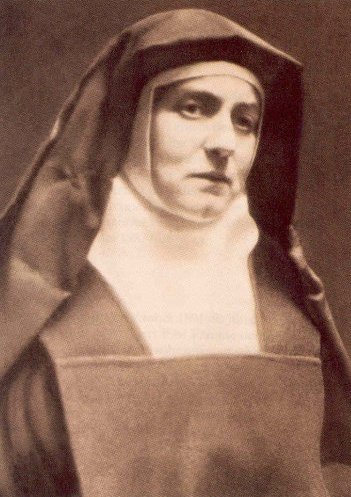 Nevertheless, though, her philosophical rigor was tempered very much by an appreciation of revealed truths as equally-given in the first moments of one's experience of reality. In other words, Stein--very much like Aquinas, in his own sort of Neoplatonism--considers the Trinity as co-given alongside the impressions of "being" that arise from an Aristotelian investigation of the world. For both Stein and Thomas, the Logos (reason, understanding) is not something deduced from real-world experiences; but rather, it is something within the context of which all real-world experiences abide. As such, God-as-Logos (i.e. the Word, or the Second Person) is a co-given reality, without which an authentic understanding of the world (and of metaphysics) is simply not possible.
Pro-Life: Beyond the Rhetoric
Posted by Andrew Haines in News, Philosophy on 6.03.2009
With all the recent flurry in the news about the killing of Dr. George Tiller, it’s hard to avoid for very long the question: “Just what does it mean to be ‘Pro-Life’?” On the one hand, most Catholic moral and ethical authorities have come out stating strongly, that ‘the murder of George Tiller is a gravely wicked thing, and is an absolutely unjustified transgression of the moral law.’ Their stance seeks to maintain a hermeneutic of continuity, so to speak, in the Pro-Life movement, valuing the life of both unborn babies and abortion doctors equally and without distinction. ‘Violence is never the solution’ in such cases, they say, and to kill an abortionist in cold blood is murder just as much as to kill an unborn child is murder. Rather, the ‘solution’ (for them) lies in recourse to civil authorities, and in the hope that the future will bring a reversal of the current abortion laws in America, and a defense of all life, from conception to natural death.
On the other hand, some Pro-Life activists have come out strongly in support of the slaying, noting that the exercise of lethal force is justified in such a case where the civil authorities condone the murder of children; and where Dr. Tiller’s stated intent was to continue performing such genocidal atrocities. For these people, to gun down Tiller in cold blood is not murder, but rather an implementation of a sort of “just war” theory on the civil level. In other words, from such a standpoint, the ‘murderous’ character of the slaying is alleviated by the fact that killing an abortionist is really the protection of innocent human life, which would otherwise be in imminent danger of utter destruction.
I trust that the Catholic moral authorities have stated something true. And I don’t want to launch into a debate, here, on the objective moral status of such a killing as happened in Kansas this week.
More importantly, I think, is the fact that much of the debate surrounding abortion in America today has become one of polemics and rhetoric, rather than a debate situated in the context of immediate and government-sanctioned genocide. Abortion is, as Dr. Robert George notes (regarding President Obama), not presumed to be the extermination of mere biological matter, but rather the killing of real (little) human beings. And thus, the ultimate tragedy is that an open declaration of class-genocide is in effect; and it is genocide that is fundamentally supported by American law.
This isn’t a debate between political ideologies. And it isn’t a disagreement that ought to be hashed out with rhetoric. The abortion debate in America is one that involves real, imminent, widespread murder; and murder condoned on the level of civilly sanctioned genocide.
Certainly, the reality of this debate doesn’t mean that we ought to go out and kill abortionists. But it does mean that we must, at least in our own minds and in our actions and convictions, restate the basic terms of the ‘argument.’ The reality of the plague of abortion means that we must understand the relevant object of our concept (i.e. the actual murder of unborn children), and bring it to the forefront of our consciousness. It will do no one any good to suppose that abortion is merely a word (even if a heinous, unbearable one). “Abortion” is a reality; and it ought to be treated as such.
The media frenzy covering the killing of Dr. George Tiller is, at the very least, bringing some of this reality to our immediate attention. And we should take the opportunity to make the most of it.
Pro-Obama Catholics?
Posted by Andrew Haines in Church Doctrine, News, Philosophy on 5.29.2009
In a recent debate, hosted by the Catholic University of America, Robert George and Douglas Kmiec faced off on the question: "The Obama Administration and the Sanctity of Human Life: Is there a common ground on life issues? What is the right response by 'Pro-Life' Citizens?"
For those unfamiliar with the two debaters, Robert George is a professor of jurisprudence at Princeton University, and an outspoken and poignant proponent of the Pro-Life cause; and Douglas Kmiec is a professor of constitutional law at Pepperdine University. Both men are Catholic; however both differ severely on how their faith ought to affect their decisions and actions as American citizens.
The cornerstone of the debate—and what probably caused it to occur in the first place—is the fact that Kmiec has openly supported President Obama on a number of occasions (even voting for him in the election) while George has remained staunchly opposed to the president's policies, and continually expresses heavy criticism toward those Catholics who supported him last November, knowing full-well his stance on issues of human life.
All in all, the debate unfolded like most do. Kmiec presented his case, George countered, and then they had a period of Q&A with moderator, Mary Ann Glendon. The main focus of the discussion was, quite naturally, the hard-line stance of President Obama toward anti-life legislation; and the responsibility of Catholics to act conscientiously in the face of such evil. A number of striking points were made on both sides, but the final tally was surely not in favor of Kmiec. Perhaps the most notable aspect of the whole event was Dr. George's candid presentation of the Obama administration's shortcomings in his 20-minute portion of the debate. George is, without a doubt, a tremendous and clear-headed thinker; and his portrayal of both the pros and cons of almost any situation is bound to be thorough. Once again, he did not disappoint, leveling a barrage of hard-hitting questions against Kmiec's Catholic-Democrat position. He outlined (quite thoroughly) the fact that Obama does not deny the human fetus to be a human being, but that it has rather become a question of 'when must we treat such a being as having fundamental right?' The critical thing, George pointed out, is that Obama's pro-abortionism is not one grounded in ignorance of biological facts; but rather in the alienation of an entire demographic of American citizens.
Overall, I thought the George-Kmiec debate was a real testament to the integrity of the Pro-Life position—and especially one so grounded in philosophical and academic honesty as is presented by Robert George. I would strongly encourage anyone interested in the the roots of the Pro-Life argument to check out this video and see what they think.
The Inner Way to God (Part 2)
Posted by Andrew Haines in Philosophy, Theology on 5.26.2009
In the last post on Rahner’s inner approach to God by the “pre-apprehension” of being, we discussed the possibility of an encounter with God based on our ‘pressing against’ his infinite being. As we saw, Rahner believes that the best account for God’s real existence is by coming to realize his Infinity—something opposed to our human finitude. We cannot conceptualize God’s fullness. But we can experience it when we find ourselves troubled by our own finitude; and when we realize how finite our lives and actions are in relation to the Infinity beyond us.
In this post, we will get a little more theoretical. (After all, Rahner was a serious philosopher/theologian, and it doesn’t do him justice to take him too lightly.)
There are some valid critiques to Rahner’s position, which we need to look at in order to justly present his theory, and set it in relation to the fuller context of the Catholic faith. And I will try to do that as concisely and clearly as possible.
The first objection might be: “Why does such a ‘pressing against’ the Infinite mean that God must exist? Couldn’t this just be evidence of some other being beyond us and greater than us?”
Most importantly, here, is Rahner’s continual mention of “infinity.” In other words, he is not simply speaking of a being-greater-than-others, but an infinite being. And this is, at least in our Christian faith, part of the definition of God. So pressing against the Infinite (if that is really what is happening) cannot be pressing against anything other than God himself—even if it doesn’t tell us much about his personal character.
A second critique might be: “Doesn’t Rahner’s inner approach to God border dangerously on making man into his own measure (perhaps a la Feuerbach and some other modern atheists)?”
I think this is a legitimate criticism. But I also note that Rahner’s argument can be used in direct rebuttal of a full-on Feuerbachian/atheist response. In other words (for those unfamiliar with Feuerbach and modern atheism), in the Vorgriff auf das Sein, Rahner stresses the fact that this “pre-apprehension” of Infinity is not something we create; but rather something we bring to our experience of the world. Whereas Feuerbach supposed that the idea of God was a mere projection of man’s best qualities into a divine “other,” Rahner wants to maintain a strong sense of man’s finitude, and the absolute reality and existence of the divine “other” over and above man’s relation to him.
For Rahner, man brings this realization of the “I” to all of his encounters with reality. This foundational self-awareness is the “horizon” upon which he experiences the entire world. And this self-awareness continuously presses against an awareness of the Infinity beyond—that is not man. In fact, man-as-man, for Rahner, even relies on this understanding of finitude; the continual longing for an Infinity that is unachievable in human experience. But again, the fundamental response to the criticism itself is that the Vorgriff is something brought to experience, and not the effect thereof nor the projection of any sort of human quality into the realm of eternity.
In the end, I think Rahner’s argument for God from this inner approach is very striking. I think that it offers quite a bit, and augments both cosmological and ontological arguments for God’s existence.
But I think, too, that it must be read with care. And I hope that I have done this—and shown this—in these last two posts.
[Thanks to StMichael for his comments on Part I of this post, which helped in formulating the objections stated here.]
The Inner Way to God (Part 1)
Posted by Andrew Haines in Philosophy, Theology on 5.23.2009
There are many arguments for the existence of God. Among others are Thomas Aquinas' "Five Ways" for the cosmological existence of God, and St. Anselm's "ontological argument" for God from the perfection of his essence. The first, Thomas', explores an approach to the divine as the necessary cause of all existing things—which could not be their own causes. The second, based on ontology, argues that God's existence must be necessary since God is a perfect being, and therefore must always and unfailing exist in reality.
Here, though, I want to look at a third (and somewhat under-valued) argument for the existence of God: the inner way.
Perhaps one of the most striking cases for the inner way to God, at least in my mind, comes from Karl Rahner's argument for the Vorgriff auf das Sein. While Rahner is a rather complicated read, and to really understand his thought requires quite a bit of work, his idea of Vorgriff auf das Sein—or the "pre-apprehension of being"—is something almost anyone can come to grips with.
Rahner's basic premise lies in the fact that we, as human beings, are limited in our ability to conceptualize (i.e. form abstract notions) about things we encounter in reality. In other words, we can see a pencil, lying on a desk; and we can form a pretty good "concept" of what that pencil is in our minds (viz. yellow, thin, long, includes-eraser, sharp-pointed, etc.). Still, though, something of our concept is left lacking, and there remains an understanding of the pencil-as-a-whole that eludes us. The longer we stare at the pencil, the more we come to learn about it.
Now imagine that deficiency when it comes to our "concept" of God. We can say lots about him—that he is good, true, loving, merciful, etc.—but our abstract sense of him always fails to capture the fullness of his being. And to a far greater degree than with the pencil. Since God is immaterial, any understanding of his "essence" is one that relies on our apprehension of a spiritual reality, which isn't easy!
Rahner's idea is that, in our fundamental and 'regular' human experience, we have a "pre-apprehension" of something that transcends our situation in the world. To put it another way, although I am faced with countless particular situations each day, there is something about the "I" that is identified with me that persists no matter what the situation, and that I come to experience in a non-conceptual way. "I" am more than the decisions I make; "I" am a person who acts in the world.
This fundamental realization (pre-apprehension) of our deepest being is the basis for all further conceptualization. In fact, only because I am "I" can I possibly form a concept of the pencil on the table. It's length and color and weight are all things foreign to "me"; but when I see them and think about them, I can come to understand them.
But more importantly, my fundamental realization of myself—the Vorgriff auf das Sein—tells me quite a bit about the way I stand in relation to what is superior to me. Whenever I act or think, I always have a sense of an infinity beyond me; and an infinite number of things that I will not and cannot be/know. To be a human person is to be limited. I am what I am. But this constant pressing against the infinite, though, is a common experience shared by all human beings. And it is, in Rahner's estimation, the common acknowledgment of something beyond me and something superior to me. It is a primal acknowledgment of the Infinite that is not me. And this is God.
Is Goodness Without God Good Enough?
Posted by Andrew Haines in Book Reviews, Philosophy on 1.20.2009
 In a society ever-growing in its urge for secularization—both culturally as well as religiously—the question of atheism versus theism is a timely one. Particularly, the question being asked by many philosophers and theologians alike is: "What does God contribute the nature of moral decision making?" or, put alternatively, "Is moral action possible for atheists, or is morality something peculiar to theists alone?"
A recent book, Is Goodness Without God Good Enough?, takes hold of this question from a variety of angles. Beginning with a famous 2001 debate between philosophers William Lane Craig and Paul Kurtz (who argue the theistic and atheistic positions respectively), the authors of the book have compiled a host of essays, which seek to ultimately discern 1) just what is at the heart of asking the question, "Is goodness without God good enough?," as well as 2) what the proper response to such a question would look like.
Throughout the book, Paul Kurtz's position seems to run as follows: in the course of human history, atheist have proven time and again to have demonstrated great moral rectitude and uprightness, despite their non-belief in God. Therefore, it is generally visible that belief in God is not a necessary condition for the exercise of moral action. On the other hand, Craig argues this: that although belief in God is not necessary for moral rectitude, God's existence alone suffices in making moral decisions truly moral. In other words, he supposes that God's perfect nature is the only true source of a moral code that is both objectively recognizable, as well as universally applicable. The two thinkers go back and forth, debating one another on these points, and trying to discern whether or not God is really essential for moral living.
Here's a spoiler: in the end, there still remains a great bit of obscurity. Craig addresses the meaning of the question, while Kurtz continually runs the end-around on his opponent, refuses to deal with the challenges leveled against his own position.
Nevertheless, the contributions made by the book's various essays, which critique the actual Craig-Kurtz debate, are quite noteworthy. Although, I would say, there isn't a great deal of substantial 'progress' that occurs in terms of answering the actual question of the debate, there are nonetheless some insightful perceptions about just what it means to talk about morality as strictly non-religious versus morality as inherently religious. This, I think, is a good thing, since the typical arguments taken up by atheists and theists alike, in such a situation, are unlikely to change much unless there is some alteration of the terms of engagement. (For a reasonable approximation of this sort of usual deadlock in a 'real world' scenario, visit Austin Cline's atheism blog at About.com.)
Although Is Goodness Without God Good Enough? doesn't settle for me much about the atheist-theist debate on the whole, it does make some notable observations which are helpful for anyone seeking to understand more fully the nature of the debate on morality, and how it relates (or does not relate) to religion. I would encourage those interested to read the book, which is a fairly easy read, and certainly serves as a helpful gateway into one of the most pressing problems of our era.
Good (Christian) Gift-Giving
Posted by Andrew Haines in Feasts, Philosophy on 1.04.2009
More from the annals of Christmas break thoughtfulness...
This topic is something we all face, and as Christians in the Western world, something we undoubtedly face with a little skepticism at times. At least I do. What am I talking about? The giving of Christmas gifts (or any holiday-related gifts, for that matter). 'What does it mean to give a gift to another person at Christmastime? How should I be disposed to others in a spirit of generosity that is authentically Catholic?'
Maybe I'm over-philosophizing—it wouldn't be the first time. But I think there is something worthwhile about critically assessing even the most basic attitudes we maintain (and, moreover, are expected to maintain) in our Church and our society. Generosity—or perhaps most generally, charity—is the fundamental disposition of the active Christian. It is the very thing that defines our conviction: God-made-man gave himself entirely so that we might be free to give ourselves entirely back to the Father. It is the purpose of the Incarnation. For that reason, it is something strongly encouraged on the Feast of the Incarnation—Christmas.
But, in order to imitate Christ's self-gift most fully, we are also expected to understand why it is that we are called to give. The response (like most things Catholic) is very simple, yet truly profound: we are called to give ourselves for the sake of love, and nothing else. As such, our gift-giving disposition should be one of genuine love, and nothing less. By giving a gift, we are not only symbolically recalling the gift of Christ as man for our salvation, but are actively and truly called to love another person by our generosity and disposition of service.
Obviously, lots of things cloud our focus here: 'Perhaps I am giving because I feel compelled to by the "spirit of Christmas." If so, is my gift worthless? Shouldn't I be giving out of pure love and not coerced expectation? But if I don't give gifts now, with imperfect motives, what will prompt me to give gifts later, when my motives are "more pure"? Isn't generosity itself, even if impurely motivated, the only means to a disposition toward charity that is most authentic and real?'
Certainly, hardly any gift is given out of absolute generosity—even the most faithful Christians have some degree of affection for the rewarding feeling that accompanies a well-received gift. This is understandable, and I think anyone would be hard-pressed to admit otherwise. But just because we as humans are oriented as such does not mean that authentic charity is a hopeless case. Just because we look forward to making someone happy (for whatever reason) does not mean that we ought not strive for purity in our dispositions. In fact—and this is the very 'Catholic' part of things—it is only by giving imperfectly that we will ever learn to give perfectly. In other words, learning to give from the genuine surrender of the heart is not something learned by theoretical prowess, but by practical trial and error.
This is something I often forget. (And I offer my apologies to those whom it affects.)
Giving, whether it be at Christmastime, birthdays, or any day of the year, ought never to be something overly calculated. Nor should it be something done out of mere coercion. Rather, in order to be truly Christian, it has to fall somewhere in between. Both extremes can teach us something or other about what it really means to give a gift—theory teaches us the importance of motivation, and expectation teaches us the importance of painful persistence. But in the end, giving a gift is an imperfect thing. It is an imperfect thing that seeks the perfection of the one true Gift, the gift of Jesus for the salvation of the world.
Inclinations vs. Intentional Prayer
Posted by Andrew Haines in Philosophy, Prayer on 12.30.2008
Well, the holidays have taken a real toll on my blogging efforts. But I suppose that isn't such a bad thing. I've been escaping the books for a few weeks—and most intellectual-ish activities along with them!
But now I'm back. And after all this time away from thinking (at least thinking critically), I have a few thoughts that are probably long overdue.
First and foremost, I've been thinking quite a bit about prayer. My understanding of prayer is something that has, over the course of my life, taken drastic turns...for better and worse. 'Knowing' how to pray is just as hard as trying to figure out what it means to say, "I prayed." I'm sure that I won't get any solid 'answers' anytime soon—it's rather a mysterious thing—but there are some fundamental truths about prayer that are not dispensable, and these can guide us to seeing just how we can grow in a life of prayer, no matter our vocation in life.
In my mind, prayer seems to fluctuate between appreciating God's presence in a mystical, sacramental sort of way, and appreciating his presence in human interaction. On the one hand, there are times where the only place God seems present is in the tabernacle, in the Eucharist, and there is nothing I want more than to be alone with him, seemingly isolated from the outside world, and to pray. On the other hand, sometimes that is the last thing on my mind; sometimes I want nothing more than to be with other human beings, and to experience the affection and love their presence draws out from the depths of my personhood. Both inclinations are directed at some form of prayer, whether it be meditative or active. Neither inclination is, however, in itself a prayer.
What seems to be necessary for real 'prayer' to occur is that, recognizing these attractions of the heart, I actually do something about it. "To pray" is, most basically, a verb. It requires action.
Whether it be an affection for Christ in the Eucharist, or the indwelling Trinity in others (or even oneself), truly praying means that we are realizing that desire to be from God, and pursuing it as God would have us pursue it: by glorifying him, and seeking to give him our fullest and deepest attention. This sort of 'intentionality' that happens with prayer is the same sort of thing that happens when we see something new, or when we find something interesting that we want to know more about. The focus of our attention—the focus of our 'self'—becomes directed at another. We engage another being with our undivided intentionality. Whether that 'other being' is a book, a pencil, another human person, a divine person, or the Trinity united, the importance of our intentionality is unchanging. We examine it, inspect it, note the impressions it presents us with, take it in, process it, meditate upon its true meaning, and engage it for what it is. We bring to this encounter just as much as does the other. And we bring to prayer just as much as does God. Prayer is the unity of two autonomous persons in a conversation of the heart. If we are not fully present, how are we ever going to pray?
With all this in mind, we can see how prayer can occur either meditatively or actively. It becomes clearer that "to pray" does not simply mean to drown out distractions, but rather to intentionally move toward the object of our affection. It means to discover the revealed God by endeavoring to approach him genuinely, and out of the affection of our hearts. We do this at church, before the Eucharist; we do it in our lives, in being and living with others. The presence of God is everywhere, and our affection towards this presence can be prayerfully transformed anywhere and everywhere. How else could St. Paul have commanded Christians to "pray without ceasing?"
Of course, realizing this and actually doing it are two different things. Understanding the theory of prayer is just the same as understanding that "I am affectionate toward this or that thing, but refuse to do something about it." Reading (or writing) about prayer is not praying. At least not in itself. However, it can be prayerfully transformed if the focus of the understanding is actively directed at coming to know God more fully, and discovering his Truth more plainly. It's not always easy to tell the difference between 'knowing' something and 'doing' something. I suppose the tell-tale sign, though, is that action will always issue a change, while knowing is the foundation for that action. "Do I see myself changing because of my prayer life, or am I simply learning more about what praying might mean?" In more philosophical terms: "Am I simply inclined to goodness, or am I intentionally disposed to it, seeking it actively, and desiring it with my entire person?"
'Understanding' Beautiful Art?
Posted by Andrew Haines in Art, Philosophy on 12.19.2008
I was at the National Gallery of Art last weekend, strolling amongst the paintings before getting off to another engagement that evening. It was relaxing, to say the least. There is something about art that is calming—at least (I think) good art. Even the most provocative of scenes, if portrayed well by their depicters, seem to induce an effect of tranquility of mind. For example, Monet's delicate flowers offer a similar consolation as El Greco's rendition of La Agonía en el Jardín.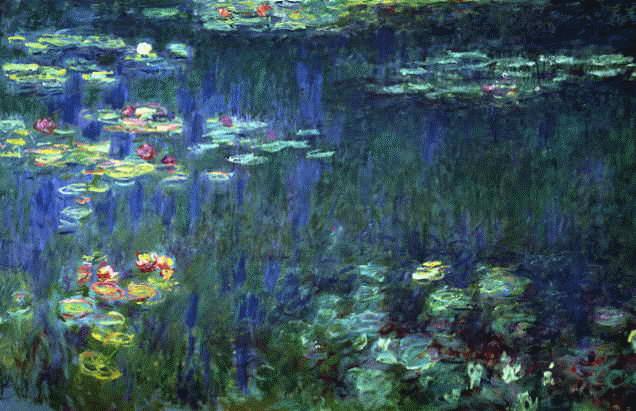
Any discussion of art is bound (although I think unfortunately) to fall into some sort of cliché. So much has been written and said about art and its relation to man's journey through life that it's difficult to say something new—at least something categorically new. One can only, to use a related metaphor, paint with wide brush strokes for so long before everything that can be said has already been put forward. For that matter, analyzing art on the grand scale is itself an art not easily practiced.
But real progress can happen more easily, I think, when we look at art on the micro-scale; i.e. as individual paintings, schools, etc. (Even speaking of 'modern art' versus 'classical art' versus 'oriental art' is a bit too broad for drawing clear distinctions.) In the end, it's the artist himself who paints the picture, not the milieu in which he lives. It is the artist himself that conveys meaning, even if it is a meaning engendered by the culture he is raised in. To find consolation in art means to find consolation in the expressions of the singular artist, not in art as a whole.
I was thinking of all this as I was at the gallery last weekend, and in reflection it seems to make sense. I had to laugh as I watched the freelance art aficionados perusing the rooms, examining closely the paintings, and then retiring to the benches to chat with one another (in fancy parlance) about such and such an artist and such and such a contribution. I wondered where the authentic solace was in this sort of endeavor—whether or not they found it in the art they looked at or in the words they were able freely to associate with it. I guess I've always been a skeptic about people who like to talk so much about fine things that they themselves eclipse beauty with wordiness and esotericism. What of just seeing and acknowledging? Isn't this a more authentic understanding of what it means that something is 'beautiful' or 'lovely'?
Perhaps I'm guilty of just the sort of thing I'm trying to explain. Maybe it would be better just to look at a nice picture and realize how beautiful it is, in se—in virtue of its created nature and the reflection it affords of the Artist.
Maritain: Art & Creativity
Posted by Andrew Haines in Art, Book Reviews, Philosophy on 11.29.2008
 Over the break—and yes, I'm still getting 'breaks' at 23, hard to believe I know—but, over the break I've been trying to read a book by the famous Thomist, Jacques Maritain, called Creative Intuition in Art and Poetry. Assuming that most here haven't read it (including myself, except for the first chapters), I can't provide much of a detailed discussion or overview. But something he speaks of in the first chapter prompted me to ask a few questions, which I will present here.
The first chapter is a review of various forms of art—Oriental, Chinese, Greek and Western—comparing and contrasting them for their commitment to and portrayal of both "Things" and the "Self." Maritain's primary argument here seems to be that Eastern art, be it Muslim geometry, Buddhist mythology or Chinese iconography, all intends to portray the 'thing-in-itself' and speaks little of the 'self,' who creates the artwork. He contrasts this with ancient Hellenic art, wherein the human form becomes the object of beauty, but remains just that—a Thing—and not an actual extension of the artist-self. Finally, he attempts to show Christian art as the beginning of a form of self-expression that does more than simply focus on beauty in things; rather, it begins to show the beauty of the creator and the ideas which are put into a work of art from the subject end.
Here, I agree very much with Maritain. His representation and analysis of art from East to West seems quite correct, especially with regard to the religious incorporation involved in each form.
Maritain's final section of the chapter is devoted to modern and future art. Here, he makes a few claims which I'm not so sure I understand—at least not in the way he intends. "We are in the presence of an exceptionally great epoch," he says, "[which] comes from the fact that on the one hand never was painting so purely painting, and on the other hand never in painting was such poignant humanity united with such powerful penetration of visible things, through the simultaneous manifestation of the painter's creative Self and of the occult meanings grasped by him in reality." (28) Although he presents his case in eloquent fashion, I think his fundamental ideas are nonetheless up for debate—primarily the notion that modern art represents "pure" art, and that in this 'purity' arises the ultimate expression of self-manifesting creativity. Certainly, modern and contemporary art is unique, and it does speak from and toward a different level of self-involvement. There is something beautiful about abstraction and impression that is not found in realistic or iconic portrayals of reality; an involvement of Self, as Maritain would put it. But as for modern art indicating a true level of progress in the world of art, I think, is something altogether different.
I'll have to read more of the book before coming to a conclusion on this. But nevertheless Maritain does a brilliant thing in Creative Intuition in Art and Poetry, which delves into the problems of art and beauty with a penetrating and fruitful focus.
Love: Dwelling of Truth & Beauty
Posted by Andrew Haines in Philosophy, The Holy Father on 11.24.2008
For Msgr. Luigi Giussani, founder of the Catholic movement, Communione e Liberazione, two things in our lives are most indicative of our proximity to the divine: 'truth' and 'beauty.' These two ideas—well known in Catholic thought even from the time of the early theologians, and especially in the work of St. Thomas Aquinas—really do manifest most plainly God's presence in things of this world, and the redemptive work carried out by Christ in sanctifying the good things we encounter each day. Truth and beauty, for Giussani, are realities which 'correspond to the heart,' and things which each human heart, at its deepest level, yearns for and is satisfied by.
A common exercise among CL faithful is to examine one's life in terms of 'Where do I find truth and beauty?' It is there, we assume, that Christ is speaking to us. Certainly, this is the recommendation of the movement at large, and has proven instrumental for many individuals in coming to know more fully the depth of the divine plan which characterizes and gives meaning to their entire lives. 'When something clicks for me, I can see Christ in that truth. After reading the same passage of scripture over and over again, its beauty finally became apparent one day—it was so beautiful!—and I was able to see Christ there.' These are common experiences for any Catholic who keeps an eye open for them, and are the particular recommendations for those wishing to pursue the Lord in CL.
Without a doubt—and especially as a philosophy student—I see something admirable in searching for the Lord by searching for truth and beauty. They are, after all, two transcendental properties of all being in which, if we find one, we can often find the other. I think that's hitting the jackpot! But, it's not the only jackpot to be hit. A thing we should never forget is something given to us by St. John the Evangelist, re-presented elsewhere, and finally distilled beautifully by Pope Benedict XVI in his encyclical, Deus Caritas est. This message is simply that one phrase: "God is Love."
Indeed, although sometimes our intellectualized minds (and particularly for those of us who are students) continue to find solace in ideas of truth and beauty, there is something to be said of love, which is in the end even more perfect. "In the end, faith, hope, and love remain," says St. Paul, "and the greatest of these is love." There is something about love that is more universal—more perfect—than even truth or sublime beauty. Although we continually seek the truth, we seek it out of love. Even though we are fixated upon beauty, we must realize that there is no beauty worth having that is not had in love. Love is the guardian of all other goods, and so long as it is not present than neither are we able to be present to them.
I think that a common frustration in living the 'CL-life' is that sometimes we can get too caught up in desiring these true and beautiful realities. 'I want to see Christ so badly in this or that thing, but I just can't—but I know he's there!' Perhaps what we ought to focus on instead is the presence of God in the simple yet profound ability to endure in seeking him. Patience, endurance and persistence are the labors of love. If we desire to see the Lord with our hearts, we are indeed enduring in the fight, and this is nothing short of love. Although we cannot often see it, we must never disregard it. Love—persistence in wanting to see the face of Christ in all we do—is even greater than seeing him.
"The Only Vote Worth Casting..."
Posted by Andrew Haines in News, Philosophy on 10.13.2008
It's been a quiet week here at the blog. I've been occupied with studying for a midterm, researching for three term papers and preparing two presentations for the coming week. All in all, it's been a load of work. I'll soon be finished with my pressing assignments, though, and back to blogging on a more regular basis. For now, here's a curious (and brief) article about Catholic political activity by a philosopher from the University of Notre Dame (which has generated quite a buzz of attention.) Don't let the cliché subject matter dissuade you from giving it a read. It's very interesting. And I'd be curious to hear some comments:
The Only Vote Worth Casting in November
Alasdair MacIntyre
When offered a choice between two politically intolerable alternatives, it is important to choose neither. And when that choice is presented in rival arguments and debates that exclude from public consideration any other set of possibilities, it becomes a duty to withdraw from those arguments and debates, so as to resist the imposition of this false choice by those who have arrogated to themselves the power of framing the alternatives. These are propositions which in the abstract may seem to invite easy agreement. But, when they find application to the coming presidential election, they are likely to be rejected out of hand. For it has become an ingrained piece of received wisdom that voting is one mark of a good citizen, not voting a sign of irresponsibility. But the only vote worth casting in November is a vote that no one will be able to cast, a vote against a system that presents one with a choice between Bush's conservatism and Kerry's liberalism, those two partners in ideological debate, both of whom need the other as a target.
Why should we reject both? Not primarily because they give us wrong answers, but because they answer the wrong questions. What then are the right political questions? One of them is: What do we owe our children? And the answer is that we owe them the best chance that we can give them of protection and fostering from the moment of conception onwards. And we can only achieve that if we give them the best chance that we can both of a flourishing family life, in which the work of their parents is fairly and adequately rewarded, and of an education which will enable them to flourish. These two sentences, if fully spelled out, amount to a politics. It is a politics that requires us to be pro-life, not only in doing whatever is most effective in reducing the number of abortions, but also in providing healthcare for expectant mothers, in facilitating adoptions, in providing aid for single-parent families and for grandparents who have taken parental responsibility for their grandchildren. And it is a politics that requires us to make as a minimal economic demand the provision of meaningful work that provides a fair and adequate wage for every working parent, a wage sufficient to keep a family well above the poverty line.
The basic economic injustice of our society is that the costs of economic growth are generally borne by those least able to afford them and that the majority of the benefits of economic growth go to those who need them least. Compare the rise in wages of ordinary working people over the last thirty years to the rise in the incomes and wealth of the top twenty percent. Compare the value of minimum wage now to its value then and next compare the value of the remuneration of CEOs to its value then. What is needed to secure family life is a sufficient minimum income for every family and that can perhaps best be secured by some version of the negative income tax, proposed long ago by Milton Friedman, a tax that could be used to secure a large and just redistribution of income and so of property.
We note at this point that we have already broken with both parties and both candidates. Try to promote the pro-life case that we have described within the Democratic Party and you will at best go unheard and at worst be shouted down. Try to advance the case for economic justice as we have described it within the Republican Party and you will be laughed out of court. Above all, insist, as we are doing, that these two cases are inseparable, that each requires the other as its complement, and you will be met with blank incomprehension. For the recognition of this is precluded by the ideological assumptions in terms of which the political alternatives are framed. Yet at the same time neither party is wholeheartedly committed to the cause of which it is the ostensible defender. Republicans happily endorse pro-choice candidates, when it is to their advantage to do so. Democrats draw back from the demands of economic justice with alacrity, when it is to their advantage to do so. And in both cases rhetorical exaggeration disguises what is lacking in political commitment.
In this situation a vote cast is not only a vote for a particular candidate, it is also a vote case for a system that presents us only with unacceptable alternatives. The way to vote against the system is not to vote.
iTunes & 19th Century Nihilism
Posted by Andrew Haines in Philosophy on 10.08.2008
I'm pretty sure that iTunes might be one of the singular most indicative examples of the American will-to-own that I can think of. We all (that is, we all iTunes users) understand why. The days of hearing songs on the radio and simply enjoying them are long gone. Now, we have to know the title and artist's name before we even think about sitting back to soak in the music. If I like it, I want to own it. And if I don't like it, then just hurry on to the next song so I can find something to buy!
I suppose I'm not really addicted to iTunes. In fact, I believe that I have one of the smaller music collections of most people (my age) that I know. What I am writing about here is really more the perception of a forming mentality than an actual case study of addictive behavior. But, left unchecked, I have seen what it can become (viz. having so much music that you'll never have time enough to listen to it all, downloading illegally to appease your fixation with acquiring mp3's, etc.)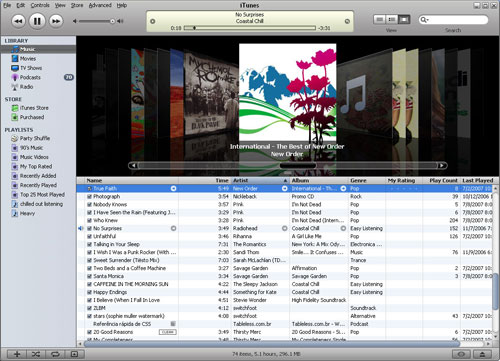
That being said (and my reputation being temporarily defended), the tendencies that such a mentality of obsessive acquisition engenders are just as bad as being actually addicted to downloading music. In fact, I would think, the mentality of 'will-to-own' might be even worse, since it is more open-ended and prone to various and, perhaps worse, manifest expressions. If we allow our character to be defined by what we can get our hands on, concupiscence won't allow us to stop at downloading music. Simply looking at the wanton acts of selfishness that occur daily throughout the world. People want more, and they are willing to go to great lengths to secure it.
Perhaps most destructive, though, about this consumeristic mindset is the proclivity to begin viewing invaluable items as purchasable. In other words, having the ability to buy whatever you want—even before you know what it is—makes one feel as though they are entitled to anything, and that anything has a price. This, of course, sounds cliché. But think about it: what does putting a "price" on something invaluable indicate? It is more than simply making attainable by human means something that lies outside the bounds of singular acquisition. It is, in actuality, presuming that we are speaking of a commodity manufacturable by human efforts, and contained within the scope of human production. We can buy pencils, cars, houses, even land (which is cultivated and prepared by human efforts). What we cannot buy are people, truth, beauty and goodness. There is, I would argue, a distinct separation between the two sets, and one that, even in America today, we haven't found a way to bridge.
The alarming thing about the 'will-to-own,' though, is that it realizes no bounds. It is, in many ways, a concrete and Westernized expression of the Nietzschean Wille zur Macht. Just go into Barnes & Nobles to find out how popular this nihilistic thinker is: nearly half the "Philosophy" shelf is dedicated to him. Then ask yourself if there is some connection between Übermensch and Überkäufer. I think there is and—in the spirit of Nietzsche—I think we are on the cusp of its simultaneous realization and demise.
Συνοπσις: A New Blog
Posted by Andrew Haines in News, Philosophy on 9.28.2008
Having a blog is a good thing, especially when you need to put in a plug for another blog. And that is what I am doing right now.
Behold, The Synopsis Project.
Although this new project is quite different than In Umbris Sancti Petri, I have a feeling that many of you who are regular readers here will enjoy what (I hope) will be going on at The Synopsis Project. While this blog is mostly dedicated to things related to theology, philosophy and the Church on a wider scale, the other will be focused primarily on philosophical issues, and will have a decidedly more 'pinpointed' approach. For anyone who's wanted to venture deeper into philosophic topics, I would warmly welcome you to become a regular visitor and commenter at The Synopsis Project.
We are still getting it off the ground—we're at about T+2 seconds, I'd say—but soon it will be fully operational, and we're looking forward to lots of good discussion!
Now for Sustainability...
Posted by Andrew Haines in Philosophy on 9.25.2008
Obviously, we figured out how to provoke comments. And all sorts of comments at that. I'm pleased that such a silly little exercise got people thinking (and typing).
Although the aim of the last post was two-fold (i.e. critiquing the current mindset of bloggers while attempting to promote useful commentary at the same time), the real purpose—as I noted—was to research how to become a 'better blogger.' Getting comments is one thing (a very important thing, no doubt), but stimulating comments that are germane to a topic, and which are sustained in quantity and quality is a different matter altogether. Now that I have your attention for a few moments, what sorts of ideas would you submit on this point?
A Blogging Challenge
Posted by Andrew Haines in Philosophy on 9.23.2008
Here's a thought-provoking (and hopefully comment-provoking) exercise, which incidentally (and perhaps oxymoronically) voices my opinion on a few things. I think it provides a good challenge to those who find it necessary to so quickly open their mouths in comboxes internet-wide...
I've been trying to look toward a few other blogs for ideas on how to blog better. For the most part, I've been getting lots of ideas—but in very few cases have they been formulated in positive terms. For some reason, blogging seems to have an inherently degenerative principle of existence (an apparent anomaly in logical thought) which reduces all possibility for constructive dialogue to mere exchanges of heated opinion. It sounds like something from The Matrix, but all you have to do is seek out any number of mainstream 'discussion' blogs to find evidence.
Blogging, in many senses, is like a classroom: one person 'teaches,' and the rest voice their approval or disapproval for that teaching based on reasoned judgments (i.e. "comments"). This can happen in various ways, but two seem prominent in my mind. There are instances of both classical and—for lack of a better term—modern constructions of blogging, each being diametrically opposed to the other. In the (anachronistically) classical approach to blogging, the blogger writes what he or she believes to be the case, anticipating questions and rebuttals, but nevertheless endeavoring to submit new substance for the discussion at hand. In other words, a topic of particular consideration is viewed in its own right, and is subsequently grappled with by inquiring disciples (themselves often master-bloggers in some other and remote niche of cyberspace).
On the other hand, the (felicitously named) modern approach to blogging is closely associated with the modern theory of classroom study, which is dominated by a subjectivist approach to teaching, weakened further by a subjectivist theory of learning. To put it more clearly, a topic is brought into consideration which is admittedly subjective on the part of the teacher, who in turn expects (although often only implicitly, and by virtue of his own example) that his listeners will attempt to discredit his claims based on similarly subjective evidence. The result of this latter method seems to be a degeneration of dialogue, furthered by each side's attempt to undercut the other's evident and otherwise-impenetrable position of subject-focused truth. In plainest terms, the modern construction of the classroom is not a classroom at all, but an endless series of contradictions aimed at establishing personal truths founded on nothing but subjective bias.
Here, I am free to become a bit teacher-ish. I am free to assume that the beauty of my own critique of blogs and bloggers lies in the critique itself, and in the necessarily self-evidencing character of any comment designed to undermine it. If anyone seeks to prove my theory wrong, his or her comment will prove it right: either the comment will be supportive of my theory that reasoned judgments and positions alone have priority in the dialectic setting of the (blog) classroom, or it will itself manifest the degenerative nature of subjectivist positions in the face of logically constructed ones.
That being said, does anyone have a comment?
Benedictus Scientiarum
Posted by Andrew Haines in News, Philosophy, Theology on 9.18.2008
 Whenever I think of the Roman university of La Sapienzia, and their bold claims against the Holy Father and the Vatican, I can't help but laugh a little. Especially in light of this:
The president of the Pontifical Council for Culture has said that evolutionary theory is “not incompatible” with the teachings of the Catholic Church, insisting that the theory of biological change over time was never condemned by the Church.
Archbishop Gianfranco Ravasi made such remarks while presenting the new interdisciplinary conference to mark the 150th anniversary of Charles Darwin’s Origin of the Species. The conference, which is a Vatican initiative to promote dialogue between scientists and theologians, is scheduled to take place in Rome in March 2009. (CNA)
Now, its already quite clear that the Church has nothing against scientific progress; and I've already written quite enough on that topic for the time being. What really strikes me about this little news clip is the next paragraph (specifically the last line):
[Ravasi] said the theologians, philosophers and scientists are attending the conference not necessarily for the purpose of coming to an agreement, but rather hoping to confirm “the possibility of dialogue and a common desire to interpret reality, albeit from different points of view.”
This statement—as seemingly insignificant as it might be at first glance—provides us a window into some very big issues. First, it shows us precisely the point of all philosophic inquiry. It outlines the basis of philosophical reasoning and methodology: namely, that philosophy is concerned not with some universal method of understanding the truth, but with the truth itself—a truth which alone is universal. In other words, varied approaches to truth are (philosophically) equally acceptable, so long as ultimate and real truth is the goal.
Second, it calls to mind the task of theology, which is quite converse to that of philosophy. In theology, the 'object' or 'aim' of study is God himself. Therefore, the truth being considered is a divine one. Moreover, since theology concerns itself with the knowledge of God directly, something understood only by way of revelation (and particularly in the person of Jesus Christ), it is therefore inherently concerned with the truth of revelation in se. Perhaps more clearly, proper theology places an importance upon the understanding of revelation just as much as it does upon the understanding of God himself. The theological 'study of God' is equally the 'study of God revealed.'
Third, Ravasi's remarks call to our attention the place of science. The word, "science," comes from a Latin word for "knowledge," "scientia." This form of knowing is concerned not only with the ultimate truth, as is philosophy, or the means of knowing, as is theology, but rather both the means and the truth. Science is the understanding of reality based on empirical and experiential observations. One cannot believe that gravity exists and cite the color blue in proof of that claim; nor can one observe an apple fall from a tree and subsequently claim that the theory of gravity has been debunked. For science, the end and the means are equally integral constituents. They must cohere with one another.
The ultimate conclusion is that each of the three—philosophy, theology and science—are inquests toward the truth. In terms of method, philosophy is highest. In terms of object, theology is highest. In terms of utility, science is highest. The real goal is to understand which truth is accessible by which method.


