Showing posts with label The Holy Father. Show all posts
Benedict, Marini & the Importance of the 'Reform of the Reform'
Posted by Andrew Haines in Church Doctrine, Liturgy, News, The Holy Father on 1.11.2010
There's been a lot of buzz lately in the Catholic news outlets about one of my favorite topics: liturgy. And I'm eager to share a few thoughts of my own on the matter...
There was a time in my life (not all that long ago) when "liturgy," for me, was not much more than a physical expression of some poorly-formed and weakly grasped ideology--one that took issue with Reformation-esque practices as (in the words of Hilaire Belloc) a "profound cleavage" from the traditions of Roman Catholicism. But, at the heart of my rash reactionism was a poor understanding of just what that Roman Catholic tradition meant for the history of Western civilization as a whole; and, accordingly, a grasp of what the Protestant influence meant for its future.
I've come to the (slightly) more informed realization, recently, that the Church's influence on culture and tradition has not merely offered a sense of universal significance to something that was otherwise without, but rather that its very importance is entirely and inextricably united with the basic, cosmological significance of history and tradition as it has always unfolded and developed. And nowhere is this more clear than in the Catholic liturgy.
 Thankfully, this opinion is more than simply personal. And, in the last few days, it has been echoed strongly by papal emcee and liturgist, Msgr Guido Marini, in his comments regarding the "reform of the reform" of Catholic liturgy. In short, Marini asserts that the liturgy celebrated by the Catholic Church should have a character of historical continuity. "I purposely use the word continuity," says Marini, "a word very dear to our present Holy Father. [...] He has made it the only authoritative criterion whereby one can correctly interpret the life of the Church." (CNS)
What is more "Catholic" than "catholicism": that is, universality, interwovenness, and the highest sense of "continuity"? And, conversely, what is more "Protestant" than an affront to such continuity (often expressed even overtly in terms of "non-denominationalism" or post-enlightened "egalitarianism")? If there is no clear series of precedence, then there is no possibility for continuity.
What I saw initially as a "profound cleavage" from Roman tradition--the Reformed infiltration of the Catholic liturgy--was a valid perception. But without attempting to comprehend the absolute depth of such cleavage, my mindset was one aimed merely at fixing the problem at hand, and not at seeking to repair the damaged roots of a thorough and complete break with the sensus fidei. "The liturgy cannot and must not be an opportunity for conflict," says Marini; yet the reformist mentality of the late 20th century amounted almost entirely to nothing but a conflict with the stated and perennial traditions of the Church for centuries before.
As Marini is keen to point out, the real work of faithful Catholics in the 21st century--for those who wish not simply to profess the faith, but to live, preserve and pray it by their deeds and practices--lies in promoting an understanding of the liturgy that is, above all, wholly Christian, and wholly undivided and non-partisan. "Fixing the glitch" is not a sufficient response to the deep wounds inflicted by the Protestant mentality of spiritual individualism (or what Belloc calls the "alienation of the soul"). Instead, Catholics must follow the example of the Holy Father, Pope Benedict XVI, by further grasping the true meaning of liturgy (theologically) and by evangelizing their fellow Christians on its deep importance in the life of faith.
"I have learned to deepen my knowledge these past two years in service to our Holy Father," admits Marini. "He is an authentic master of the spirit of the liturgy, whether by his teaching or by the example he gives in the celebration of the sacred rites."
Indeed, Pope Benedict has never modeled an attitude of reactionism; but instead always an attitude of genuine appreciation and profound love for the beauty of the liturgy that is possessed simply by virtue of its supernatural character. Benedict and Marini speak of the "reform of the reform" not because they are Reformers, but instead because they realize the importance of eradicating the very mentality of the Reformation by way of a thoroughly Catholic "hermeneutic of continuity."
To Russia with Nuncios
Posted by Andrew Haines in News, The Holy Father on 12.10.2009
Who calls Russia by its official name: the Russian Federation?
Apparently the Vatican press office, which recently released a statement indicating that Rome and Russia are soon to be trading top agents.

According to the Vatican Information Service, "the Holy See and the Russian Federation, in the desire to promote their mutual friendly relations, have decided by joint agreement to establish diplomatic relations, at the level of apostolic nunciature on the part of the Holy See and of embassy on the part of the Russian Federation."
Pretty straightforward news—but equally as groundbreaking.
The new concord comes after Thursday's meeting of Pope Benedict XVI with Russia's premier, Dmitri Medvedev. But despite the "cordial" atmosphere of the encounter, Vatican officials are saying that a papal visit to the Kremlin isn't likely. (New York Times)
Still, if the Holy Father's recent dealings with the Eastern Orthodox patriarchs have anything to do with this...I wouldn't rule such a visit entirely out of the question.
Benedict: The 'True Philosopher'
Posted by Andrew Haines in Philosophy, The Holy Father, Theology on 11.12.2009
It's been a while since I've said much about the whole reason I started this blog in the first place. After all, what would In Umbris Sancti Petri be without the successor Petri?
So what is the pope up to these days, you might ask?
Well, aside from promulgating apostolic constitutions that bring Anglicans back into communion with Rome and making pastoral visits to his flock (at home and abroad), Pope Benedict has been doing what good popes do. That is, teaching the faith.
Most recent on the roster of papally endorsed lessons has been the historical development of monastic and scholastic schools of theology--a trend that endures also throughout Ratzinger's earlier work. Since its October 28th inception at the Wednesday audiences, the topic has seen two subsequent installments; which leads one immediately to the question: "Why?"
Naturally, as an interested student of philosophy and theology myself, I'm a big advocate of the integration of faith and reason. And I think that Pope Benedict's persistent teaching on the importance of understanding Catholic intellectual history is evidence that, even at the level of the Church universal, the integration of faith and philosophy is absolutely critical for our very salvation.
In a recent post about Edith Stein, I stressed the importance of a Christian philosophy; and I cited St Thomas Aquinas as a key example of such a synthesis. But here I want to touch rather on the idea that each individual Christian--insofar as he or she is a Christian--must also necessarily be a Christian philosopher.
 If a "philosopher" is one-who-loves-wisdom, then it should come as no surprise that for the Church to endorse philosophy is nothing else than for the Church to endorse a love of Christ, who is the spoken Word of God himself. In his book, The Nature and Mission of Theology, Ratzinger writes that:
As early as the second century, Justin Martyr had characterized Christianity as the true philosophy, for which he adduced two main reasons. First, the philosopher's essential task is to search for God. Second, the attitude of the true philosopher is to live according to the Logos and in its company; that is why Christians are the true philosophers and why Christianity is the true philosophy.Furthermore, Ratzinger also claims that there is something else distinct about the Christian philosopher. While he uses his intellect to discern the truth of reality through natural reason, he also "carries in his hand the Gospel, from which he learns, not words, but facts. He is the true philosopher, because he has knowledge of the mystery of death." This problem of death, he says, is the "only real existential question facing man" after all; and it is because of the inescapable reality of death (and of its significance and role) that the Christian can ultimately make any sense of Christ'a Passion and Resurrection--the very core of the Christian faith.
Insofar as each of us faces this harsh reality, then--and insofar as we face anything which is simply beyond us--we are true philosophers. Moreover, inasmuch as we resolve the tension of these conflicts by an assent to faith in Christ (who conquers and makes sense of what is innately senseless) we are each Christians. And insofar as the two coincide--which they must quite necessarily--we are indeed Christian philosophers. Quite simply, we make sense of the mysteries we encounter not merely by natural knowledge, nor by supernatural faith, but by an integration of both.
And this is precisely what we are designed to do.
Benedict on Blogging?
Posted by Andrew Haines in News, The Holy Father on 12.03.2008
Now here's an interesting story. The pope, during his audience with administrators and students from the University of Parma, Italy, spoke a great deal about the 'dangers' of being too wrapped up in the technological advances of an age.
Students today are in danger of losing this balance, the Holy Father explained, due to the increased use of information technologies. “On the one hand, they run the risk of a growing reduction in their capacity for concentration and mental application on an individual level; on the other, that of isolating themselves individually in an increasingly virtual reality. (CNA)
The crux of Benedict's point seems to be that an overabundance of technology diminishes the need and appreciation of a genuinely social environment, disabling students from forming "constructive relations with other." On the other hand, says the pope, human interaction allows for “the opportunity to mature intellectually, morally and civilly, through the great questions that challenge the conscience of the contemporary man."
 How could I disagree with all that? It's pretty foundational stuff (not to mention the very topic of my undergraduate thesis!) But how often is it simply overlooked?
While eating out the other day, I was seated next to a table full of young girls—perhaps 13ish—accompanied by two older ladies, perhaps a mother and grandmother. It looked like a birthday party. Of course, I couldn't tell that from the conversation or interaction between the girls, but I simply guessed it based on the number of kids and their similar ages. The mother and the grandmother sat stoically on one end of the table, with eyes glazed over staring off into oblivion. The girls, on the other hand, all giggled to themselves. Each of them had in her hand some sort of cellphone/PDA/smartphone device, and was occupying herself playing games and sending text messages. I can only assume that the text messages weren't being sent to one another...
If this is any indication of what the Holy Father is getting at—and I think it is—then this shouldn't be something simply for speculation. The very future of our society hinges upon how well we teach children and young people to interact with technology. (Even blogging as much as I do is probably indicative of some overuse of the internet, I admit.) The real trick is figuring out how to enable kids to be proficient with technological advances while at the same time not allowing them to be consumed by them. Unfortunately, the pope doesn't give a quick answer for this. But I think if he had to point in one direction, it would be toward the parents.
Love: Dwelling of Truth & Beauty
Posted by Andrew Haines in Philosophy, The Holy Father on 11.24.2008
For Msgr. Luigi Giussani, founder of the Catholic movement, Communione e Liberazione, two things in our lives are most indicative of our proximity to the divine: 'truth' and 'beauty.' These two ideas—well known in Catholic thought even from the time of the early theologians, and especially in the work of St. Thomas Aquinas—really do manifest most plainly God's presence in things of this world, and the redemptive work carried out by Christ in sanctifying the good things we encounter each day. Truth and beauty, for Giussani, are realities which 'correspond to the heart,' and things which each human heart, at its deepest level, yearns for and is satisfied by.
A common exercise among CL faithful is to examine one's life in terms of 'Where do I find truth and beauty?' It is there, we assume, that Christ is speaking to us. Certainly, this is the recommendation of the movement at large, and has proven instrumental for many individuals in coming to know more fully the depth of the divine plan which characterizes and gives meaning to their entire lives. 'When something clicks for me, I can see Christ in that truth. After reading the same passage of scripture over and over again, its beauty finally became apparent one day—it was so beautiful!—and I was able to see Christ there.' These are common experiences for any Catholic who keeps an eye open for them, and are the particular recommendations for those wishing to pursue the Lord in CL.
Without a doubt—and especially as a philosophy student—I see something admirable in searching for the Lord by searching for truth and beauty. They are, after all, two transcendental properties of all being in which, if we find one, we can often find the other. I think that's hitting the jackpot! But, it's not the only jackpot to be hit. A thing we should never forget is something given to us by St. John the Evangelist, re-presented elsewhere, and finally distilled beautifully by Pope Benedict XVI in his encyclical, Deus Caritas est. This message is simply that one phrase: "God is Love."
Indeed, although sometimes our intellectualized minds (and particularly for those of us who are students) continue to find solace in ideas of truth and beauty, there is something to be said of love, which is in the end even more perfect. "In the end, faith, hope, and love remain," says St. Paul, "and the greatest of these is love." There is something about love that is more universal—more perfect—than even truth or sublime beauty. Although we continually seek the truth, we seek it out of love. Even though we are fixated upon beauty, we must realize that there is no beauty worth having that is not had in love. Love is the guardian of all other goods, and so long as it is not present than neither are we able to be present to them.
I think that a common frustration in living the 'CL-life' is that sometimes we can get too caught up in desiring these true and beautiful realities. 'I want to see Christ so badly in this or that thing, but I just can't—but I know he's there!' Perhaps what we ought to focus on instead is the presence of God in the simple yet profound ability to endure in seeking him. Patience, endurance and persistence are the labors of love. If we desire to see the Lord with our hearts, we are indeed enduring in the fight, and this is nothing short of love. Although we cannot often see it, we must never disregard it. Love—persistence in wanting to see the face of Christ in all we do—is even greater than seeing him.
The 'Soul' of Democracy: Christianity
Posted by Andrew Haines in Church Doctrine, News, The Holy Father on 11.06.2008
 There are, of course, lots of noteworthy things to think about in the wake of the election. Perhaps most germane to this blog are the two letters sent to Barack Obama, one by Francis Cardinal George of Chicago, and one by the Holy Father, Pope Benedict XVI. Both prelates extended words of congratulations to the US president-elect, and stated their continuing prayers for his cooperation in the work of justice, peace and—most pointedly—upholding fundamental human rights.
Dear President-elect Obama [wrote Cardinal George],
I write to you, in my capacity as President of the United States Conference of Catholic Bishops, to express our congratulations on your historic election as President of the United States. The people of our country have entrusted you with a great responsibility. As Catholic Bishops, we offer our prayers that God give you strength and wisdom to meet the coming challenges.
Our country is confronting many uncertainties. We pray that you will use the powers of your office to meet them with a special concern to defend the most vulnerable among us and heal the divisions in our country and our world. We stand ready to work with you in defense and support of the life and dignity of every human person.
May God bless you and Vice President-elect Biden as you prepare to assume your duties in service to our country and its citizens. (ZENIT)
Benedict's letter, unlike the cardinal's, was not published due to its "personal nature." However, I think it's fair to say that it expressed much of the same.
So what does this say about the Church and politics? What does it tell us about our own involvement in the political sphere beyond election day? I think the most reasonable conclusion is that the Church, as it has always taught, does not see political involvement solely in terms of elections and vying for political offices, in the sense that secular society portrays it. In Centesimus Annus, Pope John Paul II writes that the Church "values the democratic system…[which] is possible only in a State ruled by law, and on the basis of a correct conception of the human person." This seems to imply that what seems manifestly 'democratic'—i.e. the electoral and representative process we see in the US—is only possible due to the laws of the state it governs, and the adherence to these laws in cases concerning human dignity. Moreover, the pope goes on to say (in a 2000 letter to Cardinal Vlk) that the Church "has a specific contribution to make; not only can Christians join all persons of good will in the realization of this great project [of political activity], but they are also invited to be in some way its soul by showing the true meaning of the organization of the earthly city."
What John Paul II tells us is clear: political life isn't a once-in-four-years phenomenon. It is a sustaining presence and, in the words of the pope, the very "soul" of a democratic government. It is up to Catholics, with the support of their bishops, cardinals and pope, to maintain the efforts toward life so ardently offered in the time leading up to this year's presidential election. Now is when the moves for the next pro-life changes are initiated. Now is when we take up the task of becoming the "soul" of democracy by our witness to the fundamental dignity of life.
Liturgical Renewal Abounds in Vatican
Posted by Andrew Haines in Liturgy, The Holy Father on 9.28.2008
 Also noteworthy—and a little more germane to the title of this blog—the Holy Father has continued his tradition of trend-swaying appointments, once again in the liturgical sector:
Pope Benedict XVI made a low profile but significant move in the direction of liturgical reform by completely renewing the roster of his liturgical advisors yesterday.
A hardly noticed brief note from the Vatican's Press office announced the appointment of new consultants for the office of Liturgical Celebrations of the Supreme Pontiff. It did not mention, however, the importance of the new appointees.
The new consultants include Monsignor Nicola Bux, professor at the Theological Faculty of Puglia (Southern Italy,) and author of several books on liturgy, especially on the Eucharist. Bux recently finish a new book "Pope Benedict’s Reform," printed by the Italian publishing house Piemme, scheduled to hit the shelves in December.
The list of news consultants includes Fr. Mauro Gagliardi, an expert in Dogmatic theology and professor at the Legionaries of Christ's Pontifical Athenaeum “Regina Apostolorum”; Opus Dei Spanish priest Juan José Silvestre Valor, professor at the Pontifical University of Santa Croce in Rome; Fr. Uwe Michael Lang, C.O., an official of the Congregation for the Divine Worship and the Discipline of the Sacraments and author of the book "Turning Towards the Lord" -about the importance of facing "ad orientem" during Mass; and Fr. Paul C.F. Gunter, a Benedictine professor at the Pontifical Athenaeum Sant Anselmo in Rome and member of the editorial board of the forthcoming "Usus Antiquior," a quarterly journal dedicated to the Liturgy under the auspices of the Society of St. Catherine of Siena. The Society, which has an association with the English Province of the Order of Preachers (Dominicans), promotes the intellectual and liturgical renewal of the Church.
Also relevant to the appointments is the fact that all former consultants, appointed when Archbishop Piero Marini led the office of Liturgical Celebrations, have been dismissed by not renewing their appointments. (CNA)
Not a shock. But definitely interesting news nevertheless...
China & Modern Virtue
Posted by Andrew Haines in News, The Holy Father on 8.24.2008
There's been a lot of attention given recently to the situation of China-Vatican relations. Especially in light of the Olympics being held in Beijing, the spotlight has been intensely focused on the red country, and its internal as well as foreign policies. For the Catholic world, the last year has also marked the release of Pope Benedict XVI's Letter to Chinese Catholics, in which the Holy Father's wishes for the faithful of China are made quite explicitly known. Nevertheless, the recent invitation from the Bishop of Beijing regarding a papal visit to the Far East has certainly come as a real shock to many, including Vatican officials, who have identified the current state-of-affairs as ranking "premature" for such an apostolic voyage. In his address, given on Italian national television, Bishop Li Shan expressed that "all Chinese Catholics love and respect the pope and recognize his authority," and assured that such a visit is a "great aspiration," and would be a blessing for the Chinese people. Regardless of how it all turns out—and just how long it takes for a pope to make the journey into these somewhat hostile territories—Bishop Li Shan's statement regarding Chinese Catholics en masse struck me as very telling. What American bishop (or Italian or German bishop, for that matter) could honestly say that "all (insert respective nationality here) Catholics love and respect the pope and recognize his authority"? The answer, as I'm sure most would agree, is virtually none. I'm not even positive that Bishop Li Shan can be 100% sure either. Nonetheless, I bet he is quite certain that about 99.9% fall into that category of faithfulness to the Magisterium and obedience to the Holy Father. And he can be so certain because he knows that to be Catholic in China means to be Catholic in the face of clear and present danger.
For all the things we lack in the West—for example, the preservation of a unified and publicly recognized code of morality—the greatest deficiency we face may be the deficiency of opposition to our faith. Of course, things occur all that time that implicitly provide opposition to the Catholic faith; laws are enacted that support abortion rights, homosexual unions are given legal status, etc. But what I am talking about is an explicit opposition to the faith. And opposition whose goal it is not to undermine the faith by pursuing its own initiatives, but rather to eliminate the faith as its ultimate and final goal. This is the sort of opposition faced by Chinese Catholics, whose Church has been taken away from them and whose practice of the Catholic religion is often times limited to clandestine and secretive gatherings. This too was the type of oppression issued by Roman authorities in the first and second centuries, during which the Christian faith took root and began to flourish throughout the entire known world. If early Christians thrived when most oppressed, their Chinese counterparts will likely do the same. And it is for this reason that Bishop Li Shan can honestly say that his flock loves and respects Pope Benedict XVI and the Church he shepherds.
An interesting investigation is this: If zeal for the teachings of the Holy See is a sign of authentic acceptance of the faith, then what do we find in a large public rejection of those teachings other than a rejection of the faith. Don't tell this to the many American Catholics, who believe that what the Church says is 'outdated' and 'in need of revision.' In fact, I would venture to guess that the majority of American Catholics over the age of 35 or so see thinking more 'progressively' than the Church as being nothing less than a virtue of the modern age. After all—if we can even accept such a classical definition of "virtue" as being a habit which tends toward the good—then surpassing the 'archaic' and 'medieval' mindsets of the Church with 'free-thinking' and 'liberated' approaches to life is a virtue! What then is left for the Church in our culture than to be the object of ridicule and the Club, whose members individually surpass its collective greatness and whose name indicates nothing more than the historical setting into which one has been born?
Certainly, its a bit of a hyperbole. But its not far from the truth. In areas of the world like China, though, its unfathomable. How could the Catholic faith be anything less than the Truth? And how could any Catholic, at least insofar as doctrine and matters of faith are concerned, not support and respect the Roman Pontiff, whose flock we are and whose charge we have become through the Petrine ministry?
For Christians, the image of the sun, rising in the East and setting in the West, has always been an image of Christ. Now, perhaps the lands of the Oriens are an even greater representation of the Body of Christ than the real sun ever could be. We would do well to look East, and discover for ourselves the true meaning of what it means to be Catholic, and how visibly the 'gates of hell' are present when the Church is authentic and alive.
Veritas Dulcis Est
Posted by Andrew Haines in Liturgy, News, The Holy Father on 8.12.2008
I know. You are thinking that the header of this post might be the title of the latest papal encyclical. I'm quite sure it's not. But Fr. Foster, if you decide to use my idea I won't hold it against you...
Actually, such a quippy phrase seemed the best way to introduce Pope Benedict XVI's recent meeting with priests at his summer get-away, Bolzano-Bressanone. The candid conversation with priests of the diocese covered many issues, some of which many of us (underlings) often discuss amongst ourselves. Topping the list—in terms of outside attention anyhow—were the topics of sacramental administration and catechesis. What I found to be most interesting was the Holy Father's reply to a question about administering Holy Communion to those who are visibly unprepared to receive:
In response to another question about what do with the children and young people who request First Communion and Conformation but do not appear to be ready to persevere in the faith, Benedict XVI confessed that “when I was younger I was stricter. I said, the sacraments are the sacraments of the faith, and therefore where there is no faith, there is no praxis of faith, and thus the sacrament cannot be conferred. And I discussed this latter with my priests when I was Archbishop of Munich. (…) As time has gone on I have come to understand that we must follow always the example of the Lord, who was very open to those on the fringes of Israel at that time as well, He was a Lord of mercy, very open—according to many official authorities—with sinners, embracing them and allowing himself to be welcomed at their dinners, attracting them to communion with Him.”
“If we can perceive even a flicker of desire for communion in the Church, a desire also of these children who want to enter into communion with Jesus, I think it is fair to be more generous. Naturally of course, one aspect of our catechesis should be to make it understood that Communion, First Communion, is not an ending event, but rather demands a continual friendship with Jesus, a journey with Jesus,” the Pope continued. (CNA, 12 Aug. 2008)
I found this little glimpse into the heart of the pontiff very telling. First of all, it does wonders in breaking apart what remnants endure of the Panzerkardinal's 'rule-with-an-iron-first' reputation. More importantly, though, it exemplifies his true desire to work for religious conversion in the hearts of the faithful and non-faithful alike. It certainly seems that with a perspective like this about the distribution of Holy Communion, the pope is promulgating the true efforts of the Church to bring all into communion with the Lord, and that in the most genuine and truly Christian sense of the word.
Nevertheless, I would suspect that some former Ratzis are probably wondering just what has happened to their Motu Proprio pushing, 'traditionalist' pope. Sure enough, such a candid disclosure of his heart will earn Benedict more than a few opponents: "How can he distribute communion on the tongue, kneeling on the one hand," they will say, "and admit to something like this on the other?"
The careful and attentive observer, however, will notice that what the Holy Father has stated in Bressanone is not at all a contradiction to the distribution of Holy Communion on the tongue and kneeling. Instead, it is an affirmation of the True Presence of Christ in the Eucharist; it is evidence—it seems to me—of Christ's presence in his Church and in her mission of converting hearts and saving souls. The pope understands that regulations on the administration of the sacraments do not flow from a desire to litigate, but a desire to love. He understands that catechesis is not a matter of indoctrination, but a matter of loving instruction. Most of all, he understands that the truth is not a weapon—something we wield against enemies to see how much damage we can inflict. Rather, it is something as sweet as honey, and something toward which we must continue to attract others' hearts by our own deeds of service, charity and mercy.
Jesus Christ: "Lord of History"
Posted by Andrew Haines in The Holy Father, Theology on 8.09.2008
 I've noticed recently that one of Pope Benedict XVI's favorite titles for Our Lord is "il Signore della storia"—the Lord of history. I suppose this name is somewhat understood at first glance; Jesus Christ was a historical person (a fundamental belief of the Catholic faith) and he is rightly called "Lord," both by his disciples and by us. He is a historical Lord, then, a title which combines two of the most basic truths of Christ's life on earth. That's really all you have to know.
But why stop at the surface when the depths to be mined are so rich? There must be more in Benedict's words than meet the eye. What does he intend to say by calling Jesus Christ the "Lord of history."
First of all, connecting "Lord of history" with simply "a historical Lord" results in an unjustified equation. In the latter, "historical" modifies "Lord"; that means that "historical"—at least grammatically—is more important and influential than "Lord." In the pope's terminology for Christ, however, "Lord" retains a dominance over and above "history" which is definitive. Just as a master is the "master of a slave," Jesus is the Lord who possesses history. It is much more than saying that Christ was a historical person. Instead, it is saying that all history finds its very existence in the existence of Jesus Christ; that God is the life-giving font of all history, and his Son is its master.
"Why is this important," I hear you asking yourself. Precisely because it sums up the fullness of our faith! Certainly, the beauty and mystery of the Mass, the unbroken and lasting perseverance of Tradition, and the ever-discoverable truths of Sacred Scripture find their roots and terminus in Jesus Christ, in whom is contained all being. What would the scriptures be if not the manifestation of the divine Logos, already present before their very transcription? Where is the value of the Catholic Mass if not in Christ, already present in glory as well as in the history of mankind? Is is precisely Christ who holds together all value and sensibility. We no doubt have a sensible grasp on history, and therefore must realize that it finds its very being in the person of Christ..jpg) Nevertheless, there is a perduring element of mystery, which cannot be looked over nor discarded without concern. Seeing Christ as the primordial being, surrounding and engulfing all human, cosmic and spiritual history in himself, is nothing short of a leap of faith. In other words, we cannot prove scientifically that this is the case. However, we can prove scientifically—if we consider philosophy and metaphysics a 'science,' as the ancients and medievals rightly did—that there must be something beyond our knowledge which we cannot explain, and that this 'something' must have given life when there was no life. The "unmoved mover," as Aristotle says, is the philosophic notion of God, and this mysterious force, which philosophy and speculation can only infer by necessity, presents us with the case for a "Lord of history." Who is this unmoved life-giver, who can contain all reality and history within himself? With faith the answer is simple. Pope Benedict says it so well: "Gesú Cristo è il Signore della storia!"
Nevertheless, there is a perduring element of mystery, which cannot be looked over nor discarded without concern. Seeing Christ as the primordial being, surrounding and engulfing all human, cosmic and spiritual history in himself, is nothing short of a leap of faith. In other words, we cannot prove scientifically that this is the case. However, we can prove scientifically—if we consider philosophy and metaphysics a 'science,' as the ancients and medievals rightly did—that there must be something beyond our knowledge which we cannot explain, and that this 'something' must have given life when there was no life. The "unmoved mover," as Aristotle says, is the philosophic notion of God, and this mysterious force, which philosophy and speculation can only infer by necessity, presents us with the case for a "Lord of history." Who is this unmoved life-giver, who can contain all reality and history within himself? With faith the answer is simple. Pope Benedict says it so well: "Gesú Cristo è il Signore della storia!"
"Venite, Adoremus..."
Posted by Andrew Haines in Liturgy, The Holy Father on 7.01.2008
Probably not a shock to anyone who's been following Vatican practices for the last few years, Pope Benedict's reported affinity for Communion on the tongue has been confirmed by the pope's chief liturgist, Msgr. Guido Marini. According to the Catholic News Agency, Marini testified that "people receiving Communion kneeling and on the tongue will become common practice at the Vatican." No doubt, this step toward further adherence to the liturgical tradition of the Church was a long time coming; this and similarly traditional observations have been continuously implemented all throughout Benedict's papacy.
The practice of receiving Communion on the tongue—as many are familiar with—is still the 'normal' means by which to receive the Holy Eucharist. "In this regard," Msgr. Marini reminds us, "it is necessary not to forget the fact that the distribution of Communion on the hand remains, up to now, from the juridical standpoint, an exception (indult) to the universal law, conceded by the Holy See to those bishops' conferences who requested it." According to the CNA, the United States ranks among quite a few other countries whose bishops have elected to pursue such an indult. Benedict XVI's affection for such a posture of prayer upon reception of Holy Communion has come to the forefront in recent days, specifically after his pastoral visit to the coastal Italian town of Brindisi. All of the faithful who received Communion from the Holy Father during this celebration did so kneeling and on the tongue. As can be expected, this occurrence caused some uproar among less traditionally-minded groups in the Church, and evoked jubilant praise for those on the other side of the liturgical fence. The ultimate goal of the pope's gesture—I am quite sure—was not to inspire further animosity between 'left and right wing' Catholics, though. As pastor of the universal Church, Pope Benedict undoubtedly seeks not only to reconcile existing differences among the faithful, but to steep both 'sides' in the rich authenticity of the Catholic Tradition. The Holy Father's distribution of Communion kneeling and on the tongue is not a diatribe against the past forty years of liturgical reform, nor an emphatic affirmation of the 'traditionalist' position. Instead, it is a faithful articulation of liturgical piety and genuine Catholic teaching surrounding the dignity and honor due to Our Lord, present in the Blessed Sacrament.
If it is in fact true that the reception of Holy Communion in papal liturgies will soon assume the traditional form practiced in Brindisi, then we as Catholics ought to rejoice. The Holy Father is seeking to show us the fullness of tradition present in the Sacred Liturgy. Since the liturgy itself is the prima theologia, and the fundamental means of catechesis for the faithful, how could a further respect and reverence for Jesus Christ in the Eucharist possibly be a step in the wrong direction?
Princes & Patriarchs: Pallium Mass 2008
Posted by Andrew Haines in Feasts, The Holy Father, Theology on 6.29.2008
 Today, the Feast of Sts. Peter & Paul, marks not only the liturgical commemoration of the two 'Princes of the Church,' but also the conferral of the pallium upon the Church's new metropolitan archbishops. The pallium, signifying the pastoral role of the new archbishop over his particular 'see,' is bestowed directly by the Holy Father in an annual Mass, celebrated in St. Peter's Basilica in Rome. The primacy of juridical authority proper to the pope as Bishop of Rome is thus (symbolically) passed on to the newly appointed leaders of metropolitan archdioceses throughout the world. Although the pallium celebration is merely an outer sign of a much greater and interior reality, the solemnity of the celebration is certainly one of the most renowned in the liturgical year.
The imposition of the pallium coincides with the Feast of Sts. Peter & Paul for a very good reason: Peter is the 'rock,' upon which the entire Church was constructed by Christ; and Paul is the great preacher of that Church's faith. Together, Peter and Paul symbolize the founding and expansion of the Christian faith. In particular, Peter is understood to be the faith's representative to the Jews—he was present in Palestine from the time of Jesus' Ascension, through the events of the Acts of the Apostles, participating in the Council of Jerusalem, and finally leaving later to establish the Church in Rome. Paul, on the other hand, is called the 'Apostle to the Gentiles'—although he was present in Jerusalem for some time, his missionary efforts were predominately focused upon Greek-speaking areas of the Mediterranean, and finally Rome, where he was martyred and buried. The joint testimony of Peter and Paul truly accounts for the faith of the early Church. This same faith—which is today entrusted to the new metropolitan archbishops from around the globe—is especially present in the Church in Rome, and in the teaching and pastoral office of the Bishop of Rome, Pope Benedict XVI. This year's celebration of the Pallium Mass is particularly important, since the Ecumenical Patriarch of Constantinople, Bartholomew I, is present in Rome for the beginning of the 'Pauline Year.' His All Holiness Bartholomew I, as head of the Orthodox Church in Turkey, holds a distinct position among the Orthodox bishops. Precisely one of the main reasons for the Great Schism between the Catholic and Orthodox Churches in 1054 AD, the primacy of one bishop over others has been a key point of theological disagreement throughout history. The Ecumenical Patriarch of Constantinople is considered, in the East, to be primus inter pares ('first among equals'). Thus, while he is not seen as "higher" than other bishops, he is given the privilege of presiding at synods involving other Orthodox bishops. In the West, however, the 'Patriarch' or Rome (i.e. the pope) is seen not as a 'first among equals,' but rather as the head of the entire Catholic Church, with a distinction of office and dignity that truly sets him apart, over and above the office of other bishops. This ecclesiological distinction resulted in the mutual excommunication of both the Bishop of Rome and the Patriarch of Constantinople in the year 1054. Although the excommunications were lifted in 1965, the difference in theological outlooks endures to this day.
In light of this great historical difference between East and West, the presence of the Ecumenical Patriarch of Constantinople at a Roman Pallium Mass should inspire more than a little awe. As the Pallium Mass signifies so clearly the Western belief that the pope can and does dispense, through the authority of Peter, a shared authority to the rest of the Church's bishops, the presence of the principle Eastern Patriarch indicates some level of mutual respect and hospitality between the two Churches that has not always been so noticeable. Benedict XVI has long been identified as a diligent laborer on the ecumenical front, and today's events are evidence of that fact. It is no doubt that the rift between East and West is getting smaller and smaller, due in no small part to the theological and pastoral adeptness of our current Holy Father. The Pallium Mass of 2008 should be the cause of much hope and rejoicing for Catholics and Orthodox alike. Never before—since the Great Schism of 1054—has reconciliation between the Churches seemed so feasible. How fitting that it should occur on this day, marked specifically by its commemoration of the two ancient Princes of the Church. How pleased the Lord must be to see that his one, holy, catholic and apostolic Church growing closer and closer to perfect unity.
Eminent Mission for Chinese Catholics
Posted by Andrew Haines in Church Doctrine, The Holy Father on 6.10.2008
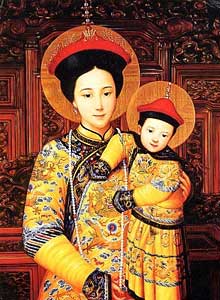 After talking with a Chinese-American seminarian at breakfast the other day, I realized that one aspect of the faith most Americans don’t hear enough about is Catholic Church in China’s struggle for autonomy. Although being in Rome has heightened my senses to this phenomenon, the fact is that China’s Communist government every day is suppressing millions of Catholics, and that the authentic Catholic Church in China continually fights for independence from the state-run ‘Church,’ backed by Beijing. Pope Benedict XVI has taken considerable steps this year in working on behalf of his oriental flock, most notably releasing a Letter to Chinese Catholics in May of 2007. In the letter, the pope speaks of his compassion for those Catholics suffering at the hands of the government, and assures them that their struggles do not go without notice. He also vows his pastoral care and imparts his fatherly wisdom to the suffering community:
I wish, therefore, to convey to all of you the expression of my fraternal closeness. With intense joy I acknowledge your faithfulness to Christ the Lord and to the Church, a faithfulness that you have manifested “sometimes at the price of grave sufferings,” since “it has been granted to you that for the sake of Christ you should not only believe in him but also suffer for his sake” (Phil 1:29). Nevertheless, some important aspects of the ecclesial life of your country give cause for concern. Without claiming to deal with every detail of the complex matters well known to you, I wish through this letter to offer some guidelines concerning the life of the Church and the task of evangelization in China, in order to help you discover what the Lord and Master, Jesus Christ, “the key, the centre and the purpose of the whole of human history” wants from you.
And what is it that Christ wants of his Church? Be it in China or elsewhere—America included—the mission of the Church “is to proclaim Christ to men and women, as the Savior of the world, basing herself—in carrying out her proper apostolate—on the power of God.” (Letter, 4) Specifically notable of the case of the Church in China is the issue of atheism, which no doubt permeates modern thought, society and culture, and is the fundamental obstacle of the Catholic Church (in my opinion) in the twenty-first century. This apostolate to preach Christ as Savior, relying “on the power of God,” speaks strongly of the effects of atheistic thought. The ‘power of God’ has been all but forgotten, and the power of governments and man has been assumed as the summum bonum toward which we ought to strive. In short, modern atheism (as I have written about before) is not so much an absence of the divine as most would believe, but rather an imposition of something finite and base into the realm of divinity. For Feuerbach, it was man’s absolute qualities; for Comte, it was ‘Humanity’; for Marxists and the Chinese government, it is the will of the state.
Struggling against the god of Communist ideology, the Church in China is in a perfect place to show the rest of the world just what it means to truly be Catholic. Not only is the Enemy utilizing the Beijing government itself to suppress authentic Catholicism, but also the officially sanctioned ‘Catholic Church’ of China, whose doctrines and clergy are both subjugated to the authority of the state. In addition, the authentic Church is battling the centuries-old mentality of the East, which has always been highly critical of all western influence, and in particular western religious and moral views. Catholic martyrs in China—particularly Jesuit and other religious missionaries—give evidence to the gravity of this situation. Nowadays, the martyrs are much less known, but without doubt there are still great amounts of blood being shed for the faith each day. As Tertullian writes, “the blood of martyrs is the seed of Christians,” and the fruit to be borne from such suffering and struggle will certainly show forth the glory and Providence of God, just as the blood of the old martyrs has given abundant life in the countries where they preached.
We ought not to lose focus on the goal of the Christian mission: to teach Jesus Christ as Savior of all men and women, and to rely in all things on the power of God. This charge of Pope Benedict is particularly relevant in today’s relativistic and consumeristic world, and no doubt will be the labor of the Church until Christ comes again to reclaim all things for himself.
"Greek Wisdom" in Service to Faith
Posted by Andrew Haines in Church Fathers, The Holy Father, Theology on 5.16.2008
At this week’s Wednesday Audience, Pope Benedict took the opportunity to talk about a “mysterious figure” in the history of Catholic thought, Pseudo-Dionysius. The real man-behind-the-name is a hotly contested topic in intellectual circles, but the pope sided with the opinion that Pseudo-Dionysius was in fact “a theologian of the sixth century, whose name is not really known, and who wrote under the name of Dionysius the Areopagite,” an early disciple of St. Paul. Pseudo-Dionysius, in addition to being the most often referenced thinker in St. Thomas Aquinas’ Summa Theologiae (a hefty feat in and of itself), is also author to some of the most fundamental works in early Catholic philosophic and theological thought: The Divine Names is probably his most notable work, and details the application of Neo-Platonic ‘emanation’ within the realm of early Trinitarian theology. It is precisely in this Hellenic conception of God for Pseudo-Dionysius that Pope Benedict XVI finds such great value. “If the author of these books,” he said, “chose five centuries afterward the pseudonym of Dionysius the Areopagite, it says that his intention was to put the wisdom of the Greeks into the service of the Gospel, and to aid in the encounter between Greek culture and understanding and the Christian message.” This certainly outlines Benedict’s entire theological approach—putting secular reason and science at the service of the Gospel—and serves as a basis for the development of such unification in the Church throughout the years. Undoubtedly, the confluence of the two schools of thought, both Greek and Christian, was not always seen as tenable. Tertullian, the prominent Latin writer of the second century after Christ, is credited with the ever-famous question, “What has Athens to do with Jerusalem?” That is to say, “What does reason have to do with faith?”
Fortunately for us, an articulate synthesis of the answer to such a question can be found almost two thousand years later in the work of our current Holy Father, and also in the work of his predecessor, Pope John Paul II. The late pope’s encyclical letter, Fides et Ratio, discusses this very topic in great detail and provides the core for most contemporary discussion of it within the Church. Pope Benedict’s synthesis on Wednesday of what it means to hold together the two tenets of theological faith and human reason was equally beautiful, yet a bit more constricted to the realm of Platonic philosophy and its relation to Jesus Christ. The Holy Father put the whole project in terms of “negative theology,” a classic means of keeping the tension between the absolutely sure and the absolutely unsure. “The face of God is our incapacity to really express who he is,” said the pope. “It is, so to say…a ‘negative theology.’ We can more easily say what God is not than express what he truly is. Only by way of these images [which we attain through our interaction with the world] can we gauge his true face; yet on the other hand his face is very concrete: he is Jesus Christ.”
Keeping the productive tension between faith and reason is precisely the task at hand for budding Catholic intellectuals. If we hope to provide a credible witness to our faith—one that is not simply ‘fideist’ (i.e. non-rational) nor completely intellectualist—we must always strive to maintain the interdependence of both faith and reason with one another. In the Letter of St. Peter, the author writes that the Christian should “always be ready to give an explanation to anyone who asks you for a reason for your hope.” (1 Pt 3:15) How this is! And how well is it manifested in the teaching and ministry of Pope Benedict XVI? Surely, we have as our earthly Vicar of Christ a great teacher and student of the Catholic Tradition, and it would do us well to pay attention to his insights and to stress in our own lives the truths he so beautifully articulates.
Pentecost and the Human Person
Posted by Andrew Haines in Book Reviews, The Holy Father, Theology on 4.29.2008
 In anticipation of the feast of Pentecost, which will soon be upon us, something struck me in my reading that I thought would make for a good reflection. In his book, Christ Our Joy: The Theological Vision of Pope Benedict XVI, Msgr. Joseph Murphy submits a profound understanding of the role of the Holy Spirit in the lives of the Catholic faithful and in the mission of the Church; I am inclined to believe he is onto something here:
Rarely as in our time have people become so dramatically aware of how inaccessible others ultimately are and of how difficult it is to give oneself to another or understand the other in an enduring way.
Pentecost, says Ratzinger, is the response to this situation. The Spirit sheds light on the fundamental human question, “How can we reach one another?” More specifically, how is it possible to remain oneself and yet leave the prison of one’s solitude to encounter the other from within? The answer lies neither in a dissolution of self, after the manner of some of the Asiatic religions, nor in simple activism. Furthermore, the “I” and the “you” cannot be reconciled with each other if the “I” is not reconciled with itself.
The Christian answer is to be found in the Trinity, which is the highest unity. In the Trinity, the oppositeness of the “I” and the “you” is not taken away; instead, a mutual compenetration takes place in the Holy Spirit. (Murphy, pp. 153-4)
Really, this claim on the part of the author—and ultimately the Holy Father—is nothing more than a further articulation of the Catholic belief that man was created in the “image and likeness” of God. In other words, we were specifically designed to be Trinitarian in our relationship with others and with God himself. Just as God communicates himself to himself in the relation of divine persons (e.g. the Father to the Son and vice versa) without losing anything of himself in the process, the human person is hard-wired to do the same; that is, to realize the depth of ‘self’ in the auto-communication of that self to another (by acts of love).
This idea stands in stark contrast to modern philosophy’s notion of self-understanding, which consists in either the “dissolution” mentioned by Murphy as evidenced in eastern religions and Nietzschian nihilism, or the “simple activism” of the scientific positivist, who sees God as nothing more than the totality of material reality. Certainly in the history of his theological and philosophical pursuits, Pope Benedict has considered both of these extremes and weighed them in the balance of authentic and discernable truth. In the end, as the terms suggest, both extremes prove too extreme. For one convicted by a faith in God, who is Triune, a new reality emerges: “The relation of each divine person itself becomes the nature of that person.” In simpler terms, the very and complete giving of self, which defines each person of the Holy Trinity, also defines the human person who images the Trinity in his or her mode of existing. We are created for no other reason than to give ourselves completely to the other. The title of Msgr. Murphy’s book identifies well the result of such a self-donation: “Christ Our Joy.” In fact, true and lasting joy—as Benedict’s continuing theological work suggests—can only come from a deep and abiding relationship with Jesus Christ, joined to God the Father in the Holy Spirit.
Enacting "Christ Our Hope"
Posted by Andrew Haines in The Holy Father on 4.21.2008
 As I was sitting in class this morning, I was thinking to myself, “I wonder if the pope gets jetlag…” Really, I wonder if he does? I bet the papal plane is no joke, and I’m pretty sure he doesn’t have the need to resort to earplugs and inflatable neck pillows to get a little in-flight sleep. However, even if it is the case that Pastor Unus provides a bit better trans-Atlantic service than the typical airline, I bet the Holy Father is still rather worn out from having done such an “awesome” job during his recent pilgrimage (to quote the ever debonair American wordsmith, George W. Bush). As the US recovers in its own way—by readjusting to the pre-papal un-hype of the daily grind—Benedict will certainly enjoy some time of convalescence in his Vatican apartment or, perhaps, at Castel Gandolfo. Either way, life is getting back to normal for us all…or is it?
Maybe the better question would be, “Or should it?” As much as it’s necessary to pick up where we left off before the Benedictine visit, appropriately entitled "Christ Our Hope," I think it would be an affront to the sincerity and wisdom of the Holy Father if we all just reassumed whatever we had been doing a week ago. In my last couple of posts I’ve written some about how truly wise and brilliant Pope Benedict XVI really is, and a little about how we should not only hear him out, but take up his cause and implement it in the world we live in. This isn’t meant to be a figurative or ‘fluffy’ lip service to the Supreme Pontiff; I really mean it! All of us, as Catholics, believe that we have a foundational vocation to holiness. Above all else, we are called to be holy. Part of hearing a vocation—be it to holiness, marriage, religious life, the priesthood, or coming to dinner on time—is listening. Perhaps this seems an overly facile concept, but it’s one that needs to be mentioned. If we all listened to the source of our vocation, we would never question what it is that we are called to do. However, the overwhelming degree of doubt, skepticism, mistrust and practical atheism that exudes forth from modern society gives evidence that we are not, in fact, doing enough to listen. Even among Catholics, these same problems persist in greater and greater measure. If we ought to listen, we have to know whom to listen to. If the source of our vocation to holiness comes from one who is Himself holy, then our attention needs to be focused upon that personal God, to whom the angels sing the unceasing and celestial Sanctus, Sanctus, Sanctus, which we are privileged to participate in at each Mass. Really, if we hope to be holy, our lives need to become the very enacting of that Sanctus acclamation. We need to render praise to God with our whole being.
Pope Benedict preaches nothing other than this call to holiness. He says nothing apart from the truth that we are called to, the truth of faith which is a truth higher than all others, and which leads to the ultimate Truth of Jesus Christ. If we desire to hear the vocem calling out our vocation, let us realize that the vox of the Holy Father is perfectly consonant with that of the Lord:
“You are a chosen race, a royal priesthood, a holy nation, a people he claims for his own, to proclaim his glorious works” (1 Pet 2:9). These words of the Apostle Peter do not simply remind us of the dignity, which is ours by God's grace; they also challenge us to an ever greater fidelity to the glorious inheritance which we have received in Christ (cf. Eph 1:18). They challenge us to examine our consciences, to purify our hearts, to renew our baptismal commitment to reject Satan and all his empty promises. They challenge us to be a people of joy, heralds of the unfailing hope (cf. Rom 5:5) born of faith in God's word, and trust in his promises.(cf. Homily from Mass at Yankee Stadium, 20 April, 2008)
I do not intend to simply acknowledge the pope’s goodness of character and move on. I do not hope only that people saw his apostolic journey to America as a good-will voyage. I do not encourage those who seek meaning in the Holy Father’s pilgrimage only in the ostentations and easily-critiqued ceremony, which naturally accompanies his office and influence. Rather, I believe we should be doing something about the Truth he proclaims and the radical call to holiness that he has never shied away from. If we simply go back to doing what we were doing a week ago, then we have failed to receive the true message of hope that Pope Benedict sought to provide us: the Gospel of Jesus Christ.
Benedict to Educators: "Who Are We?"
Posted by Andrew Haines in Education, The Holy Father on 4.18.2008
 In light of Pope Benedict’s recent words on the topic of Catholic education, I thought another post regarding the idea wouldn’t hurt. As I guessed (and as most others predicted, for that matter), the Holy Father’s encounter with the heads of Catholic educational institutions in the United States yesterday was not lacking in either candor or piquancy. His call for reflection in what it truly means to be a 'Catholic' university is, at least in my opinion, beautifully worded, and evidences quite well his intimate association with education, both as bishop and former professor. Below is a brief excerpt from the address:
This same dynamic of communal identity—to whom do I belong?—vivifies the ethos of our Catholic institutions. A university or school's Catholic identity is not simply a question of the number of Catholic students. It is a question of conviction - do we really believe that only in the mystery of the Word made flesh does the mystery of man truly become clear? (cf. Gaudium et Spes, 22) Are we ready to commit our entire self—intellect and will, mind and heart—to God? Do we accept the truth Christ reveals? Is the faith tangible in our universities and schools? Is it given fervent expression liturgically, sacramentally, through prayer, acts of charity, a concern for justice, and respect for God's creation? Only in this way do we really bear witness to the meaning of who we are and what we uphold.
From this perspective one can recognize that the contemporary “crisis of truth” is rooted in a “crisis of faith.” Only through faith can we freely give our assent to God's testimony and acknowledge him as the transcendent guarantor of the truth he reveals. Again, we see why fostering personal intimacy with Jesus Christ and communal witness to his loving truth is indispensable in Catholic institutions of learning. Yet we all know, and observe with concern, the difficulty or reluctance many people have today in entrusting themselves to God. It is a complex phenomenon and one which I ponder continually. While we have sought diligently to engage the intellect of our young, perhaps we have neglected the will. Subsequently we observe, with distress, the notion of freedom being distorted. Freedom is not an opting out. It is an opting in - a participation in Being itself. Hence authentic freedom can never be attained by turning away from God. Such a choice would ultimately disregard the very truth we need in order to understand ourselves. A particular responsibility therefore for each of you, and your colleagues, is to evoke among the young the desire for the act of faith, encouraging them to commit themselves to the ecclesial life that follows from this belief. It is here that freedom reaches the certainty of truth. In choosing to live by that truth, we embrace the fullness of the life of faith which is given to us in the Church.
Clearly, then, Catholic identity is not dependent upon statistics. Neither can it be equated simply with orthodoxy of course content. It demands and inspires much more: namely that each and every aspect of your learning communities reverberates within the ecclesial life of faith. Only in faith can truth become incarnate and reason truly human, capable of directing the will along the path of freedom (cf. Spe Salvi, 23). In this way our institutions make a vital contribution to the mission of the Church and truly serve society. They become places in which God's active presence in human affairs is recognized and in which every young person discovers the joy of entering into Christ's “being for others.” (cf. ibid., 28)
As I read this earlier, I remember thinking, “Wow, he is no dummy!” It really does amaze me how well he is able to synthesize and articulate such a vast issue as the “crisis of truth,” which encroaches not only upon America but also upon the entire developed world. Hopefully Benedict’s message sunk in with at least a few of those present; I honestly don’t see how it could be taken less-than-seriously by anyone. Nevertheless, we should continue to pray that his words come to bear fruit in the holy actions of those in positions of authority at Catholic institutions. If the Holy Father’s ideals were put into practice, people would undoubtedly be amazed by the increase of faith, hope, charity and intellectual precision that would burst forth from Catholic universities the world over.
Benedict XVI: The Disciple, The Teacher
Posted by Andrew Haines in The Holy Father on 4.16.2008
While other bloggers are milling over the pope’s current expedition to the States, someone has to keep the stream of consciousness flowing. Incidentally, that someone would be me. Nevertheless, I’ll succumb to some of the pressure, but in a different vein than is likely being presented elsewhere.
Being in Rome, Pope Benedict XVI is a pretty staple figure. Although I can certainly never get enough of him—I know that becoming ‘accustomed’ to his presence would be a very bad thing—I do feel that being here has given me a wonderful chance to grow more and more familiar with his large body of work. Our current Holy Father’s writings span a more-than-substantial portion of the theological gamut, and I believe it won’t be for years until anyone really has a true grasp on his overall sensus theologicus. However, with sustained and continual study (not to mention the occasional audience or Angelus meditation), Ratzinger’s theology is becoming for me a clearer and more profound topic of thought.
I once heard an in-the-know priest say—probably here at the College—that Benedict has become so comfortable in his ability to defend the Catholic faith that he is truly unafraid to face opponents on the intellectual battlefield. First of all, I can’t even imagine being so sure of defending my ideas that I wouldn’t at least be a little fearful of making some sort of mistake. Then again, that is precisely what separates me and the Holy Father…that and about sixty years of academic rigor. The fact is that Pope Benedict is not only a man of superior mental clarity, but more importantly a man of intense prayerfulness and admirable personal holiness; in the end, holiness along suffices in warranting fearlessness in the presence of adversaries. Unless a man is absolutely sure of Christ and the Truth he presents us, how can he be sure of anything?
Really, that question may be better asked in reverse: unless we are sure of something, how can we ultimately be sure of Christ, and of the Truth he is and presents? While the former query is useful in demonstrating why Benedict is able to be a man of conviction, this latter question is helpful in understanding how he goes about transmitting that certainty. Although it is all too easy to think of the papal office as a legislative, authoritarian one, a true exercise of papal influence is inevitably pastoral; after all, the Supreme Pontiff is rightly called the ‘Bishop of Rome’ and ‘Pastor of the Universal Church.’ Indeed, Pope Benedict XVI has thus far done an exemplary job of living out this vocation to shepherd Christ’s entire flock, and it is precisely by providing a surety about God that he has done it. His catecheses as pope have been filled with references to the Early Church Fathers, drawing upon the foundations of the faith and elucidating the intricacies of that same faith, which we still profess. His writings as Joseph Cardinal Ratzinger are rooted in a deep tradition of philosophical and theological firmness, always seeking the integrity of a human person in relationship with the ever-transcendent yet infinitely-knowable Triune God. He presents to us a certainty about the Catholic faith, present in a vast corpus of writings and addresses that is arguably unsurpassed in modern times.
While my fellow countrymen are gearing up for a few days of papal bliss, I’ll be continuing my studies of the Holy Father’s contribution to the theological world here in Europe. Hopefully his American appearance will inspire many more in the US to do likewise. Really, Pope Benedict’s message is theological in the deepest sense—in the sense of coming to know and understand who God really is, and in learning to love him with our whole heart, mind and soul.
The Quest for a "New Humanism"
Posted by Andrew Haines in Church Doctrine, Philosophy, The Holy Father, Theology on 4.15.2008
One idea that is very evident in my own personal study of philosophy and theology seems to be the question of ‘humanism’: what is it and why is it important? The exaltation of the human person, as pagan as it has often become, is nevertheless an integral part of Catholic thought, specifically insofar as Jesus Christ presents to us the perfection of human nature as manifested in a divine person. Moreover, in addition to my private interest in this question of humanism, it also appears to be one of the foundational points in the thought of Pope Benedict XVI, and certainly one of the most talked-about ideas in modern Catholic academia; writers like Luigi Giussani and Henri De Lubac do wonders in presenting the challenge as one both of importance and feasible consideration. But how imminent is the need to reflect upon such an issue that oftentimes seems forever aloof and ultimately unattainable? The Holy Father tells us precisely that: in a recent letter to Cardinal Renato Martino, Benedict writes that it is “ever more vital…to promote a ‘new humanism.’” The pope here is speaking with principal regard to the place of peace and justice in the modern world. He identifies that, as part of a true exaltation of human dignity and worth, technological and scientific advance cannot be the sole benchmarks by which we measure success. “[H]uman development,” he says, “cannot be reduced to simple economic growth, it must include the moral and spiritual dimension. A truly integral humanism must, at the same time, also express solidarity.” In contrast to the ever-popular notion that success demands efficiency, the Holy Father seems to side more with Blessed Mother Teresa’s famous axiom, that God does not require success, but fidelity. Certainly, fidelity to God in understanding the value of the individual human life far supercedes any economic or technological progress that discounts the individual for the sake of the whole. This latter model is not Christian, since it is not concerned with salvation but efficiency.
“True and lasting peace is unimaginable without the development of each person and of all peoples,” writes Benedict. “Nor is it conceivable to think of reducing arms if first we do not eliminate violence at its roots, if man does not first turn decisively to searching for peace and for what is good and just,” namely the meaning of human life. Like all things Catholic, the answer to the question is bigger than the question itself; realizing how to promote true justice and peace is something only captured in the fullness of the Catholic Tradition, and in a deep-seated love for Christ in the sacraments and in the people of God. The Holy Father agrees, that “it will be difficult to find a solution to the various technical problems [of national security and disarmament] without man’s conversion to good on a cultural, moral and spiritual level.” We must not be primarily concerned with security, but rather with our vulnerability before the Almighty God. In recognizing our weakness as human beings—in need of salvation through Christ—the prospectus of viable solutions to more tangible problems becomes clearer and ever more achievable.
This is precisely the import of the ‘new humanism’ called for by Catholic intellectuals the world over. “The future of humanity depends upon a commitment on everyone's part,” concludes Benedict. “Only by pursuing an integral and solidary humanism…can humanity progress toward the true and lasting peace for which it longs.”
[cf. Vatican Information Services article for a full report on the pope's letter to Cardinal Martino.]
A Pontifical Farewell
Posted by Andrew Haines in News, The Holy Father on 4.13.2008
In typical NAC fashion, "anything worth doing is worth over-doing." Thus, an improvised procession with American and Vatican flags down the Janiculum Hill to St. Peter's Square for today's papal audience wasn't really too far-fetched. At least the pope noticed!
In just a couple of days, the Holy Father will set out upon his long-awaited visit to the United States of America. While no one is really and precisely sure what the Holy Father will choose to talk about during his American sojourn—not even Archibishop Pietro Sambi, the Apostolic Nuncio to the US—there’s certainly no doubting that Benedict will use this visit as a platform to boldly challenge Catholics and non-Catholics alike. While some reporters have been sticking with the traditional themes of “peace,” “justice” and “healing,” other have proposed that in fact the Pontiff will submit an entirely new teaching during the course of his time abroad. Obviously, the balance is somewhere in the middle; presenting the truth always requires an equilibrium between sticking with what people already know and pushing them to consider that reality in a new light, from a new angle. If I had to make a guess at what the pope will be focusing on, that would be it. As for the more specific addresses he is scheduled to deliver, a few rank right at the top in terms of significance. Certainly, the Mass homilies in both New York and Washington will provide the cornerstones of the entire visit, since he’ll have his biggest crowds by far at these two events. The address to the United Nations will probably come in at a close second as far as notability goes, and will likely focus on humanitarian efforts, as well as the ever-debated war in Iraq, which has thus far claimed the lives of a number of Catholic clerics and countless Catholic faithful; this is a matter very close to Benedict’s heart. Nevertheless, the speech I am most interested to hear—and which I think will subsequently provide the most ‘entertainment,’ for lack of a better word—is the Holy Father’s scheduled address to the presidents of the two-hundred-and-some Catholic universities in the United States. Speaking to the assembly in Washington D.C., I think the pope’s background as a professor and his deep appreciation for learning and holiness will spark an instigating speech, and probably fuel a heated and ongoing dialogue amidst Catholic intellectuals for some time. That’s just me though…we’ll see.
In the end, the same thing always happens: the pope comes, people get excited—the pope leaves and the excitement wanes. Ultimately, the lasting effect of a papal visit comes from those who take his words and actions seriously, both Catholics and non-Catholics alike, and who work toward the goals that he presents. Pope Benedict is clearly a man of great personal holiness and incredible wisdom and charity. I believe that only good can come out of this trip, and the task will be for us to recognize that good and run with it. The world is most notably broken in these days, and now is a wonderful chance for us to pick up a few of the pieces and start building up the City of God.


