Showing posts with label Art. Show all posts
Duruflé's Messe "Cum jubilo"
One of the most interesting things I've been a part of in recent months (or really ever, for that matter) has finally come to fruition. No, not my M.A. But it's almost as good!
Altogether, the CD is an entire Mass (sung the way it ought to be!) comprised of both Gregorian chant (Introit, Alleluia, etc.) and Duruflé's compositions of the Kyrie, Gloria, Sanctus/Benedictus and Agnus Dei. It even includes all the prayers, propers and readings from the Mass of the Immaculate Conception—the College's patronal feast.
What's more, there's a great deal of organ improvisation as well, done by one of the most influential and noted organists in the world today: Stephen Tharp. From the bells on the first track to the organ sortie on the final, this recording is something worth checking out. Even the CD booklet has some cool pictures, and some interesting (and meditative) shots of the NAC that some might enjoy. (The cover photo, above, is the mosaic in the apse of the Immaculate Conception chapel at NAC.) Plus, you'll get to hear me sing—and you'll be supporting a good cause.
So visit JAV and pick up a copy. And play it for your kids. They will like it too! [And if they don't, you can teach them!]
'Understanding' Beautiful Art?
Posted by Andrew Haines in Art, Philosophy on 12.19.2008
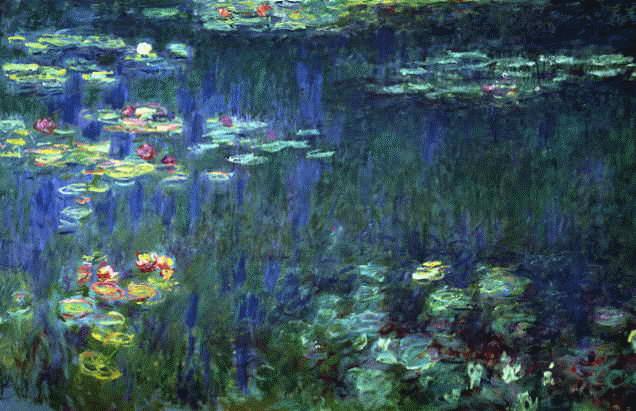
I was at the National Gallery of Art last weekend, strolling amongst the paintings before getting off to another engagement that evening. It was relaxing, to say the least. There is something about art that is calming—at least (I think) good art. Even the most provocative of scenes, if portrayed well by their depicters, seem to induce an effect of tranquility of mind. For example, Monet's delicate flowers offer a similar consolation as El Greco's rendition of La Agonía en el Jardín.
Any discussion of art is bound (although I think unfortunately) to fall into some sort of cliché. So much has been written and said about art and its relation to man's journey through life that it's difficult to say something new—at least something categorically new. One can only, to use a related metaphor, paint with wide brush strokes for so long before everything that can be said has already been put forward. For that matter, analyzing art on the grand scale is itself an art not easily practiced.
But real progress can happen more easily, I think, when we look at art on the micro-scale; i.e. as individual paintings, schools, etc. (Even speaking of 'modern art' versus 'classical art' versus 'oriental art' is a bit too broad for drawing clear distinctions.) In the end, it's the artist himself who paints the picture, not the milieu in which he lives. It is the artist himself that conveys meaning, even if it is a meaning engendered by the culture he is raised in. To find consolation in art means to find consolation in the expressions of the singular artist, not in art as a whole.
I was thinking of all this as I was at the gallery last weekend, and in reflection it seems to make sense. I had to laugh as I watched the freelance art aficionados perusing the rooms, examining closely the paintings, and then retiring to the benches to chat with one another (in fancy parlance) about such and such an artist and such and such a contribution. I wondered where the authentic solace was in this sort of endeavor—whether or not they found it in the art they looked at or in the words they were able freely to associate with it. I guess I've always been a skeptic about people who like to talk so much about fine things that they themselves eclipse beauty with wordiness and esotericism. What of just seeing and acknowledging? Isn't this a more authentic understanding of what it means that something is 'beautiful' or 'lovely'?
Perhaps I'm guilty of just the sort of thing I'm trying to explain. Maybe it would be better just to look at a nice picture and realize how beautiful it is, in se—in virtue of its created nature and the reflection it affords of the Artist.

Maritain: Art & Creativity
Posted by Andrew Haines in Art, Book Reviews, Philosophy on 11.29.2008

The first chapter is a review of various forms of art—Oriental, Chinese, Greek and Western—comparing and contrasting them for their commitment to and portrayal of both "Things" and the "Self." Maritain's primary argument here seems to be that Eastern art, be it Muslim geometry, Buddhist mythology or Chinese iconography, all intends to portray the 'thing-in-itself' and speaks little of the 'self,' who creates the artwork. He contrasts this with ancient Hellenic art, wherein the human form becomes the object of beauty, but remains just that—a Thing—and not an actual extension of the artist-self. Finally, he attempts to show Christian art as the beginning of a form of self-expression that does more than simply focus on beauty in things; rather, it begins to show the beauty of the creator and the ideas which are put into a work of art from the subject end.
Here, I agree very much with Maritain. His representation and analysis of art from East to West seems quite correct, especially with regard to the religious incorporation involved in each form.
Maritain's final section of the chapter is devoted to modern and future art. Here, he makes a few claims which I'm not so sure I understand—at least not in the way he intends. "We are in the presence of an exceptionally great epoch," he says, "[which] comes from the fact that on the one hand never was painting so purely painting, and on the other hand never in painting was such poignant humanity united with such powerful penetration of visible things, through the simultaneous manifestation of the painter's creative Self and of the occult meanings grasped by him in reality." (28) Although he presents his case in eloquent fashion, I think his fundamental ideas are nonetheless up for debate—primarily the notion that modern art represents "pure" art, and that in this 'purity' arises the ultimate expression of self-manifesting creativity. Certainly, modern and contemporary art is unique, and it does speak from and toward a different level of self-involvement. There is something beautiful about abstraction and impression that is not found in realistic or iconic portrayals of reality; an involvement of Self, as Maritain would put it. But as for modern art indicating a true level of progress in the world of art, I think, is something altogether different.
I'll have to read more of the book before coming to a conclusion on this. But nevertheless Maritain does a brilliant thing in Creative Intuition in Art and Poetry, which delves into the problems of art and beauty with a penetrating and fruitful focus.


