Showing posts with label Saints. Show all posts
Edith Stein: A New Look at Catholic Philosophy
Posted by Andrew Haines in Philosophy, Saints, Theology on 10.30.2009

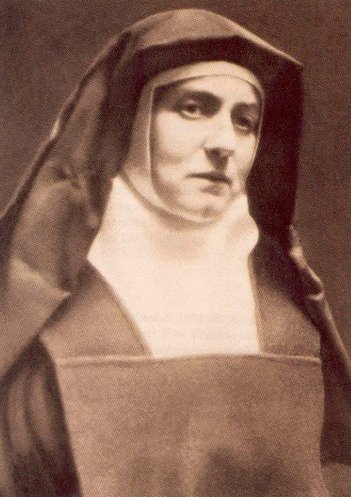 Nevertheless, though, her philosophical rigor was tempered very much by an appreciation of revealed truths as equally-given in the first moments of one's experience of reality. In other words, Stein--very much like Aquinas, in his own sort of Neoplatonism--considers the Trinity as co-given alongside the impressions of "being" that arise from an Aristotelian investigation of the world. For both Stein and Thomas, the Logos (reason, understanding) is not something deduced from real-world experiences; but rather, it is something within the context of which all real-world experiences abide. As such, God-as-Logos (i.e. the Word, or the Second Person) is a co-given reality, without which an authentic understanding of the world (and of metaphysics) is simply not possible.
Blast From the (Medieval) Past
Posted by Andrew Haines in Church Fathers, Saints, Theology on 12.08.2008
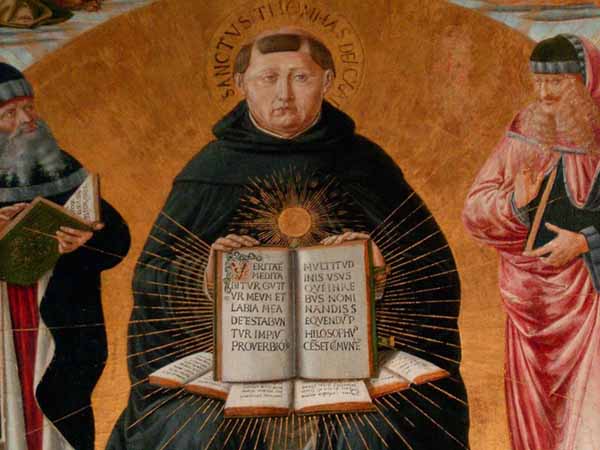
According to some, Thomas Aquinas is making a comeback. And I would tend to agree.
Now, call me biased—sure I might have written a few (dozen) essays on the guy. But I'm definitely not the only one enthralled with St. Thomas Aquinas nowadays. In fact, in the words of Archbishop Jean Louis Bruguès, secretary of the Congregation for Catholic Education, the 13th century Thomas' "theory of virtue will stimulate a renewal of moral theology." And that's no vain claim; I believe it.
As a student of philosophy (and dabbler in theology) Aquinas is one of the big hitters, hands down. While the Church has no official philosophical position, perhaps the closest we'll ever come is that of Thomas. His prolific writing is unsurpassed in the philosophical/theological world even today, and the scope of his focus amazes even the most reborn Renaissance men. Moreover, his endeavors into the world of theology (and particularly moral theology) have proven remarkable. The Thomistic 'natural law' theory was revolutionary at its inception, and still holds water 800 years later. But perhaps what's most interesting about the Angelic Doctor's reputation: he can take a lickin' and keep on tickin'.
"Moral theology based on St. Thomas Aquinas is among one of theology's most popular branches today, says [Archbishop Bruguès], but this popularity has come about only after decades of disdain." (Zenit) Indeed, after a long run in seminaries and theological faculties the world over, Thomas suffered a fall from popular grace, culminating in the hectic 1960s. Certainly, Aquinas' dogmatic stances on reality in relation to the faith were not welcomed in the ever secularizing academic environment of the neo-Enlightenment. But the reinvigoration of moral theology in the later part of the 20th century provided a window of return for the neglected Doctor. "[B]y the beginning of the 80s, many issues referring to ecology and the development of medical techniques began to be at the center of attention of bioethics." This ethically-charged atmosphere proved a capital opportunity for Thomas' reintroduction into academia. "Moral theology was becoming the most appreciated subject, the only branch of theology that was really taken into account in a secularized society."
Now, its tempting to think that Thomas Aquinas is more popular than ever. Sure, he's just as unpopular as ever with those who disagree with him, but for those looking toward the classical foundations of ethics (especially for the sake of bioethics and like fields), there is nothing quite like the clear thought of this medieval monk (who, incidentally, is famous for having had six scribes writing simultaneously on six different treatises!) Of course we've all heard of Thomas, but how many of us have actually read him? This might be a good chance to jump on the orthodoxy bandwagon, run to your nearest Amazon.com and pick up a copy of the Summa Theologiae. (Or, if you prefer, you can just read it online. Latin anyone?)
'Cosmic Patriots' for Christ
Posted by Andrew Haines in Book Reviews, Saints, Theology on 11.15.2008
There is something funny about trying to be pertinent to today's world. On the one hand, you have the news: chock full of sad stories, cynicism, despair and harsh, cold 'reality.' On the other hand, you have fluff (or at least what the world and most people consider fluff): optimism, talk about how good life really is under all the harshness, etc. Neither is really appealing—at least to me. Sometimes I like to hear about the news, but a little goes a long way. Sometimes I need a pick-me-up, and a nice story with a good ending makes me feel better. But again, less is more as far as that goes.
What do people really want? False pessimism is bad; false optimism is perhaps even worse. Is it really possible to fall somewhere in between? Even more importantly, what are we called to see, as Christians, in a world that is at times unbearable and at times all too enticing?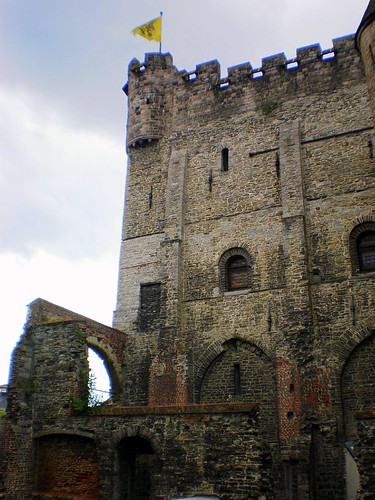
My acceptance of the universe is not optimism, it is more like patriotism. It is a matter of primary loyalty. The world is not a lodging-house at Brighton, which we are to leave because it is miserable. It is the fortress of our family, with the flag flying on the turret, and the more miserable it is the less we should leave it. The point is not that this world is too sad to love or too glad not to love; the point is that when you do love a thing, its gladness is a reason for loving it, and its sadness a reason for loving it more. All optimistic thoughts about England and all pessimistic thoughts about her are alike reasons for the English patriot. Similarly, optimism and pessimism are alike arguments for the cosmic patriot.
That final term—"cosmic patriotism"—is certainly a Chesterton special. In his typical way, he captures all the facets of a very multifaceted reality in a single, poignant phrase. We all know what a patriot is (or at least what one used to be, when the word meant something a little stronger). I assume that "cosmic" is an equally familiar term, although again one with a little baggage in contemporary society. When put together, though, Chesterton's "cosmic patriotism" makes perfect sense; it resonates in the heart of modern man. We must be devoted citizens and lovers of the universe we live in. The more miserable it is, as he says, the less we should want to leave it.
Chesterton had a keen eye for what made certain things resplendent with Christian beauty. Certainly, the cosmos is one of those things: ordered by the Logos and permeated by the logoi spermatikoi, it is the handiwork of God and the manifestation of his glory. Saint Irenaeus added to St. Justin Martyr's thought with the wise insight that Gloria Dei vivens homo ("The glory of God is a living man"). What is often forgotten of Irenaeus' statement, however, is the second part of the sentence: gloria autem hominis visio Dei ("The glory of man is the vision of God"). It is this vision of God in his creative majesty that Chesterton speaks to. It is to the divinely made universe, of which we are all beloved citizens, to which we are in turn called to be patriots. No matter how bad it sometimes seems, and no matter how enticing it can sometimes be, it is nothing other than God's love made known to us. "It is the fortress of our family, with the flag flying on the turret, and the more miserable it is the less we should leave it."
Augustine: The Scholar of 'Evil'
Posted by Andrew Haines in Church Fathers, Feasts, Saints, Theology on 8.28.2008

Much of Augustine's writing is characterized—by most scholars—as being rigoristic or highly delineated. In other words, his thought is starkly incongruent with most of today's relativistic positions, and is conversely quite well articulated, even to the point of being somewhat doctrinal. Of course, this isn't a critique of the great thinker (of whom I'm quite fond), but rather a realistic forward to his work, and perhaps a brief explanation of why modern personalities often find him somewhat difficult to read. Saint Augustine's most popular work, Confessions, is but one of nearly countless articles and books penned by the fifth-century scholar. City of God and De Trinitate, as well as De Doctrina Christiana and his range of letters against various heretics, mark his other more notable works.
It would be hard to single out just one or two points which Augustine contributed, above all else, to the situation of Catholic theology in the early Middle Ages. Nonetheless, his consideration of the nature of "evil" would be ranked high on anyone's list. The quick summarization of his view: "Evil is the privation of a due good." It is not a substance in itself, but is rather the lack of substance where one should be able to find it. In other words, it is non-being where being ought to be.
Such a simple doctrine as this revolutionized the world in which Augustine lived. Because of his roots as a Manichaen—a belief system which professed that evil and good battle in the cosmos, each force being equal to the other in power and existence—the theologian was well aware that such a unique view on 'good and evil' was indeed revolutionary. Nevertheless, because of his faith and astute understanding of reality, he was able to deduce that evil could not 'exist' in the same way as anything else. Reality is logical; evil is illogical. It occurs when people do things that are contrary to goodness, the ultimate aim of mankind and the ultimate expression of logicality and order. If goodness and good things are rationally desirable, then anything to the contrary is thus irrational and thereby non-existent (in the strict metaphysical sense of the word). This perception of evil as non-being was a radical departure from Manichean thought, as well as from Eastern world views, and marked the beginning of a new form of thought in Western philosophy and theology. Augustine made great progress in our understanding of God, and our perception of his activity in the universe.
For this reason, I would submit that St. Augustine is perhaps one of the greatest sources for the pro-life cause. Despite the clear controversy of late, involving misinterpretations of his doctrine and extrapolations of his thought processes, Augustine himself would nevertheless admit that the deprivation of life where life exists is the greatest form of evil: death. Conversely, to foster and pursue goodness where it exists is precisely the aim of man, and the reason for which he was created. Ultimately, this is made manifest in the beatific vision.
The Augustinian bottom-line is this: God is good, and goodness is made temporally present in the dynamism of created things and, above all, in a human life. Anything promoting the contrary is evil. And I would challenge any politician to represent that view as constitutive of their platform.
Saint Justin Martyr on the Trinity
Posted by Andrew Haines in Church Doctrine, Saints, Theology on 4.07.2008
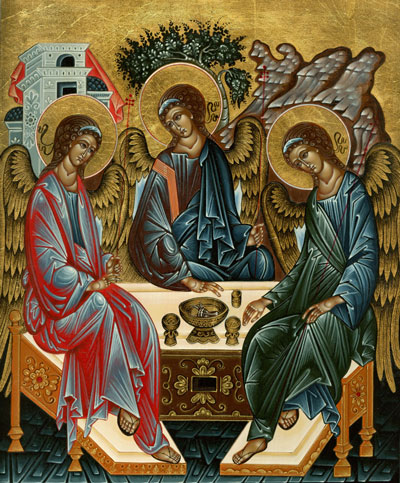
I think St. Justin’s analogy draws its force from our primal fascination with fire, the same fascination that wound up granting fire a key place in the high celebrations of the Catholic liturgical life (i.e. the Easter Vigil, baptisms, and at every Mass in the candles on the altar and in the procession). We obviously see fire as something bordering on the transcendent: it destroys yet brings life; it is a glimpse of the redemptive suffering of Christ on the Cross. There is just something mesmerizing about fire and about light. Even Jesus says that he is the Light, and that he has come to set the earth on fire. How fitting then that Justin uses this foundational element of human existence in expressing the mystery of Trinitarian existence.
In Justin’s analogy, just as one can light a second flame from a first, so too the Son is begotten of the Father. The Son’s existence, like the second flame, does not diminish the brilliance of the first Flame; both shine just as brightly as the other. Similarly, the Holy Spirit is a third flame, formed form the first two and shining just as brightly. While we can distinguish between the ‘flames’ proper—that is between their function as individual tongues of fire—we cannot distinguish between their substantial composition: they are all three fire. This relationship of ‘consubstantiality’ between the three flames is directly related to the consubstantial relationship of Father, Son and Holy Spirit; we can distinguish their function as Persons, but never their substance, since they share in one substance and are therefore one God.
Saint Justin Martyr, an early Father of the Church, was steeped in the tradition of Greek philosophy, so using earthly elements to convey transcendental truth was not uncommon. What amazes me about his analogy is the beautiful clarity with which we see a reflection of the divine in the spatio-temporal world. Although we cannot capture the mystery of God in words or even in thought or analogy, we must inevitably see the image of the Trinity in our daily experience, just as a reflection is seen in a mirror. If we capture the reflection, we have destroyed its nature, for then it is no longer a reflection of a higher reality but an independently existing one that is tangible and ‘real.’ The same is true of our perception of the Trinity in the world; if we were to capture it completely with our minds, it would no longer be a mystery, which is essential to its nature as the transcendent and divine being. Justin saw this clearly, and he expressed it beautifully. Hopefully his brilliant reflections and humble submission to the almighty power of God—Father, Son and Holy Spirit, consubstantial with one another yet distinct in their personhood—will inspire us to further submit our own intellects and wills to so great and majestic a Deity as the Holy Trinity.
Sanguis Martyrum Semen Christianorum

I don't want to jump the gun here, but this is precisely the kind of situation from which martyrs arise. In times of persecution, when the faith is subjected to the whims of state and politics, courageous men and woman submit their lives most fully to the God whom they love. In this case, Archbishop Raho must have known that what he was doing by publicly celebrating Masses and other liturgies, especially in a hostile environment, would draw lots of attention; most of it initially turned out to be bad attention. However, now that he has died at the hands of a terrorist organization (in one way or another), that attention is bound to become much more profound, and even perhaps a cause for conversion.
As I recently quoted in a previous post, the early Latin writer, Tertullian, is attributed the saying that "the blood of martyrs is the seed of the Christian faith," and I cannot think of a better modern-day example than this. Although we are often led to believe that the Church prospers most easily when everyone feels fuzzy toward everyone else, the fact of the matter is that for 2,000 years conflict and strife has provided the continuing life of the Catholic Church. While our aim must be peace, since that is what we believe God desires most fully for us both here and in heaven, we must also take note that the Paschal Mystery of Jesus Christ is laden with the depths of suffering and the most excruciating agony imaginable. Our redemption came forth from the pierced side of Christ on the Cross, in his Precious Blood and in his Body, scourged and crucified for our sake. If we are followers of Christ then we also must die with Christ, and I'm inclined to believe that Archbishop Raho did precisely that. Only time will tell the details of his death, but for now we ought to pray for him and for his local church, that they see the great honor with which the Lord has graced them: the death of his faithful one.
What is 'Sanctity?'
I suppose even the most basic of things are not free from being misunderstood, and quite profoundly at that. I was reading an article the other day about a TV hostess who professed her own opinion that there are no more saints because of modern medicine. Her view: saints were psychotic people that heard voices and saw things that nowadays we don’t suffer from because of an increase in psychological and medicinal treatments. Ya… it’s kinda’ unorthodox…
But, she does bring up a good point. As much as I’d like to simply say that she’s wrong—which I am—I am also inclined to admit that there are probably many, many people who have the same opinion as her. Even if they don’t say that it’s a psychological disorder gone awry, I’d guess that many people think sanctity is truly something unattainable in today’s world, and completely anachronistic. What’s more, I think that, when faced with actual sanctity—with real holiness—most people wouldn’t know what to make of it. Our minds are wired for words, like “good,” “fair,” “caring,” and (the icing on the cake) “non-judgmental”; we live in a world that lauds the trite and clichéd. After all, we should ask, what is truly admirable about these things if they don’t lead to holiness?
I think that the crux of much of this misunderstanding was also articulated well by the same hostess, when she disavowed even the sanctity of Blessed Mother Teresa of Calcutta. Her reason: recent revelation that Mother experienced doubts in her faith during the last years of her life ‘prove’ that she really didn’t believe in God and thus, that her ‘sanctity’ was really just something human, something humanitarian, something unconnected to the divine.
Communio Sanctorum
Posted by Anonymous in Church Doctrine, Saints, Theology on 12.15.2007

1.Communio in fide (Communion in faith)
As the early Church in Jerusalem "... devoted themselves to the apostles' teaching..." (Acts 2:42) so too does the Church today posses the same faith which every member shares in commune with the other. It is this treasure of faith that enlightens our life and gives us a common direction and end, namely God.
2. Sacramentorum communio (Communion of the Sacraments)
"All the sacraments are sacred links uniting the faithful with one another and binding them to Jesus Christ, and above all Baptism, the gate by which we enter into the Church. " (CCC, 950) It is through the Sacraments that we share a common life and Spirit, the Holy Spirit who gives us instant communication with all the Saints, known and unknown; past, present and future. I don't care what kind of cell phone you have, none of them are this reliable, transcend time or are so useful in a bind!
3. Charistmatum communio (Communion of charisms)
"Within the communion of the Church, the Holy Spirit "distributes special graces among the faithful of every rank for the building up of the Church. Now, "to each is given the manifestation of the Spirit for the common good." (951) Only in the Church do we find an institution that rejoices in the gifts of others. There is absolutely no room for jealousy or bitterness at the good of another because in the Church, someone elses good is your good. We are all on the same team and make up the one body of Christ. Is their a gift you haven't been given but need for the fulfillment of a task? Ask a Saint or pray for it to God. They are available 24/7...
4. Erant illis omnia communia (They had all things in common)
"Everything the true Christian has is to be regarded as a good possessed in common with everyone else. All Christians should be ready and eager to come to the help of the needy . . . and of their neighbors in want." A Christian is a steward of the Lord's goods." (CCC, 952) Simply put, if we are a faithful Catholic, then our life is no longer our own but it is hidden with Christ in God. If we belong to Christ's body, the Church, that means we only belong to it in relation to everyone else in it. So if there is someone in the Church that is in need then we must give them any and all assistance that we can. We don't have the right to extras when members of our family, the Church, have not even what they need. "What you did to the least of these, you did unto me." (Mt 25:40)
5. Communio caritatis (Communion of Charity)
"'None of us lives to himself, and none of us dies to himself.' 'If one member suffers, all suffer together; if one member is honored, all rejoice together. Now you are the body of Christ and individually members of it.' 'Charity does not insist on its own way.' In this solidarity with all men, living or dead, which is founded on the communion of saints, the least of our acts done in charity redounds to the profit of all. Every sin harms this communion." (CCC, 953)
If we understand the above five elements of the communio santorum, then we will realize that the relationships we have with the Saints is much deeper then only asking for help when we need it. Rather, the Saints become our friends. We can speak with them and ask for their prayers and be assured of their love for us. Truly the Church is the family of God with Christ being the head. We only share in these holy things with holy persons (Saints) because Christ is the source of all holiness and goodness. Thank God we have this inexhaustible treasure of gifts that will never fail us.
Credo in sanctorum communio!
Chapter 43: On Those Who Come Late to the Work of God
Posted by Anonymous in Biblical Commentary, Saints on 12.09.2007

(- Rule of Saint Benedict, Chap. 43)
Everyone experiences virtually endless duties and tasks to complete during the day, to say nothing of the preoccupations that most endure with regards to putting food on the table, providing a holy environment for their children that they may flourish, living in freedom, peace, etc... These are the most practical and seemingly important things in our life. However, in the noise of our changing world it is always too easy to forget the one thing necessary. "But the Lord answered her, 'Martha, Martha, you are anxious and troubled about many things; one thing is necessary.'" (Lk 10:41-42) Martha certainly was preoccupied with the things of her day that were important to get done but Mary had chosen the better and necessary part, sitting at the feet of Christ. We as followers of the Lord must let the words of St. Benedict resound in our hearts, "Let nothing, therefore, be put before the work of God."
Contemplating the face of Christ - "Have I been with you so long, and yet you don't know me, Philip? He who has seen me has seen the Father." (Jn 14:9) - is an essential dimension to the life of every Christian, for in gazing upon His face we see the Father. Jesus truly is the human face of God and the Divine face of man.
It is only too easy for all of us to push to the side our prayer time with God. We always seem to have something more pressing at hand. However, if we fail to pray, then all our actions will be empty indeed, for only in the light of the Triune God, Father, Son and Holy Spirit, do our actions become filled with life and meaning.
May we pray for the grace necessary to put God first and be not only listeners but also hearers of the Word, who says: "But seek first his kingdom and his righteousness, and all these things shall be yours as well." (Mt 6:33)
Showing the Umbras of St. Peter
Posted by Andrew Haines in Saints, Seminary Life on 11.18.2007
If I could spend a few hours per day just walking around St. Peter's Basilica and showing people the visible signs of the Catholic faith, I would be the happiest person in the world. Unfortunately, I have class. But fortunately, I can spend some time on the weekends, like today, doing some 'improv' tour-guiding. Today was a great example of what amazing fruit the Lord sometimes issues forth on such occasions...
On our way 'sneaking' out of the Clementine Chapel, we picked up a few (like nine) more Americans and all headed up to the main basilica for a walk around and, again, a little 'side trip' to some not-so-seen but amazing places to pray. (In Italy, it's all about who you know and how you ask... luckily the guards were feeling nice today!) Again, just allowing people to see and pray at some of the sites in St. Peter's was enough to instill tears in even the most seemingly skeptical of eyes. In short, it was incredible.
I am convinced that this is precisely the reason we are here, as seminarians, to study; not only do we learn theology, but the history of the Church and the saints, and also the very lives of the saints when we visit their tombs and show others the glory of their holiness. I hope that the Lord continues to sustain my fervor with opportunities like this. It really is a blessing to have the chance to be humbled so much by the greatness of God, who surpasses us all to an infinite degree!
The Difference Between Saints & Sinners
Posted by Andrew Haines in Biblical Commentary, Feasts, Saints on 11.03.2007

It’s a scary thing to admit, but according to the Catholic faith we are all called to be saints; I know I’ve mentioned this before, perhaps quite often, but it’s been a reoccurring thought in my mind and one I think is worth posting. When you say it out loud—“I am called to be a saint”—and think about it seriously, it almost sounds silly. We all know our sins and weaknesses, particularly those sins that are glaring and seem insurmountable, which we think are directly hindering our growth in holiness. The fact is that… well, we are right: by ourselves we are hopelessly drowning in our sinfulness.
However, like anything Catholic, there is another side.
A good priest once told me that I should “learn to fall in love” with my sins, since it would be through them that God chooses to save me. It’s quite a bold statement, but after I thought about it a little, it really made sense. If there were no sin in my life—particularly if there were no sins that made me cringe every time I thought of them—would I ever find it necessary to approach the Lord? If I were perfectly behaved and well disposed, what need would I have for God? This is not to say that we should intentionally sin, or even concede to it at all; it simply means that we should acknowledge our failings as an opportunity to encounter Jesus and experience his vast mercy. The Gospel reading from Mass on the 30th Sunday in Ordinary Time (celebrated this year on October 28th) speaks beautifully on this topic. Jesus tells the parable:
“Two people went up to the temple area to pray; one was a Pharisee and the other was a tax collector.
The Pharisee took up his position and spoke this prayer to himself,
‘O God, I thank you that I am not like the rest of humanity—greedy, dishonest, adulterous—or even like this tax collector.
I fast twice a week, and I pay tithes on my whole income.’
But the tax collector stood off at a distance and would not even raise his eyes to heaven but beat his breast and prayed,
‘O God, be merciful to me a sinner.’
I tell you, the latter went home justified, not the former.”
Clearly the Pharisee, who supposed his own holiness (and perhaps was a very good man), was totally uninterested in God; it even says that he “spoke [his] prayer to himself.” On the other hand, the tax collector—probably a dishonest and sly man—admitted his guilt and simply begged to God for his mercy; he “would not even raise his eyes to heaven.” The tax collector went away justified. The tax collector “fell in love” with his sin because he realized it was there that the Father would encounter him and make him worthy of heaven. This man wanted to be a saint—and what’s more, he knew that he could be if he only let the Lord transform him.
The Glorious Company of Martyrs
Posted by Andrew Haines in Feasts, Saints, The Holy Father on 11.01.2007
In the Catholic tradition, much value is placed on the lives of the martyrs. We all hear stories about the martyrs—specifically in recent days about the 498 martyrs of the Spanish Civil War beatified last Sunday in the Vatican—but what does it mean to be a martyr? Etymologically, the word in Greek, «martyros», means “a witness.” Obviously, this is quite a broad definition and the way modern language uses the word is usually much more specific; however, this basic significance is the root of all other uses of the word.
The pope went on to describe the life of faith as “a peaceful battle of love that every Christian, like St. Paul, must wage tirelessly. It is the race to spread the Gospel to which we are committed even unto death.” To me, this seems like a claim with a very counter-cultural and counter-intuitive message. At first it seems a bit passive—a “peaceful battle” doesn’t exactly incite much zeal by itself. However, a peaceful “battle of love” provokes a much different response; it elicits the necessity for self-emptying and self-giving, “even unto death.” It is not too much to say that, as Catholics, we should be willing to empty ourselves even of our own blood, if the Lord so desires. This ‘witness’ to others of the veracity of the Church’s faith perfectly brings about a vision of Christ as the divine Savior, who has overcome death itself. It has long been taught that the “blood of the martyrs is the seed of faith.” This is the “universal vocation to holiness” to which we are all called and this, I think, quite effectively sums up what it means to be a martyr.
A Bit About the 'Greg'
Posted by Andrew Haines in Saints, Seminary Life on 10.22.2007
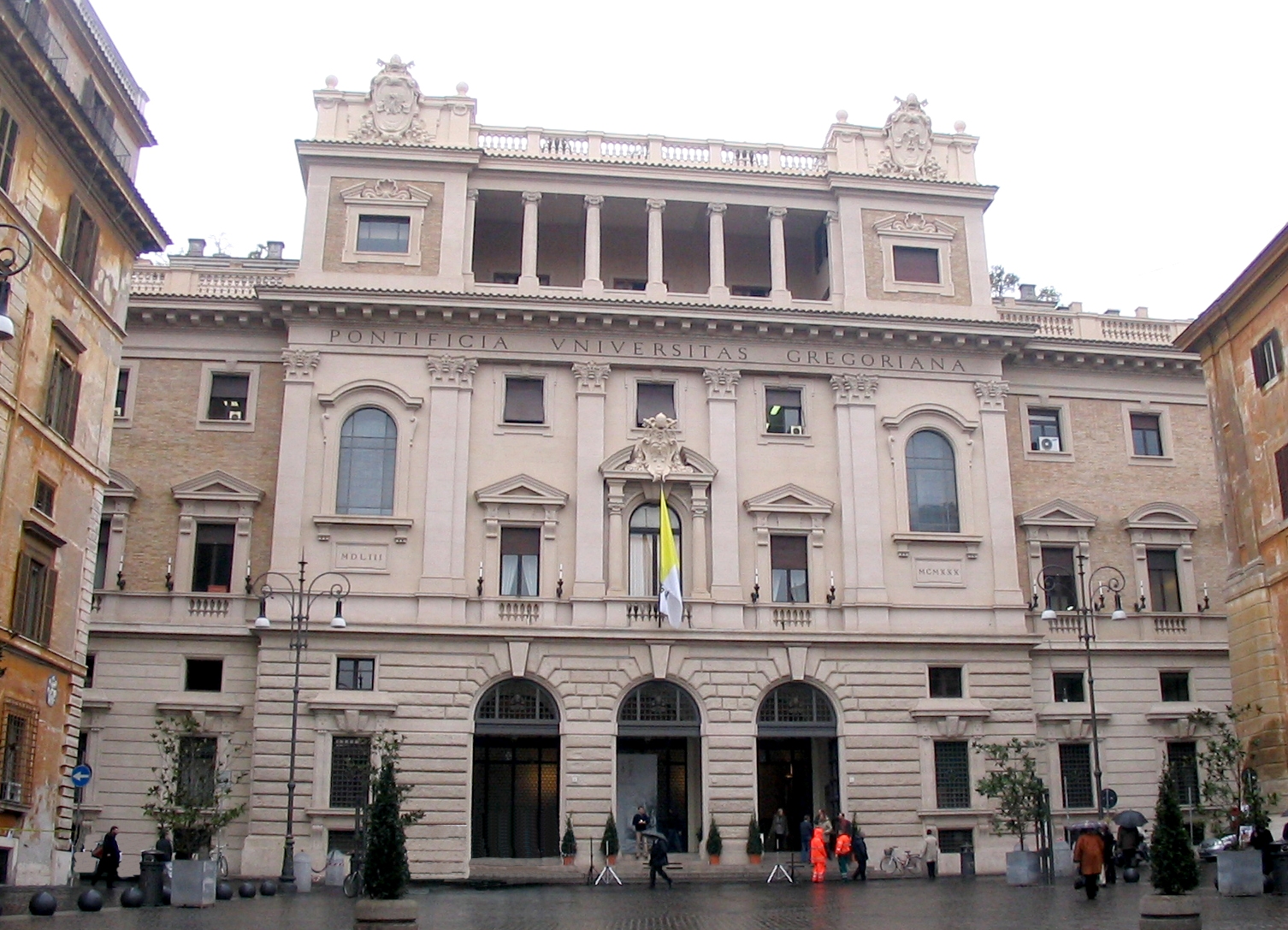
Whilst in class today, one of our professors was giving us a brief history of the Pontifical Gregorian University. Although I knew a few things about the school, he told us some interesting facts that I thought would be worth sharing… after all, I’ll be here for 4 years, and I hope you’ll be reading my blog during that time, too!
The Gregorian—or ‘Greg’ as we call say—is the result of the original ‘Roman College’ founded by St. Ignatius of Loyola over 450 years ago. Now, it has one of the largest faculties of theology of any university in the world, and has over 1600 students from around the globe. (cf. Wikipedia)
Although it was originally begun as a small institute, Ignatius’ Roman College eventually found a grand home in a new building on the Piazza Collegio Romano in Rome (across from the Palazzo Doria Pamphilj downtown, for those who might care…). Pope Gregory XIII provided gracious funding for this school, and ever since it has retained the name of Gregoriana. When the Kingdom of Italy—the first unified kingdom in quite some time—took over the city of Rome, the Church was forced out, and the College was confiscated and relocated. At this time it was granted ‘pontifical’ status, simply meaning that it was placed under the direct care of the Vatican and thereby protected from ultimate destruction. In 1930, the Gregorian was given its present home on the Piazza della Pilotta, which is very near to the heart of the ancient city, and the place I take classes today. [The picture above is of the current façade.]
Throughout the college’s history, many important people have passed through its halls: St. Ignatius of Loyola (founder), St. Robert Bellarmine (rector, Cardinal), St. Maximilian Kolbe (martyr of the Holocaust), over 15 other canonized saints and, in total, 14 popes. In short, the university has been the seedbed of many of the Church’s doctrines and teachings, having provided a basic theological education to many of history’s greatest thinkers. It goes without saying that I feel about as small as dust when I walk into the classroom each day and remember those who sat in the same, uncomfortable seats before me. For my brother seminarians and myself I ask for your continued prayers, that we might gain what we can from this amazing experience of theology and faith, and someday be able to convey the Church’s mission of salvation and charity to the entire world.
Sant’Ignazio, prega per noi!
Our Good Mother

Mary is our spiritual mother; Christ gave us to her on the cross. She will do more for us than just bring our petitions before her son. She will also bring all of our good works, sacrifices, and praise to her son, if we offer it through her. This is part of what St. Louis Marie de Montfort called the 'True Devotion' to Mary, and it is important to remember that any devotion to any saint or any holy event is ultimately a devotion to Christ. True devotion to Mary is devotion to Christ through Mary. My words will not explain the importance of this effectively, so here is a one example of how St. Louis do Montfort explains his True Devotion.
"when we present something to him by the pure, virginal hands of his beloved Mother, we take him by his weak side, in a manner of speaking. He does not consider so much the present itself as the person who offers it. Thus Mary, who is never slighted by her Son but is always well received, prevails upon him to accept with pleasure everything she offers him, regardless of its value. Mary has only to present the gift for Jesus graciously to accept it."
For the Full Text of St. Louis Marie de Montfort's True Devotion to Mary Click here. I will start my next book review in my next post.
The First Video Podcast
Posted by Anonymous in Saints, Seminary Life, The Holy Father on 8.30.2007
This is the first video podcast. We hope that you enjoy it, and please leave comments, suggestions and anything else that you think will help this to be a more valuable video podcast.
Living "In Umbris Sancti Petri"
Posted by Andrew Haines in Saints, Seminary Life, The Holy Father on 8.25.2007
Yesterday morning, the incoming class of seminarians here at the North American College began our orientation in the traditional manner: by making a trip to the tomb of St. Peter the Apostle, in the crypt of St. Peter’s Basilica in the Vatican. One of the greatest “features” of going to school here in Rome is the proximity of everyday life and the reality of the universal Church. This occasion was no exception.
Led by our Rector (the priest in charge of a seminary), we all piled out of the college a little after 7 o’clock in the morning and made our way over to the basilica – about a 10-minute walk. For as busy as it normally gets during the day, the morning provides a great chance for prayer since virtually none of the regular tourists are there yet. The people who were there got quite an eye (and camera) full, though; fifty-four seminarians walking in, dressed in Roman collars, is exactly the sort of thing people dream of catching on film when they go to visit the center of the Catholic Church. For some of our number, it was the first time they had ever laid eyes on the enormous, magnificent Basilica of St. Peter. Even more impressive than the architecture, though, is the reason why it was built in the first place...
In the confessio, under the high altar, are the bones of the first pope, Peter. It was exactly in front of these bones that we had the great privilege to participate in the Holy Mass, an honor which I will not soon forget. The Mass alone is enough to transform hearts, but knowing that you are present at the Paschal Sacrifice of Jesus Christ, in the physical presence of both Him (in the Real Presence of the Eucharist) and one of the greatest saints ever – Peter – really makes you see what being Catholic is all about. The Lord did not simply give us a memory of Himself, but rather a Church, founded upon the “Rock” of Petrus and called to continually make the same Christ present throughout the world until His coming again in glory.
Yesterday morning, fifty-four seminarians got a little better taste of what being a priest of Jesus Christ entails; just like Peter, we must be willing to suffer at the side of Christ (even confessing to Him our unworthiness after denying Him through our sin) and even be willing to suffer physical and spiritual martyrdom for the sake of the Kingdom, even as Peter was crucified in the footsteps of His Savior. However, in the end, and like Peter, we can be assured of God’s loving and saving plan for our lives, and be assured that if we suffer with Christ, we shall also reign with Him in heaven. Sanctus Petrus, ora pro nobis!

Mary and Prayer
Posted by Andrew Reinhart in Church Doctrine, Prayer, Saints on 8.23.2007

Every time Mary appears in the Gospels she gives us an example of how we should live out our own lives as disciples of her son. I especially like to meditate on Mary's first and last words. Her first words in the Gospel are the fiat. "Let it be done unto me..." This is an example of how we should live out our relationship with God. Especially in our prayer lives, I think we are often dissapointed about our time spent in prayer because we want our prayer 'to be done according to our wills,' but the best time spent in prayer is time spent allowing God to do what he wills. Yes, this could even be a dry empty feeling prayer. Another crucial part of our lives that requires a personal fiat is the acceptance of our vocation in life. We must accept Marriage, Priesthood, or Consecrated Life. This means saying 'yes' to the one that God wants and at times this means saying 'no' to the one that I want.
The last words Mary speaks are at the wedding feast in Cana. Here she simply says to the servants "do whatever he (Jesus) tells you." In some sense these words are spoken to the whole world, because remember we are all called to become servants in our Fathers kingdom. She is also giving us an example. Our words as disciples of Christ should point others to Christ and not to ourselves. This is very difficult, but a good meditation about using the tongue correctly can be made by slowly reading and praying over the third chapter of James. Look for a piece on Mary as Mediatrix next time (then I will start the next review with the next post. Let me know if you would like to hear about a book on Mary).
Corpus Christi, Corpus Ecclesiae
Posted by Andrew Haines in Church Doctrine, Saints on 8.17.2007
The other night, at a procession in honor of the first bishop of Assisi, the current occupant of that seat offered some insightful meditations on the Faith, one of which I would like to highlight here. In this he spoke of the communion, which must exist among all members of the Church. Returning to the popular theme that "no man is an island,"he went on to say that we are rather a body, or (in a geographical one-upping of Donne) an archipelago.
While others have provided commentaries on this concept that are far deeper and more learned than anything I could produce, I would like to gather some reflections on how this sense of communion really is one of the central ideas of our religious life. Sure, our faith life must be based upon a personal relationship with Jesus Christ; however, it must move beyond this into the practice of this faith within a community, which is why Christ founded the Church. Think about how much our faith depends upon others; our parents, other family members, friends, and (hopefully) priests and others within a church community. Unless you're St. Paul, our Lord is not going to knock you off your horse and tell you to get with the program; if you are a Christian, it's because you have been led to be one by others. Of course, this doesn't mean that one doesn't, at somepoint in their faith journey, have to make a personal choice to be a disciple; it's just saying that you don't get to that point all on your own.
The beautiful thing about the Catholic Faith is that this connection with others is not only in a sense "horizontal" (among those of the same time period), but also "vertical" (including those of different time periods). I think that one of the most awesome parts of the ordination Mass comes at the Litany of the Saints, when the ordinandi lay down before the altar, and everyone in the church kneels as we call upon the saints, those disciples who came before us in the faith, to come and help us today, continuing their activity in the Church even from beyond the grave (although I don't know if it would technically be theologically correct to call them benevolent zombies).
Of course, as with many things, there's a flip side to this coin. If we, the Church Militant on Earth, call upon the assistance of the Church Triumphant in Heaven, we ourselves are also called to pray for the Church Suffering, namely those who are saved, yet are now in Purgatory receiving a final purification before being admitted to the fullness of Heaven. In the same way, we are called to exercise this reaching out on the horizontal plane as well, leading others to Christ through our example and words. As it says in the Bible (always a good source book), from those to whom much has been given, much shall be expected; therefore, if we have received the pearl of great price, how much more are we called upon to lead others to it as well.

Exaltata est Virgo Maria...
Posted by Andrew Haines in Church Doctrine, Feasts, Saints on 8.15.2007
Hodie, Maria Virgo assumpta est ad caelos; Today, the Virgin Mary was assumed into heaven. Alleluia!
Well, what can I really say about this one? Perhaps I should just let Pope Pius XII, who defined the dogma of the Assumption, speak for himself:
“[We hope that] those who meditate upon the glorious example Mary offers us may be more and more convinced of the value of a human life entirely devoted to carrying out the heavenly Father's will and to bringing good to others. Thus, while the illusory teachings of materialism and the corruption of morals that follows from these teachings threaten to extinguish the light of virtue and to ruin the lives of men by exciting discord among them, in this magnificent way all may see clearly to what a lofty goal our bodies and souls are destined. Finally it is our hope that belief in Mary's bodily Assumption into heaven will make our belief in our own resurrection stronger and render it more effective.” (Munificentissimus Deus, 42)
No, that wasn’t Latin. That was just very complex English (which, as you might have guessed, is a translation from the Latin original). Permit me to venture a further “translation” of this somewhat elaborate yet absolutely essential statement…
The Church has always venerated the Blessed Virgin Mary above all the other saints, because it was through her womb that the Lord Jesus was made Incarnate for the salvation of the world. Through Mary’s fiat – “let it be done” – in response to the angel Gabriel on the day of the Annunciation, God’s Will was permitted to come into full force; by the humble, submissive “yes” of a lowly woman, the Almighty chose to send His only Son to live, suffer and die for the sins of all mankind. In a word, Mary’s love for the Lord was enough that she even offered her very life, her being, to bring about the completion of God’s plan for salvation through Christ!
This is precisely what Pope Pius XII intends to point out by his dogmatic proclamation of the Assumption. We can be sure – the Catholic Church as a whole – that Mary must have been assumed, body and soul, into heaven; she was absolutely unblemished, and her whole person was undefiled by sin (as we know through the dogma of the Immaculate Conception). By contemplating this glorious mystery of the faith, as the Holy Father states, we come to more fully realize the Father’s Will for the rest of humanity: we are called to act as Mary did, and to offer our whole being to the Lord. Even in a world that continually downplays the value of humble submissiveness (cf. my post on Christian Humanism), the model of the Blessed Mother is precisely what we need to focus on if we are going to be able to rightly offer our lives, whole and entire, to the Heart of the Father. If we truly focus on the virtue of the Blessed Virgin, someday we too might be humble enough to utter the same as she did at the Annunciation: “Fiat mihi secundum verbum tuum; Let it be done unto me according to your word.”

The Saint for the Suburbs
Posted by Riley Williams in Saints on 8.07.2007

Being in Assisi, the small Italian town where St. Francis (of said location) was born, lived much of his earthly life, and then passed on to the next, has proven to be a wonderful opportunity for reflection for Andrew Haines and myself, both studying Italian here for the next two weeks. The city is lovely – in fact, it feels so much like the 1300's that I expect at any moment a cart to go by with the driver shouting, "bring out your dead."
However, once such superficial observations are taken, deeper reflection brings one to realize the incredible ordinariness of this place: St. Francis, one of the greatest saints in our history, did not grow up in a monastery, nor in some shrine town like Lourdes or Fatima. Really, Assisi is like the ‘burbs of the Middle Ages, with St. Francis growing up in a family comparable, I'm sure, to those of many readers of this post. His father was a cloth merchant who had high hopes for his son (a career in the military, which ultimately didn't pan out when Francis got captured in his first battle). Because of his father's lucrative career, St. Francis was able to enjoy a comfortable standard of living – he wore Abercrombie, listened to Green Day, drove a Jetta, all that.
Luckily for the Church, and for us, he soon discovered a more noble calling when he heard a voice from the crucifix in a church he was repairing by hand, calling him to "rebuild my Church." He did this not by rebuilding physical church buildings, but rather by living a life in which he sought to build up, as best he could, the people who make up the Church, by his example of response to the call of our Lord in the Gospel, "follow Me."
In the interest of brevity, I will forgo giving a full account of St. Francis's life, many of which can be found online, and instead get to the point of this all (applause track). The thing about St. Francis, one of the greatest saints in history, is that he is really no different than any of us, at least in his origins. What made the difference in his life is that he put into practice what we are called to do, namely, to be living witnesses to the grace of God at work. Although he appreciated the finer things in life, he realized that God was calling him to love poverty (Lady Poverty, he called her), and so lived a life of radical poverty; though he cared about his own physical appearance, he would eventually overcome his initial revulsion upon meeting a leper and later embrace the sick man, seeing in him and his illness a reflection of the suffering Christ. Though he initially loved being popular according to the judgment of the world, he later realized that one's status in the Divine Judgment is more important. With such generosity of spirit did he follow Christ that he even received the stigmata, the physical marks of the crucifixion, on his body. However, he started out not that different from any of us.
So, what do we take from all this? While there are obviously many things of value in this story, let's focus on one in particular here: St. Francis responded to the challenge of Christ: "follow Me." He came from an average background, yet once he resolved to give himself fully to Christ, great things happened. You see, when we give God the permission to use us as instruments in accomplishing His will, extraordinary things will happen through our ordinary actions. It doesn't mean going out and doing something huge; rather, be like Francis: who are the lepers in your life whom you can embrace? What are the unattractive choices to which you feel God is calling you, or that you know are right, yet you are still holding back a little? Just as every relationship starts somewhere, so does our spiritual relationship with God have to start somewhere, even if it's something as simple as inconveniencing ourselves in some small way, because we know God wants more from us. By knowing the lives of the saints, God's friends, we can understand how to better respond to God in our own lives.


