Maritain: Art & Creativity
Posted by Andrew Haines in Art, Book Reviews, Philosophy on 11.29.2008
 Over the break—and yes, I'm still getting 'breaks' at 23, hard to believe I know—but, over the break I've been trying to read a book by the famous Thomist, Jacques Maritain, called Creative Intuition in Art and Poetry. Assuming that most here haven't read it (including myself, except for the first chapters), I can't provide much of a detailed discussion or overview. But something he speaks of in the first chapter prompted me to ask a few questions, which I will present here.
The first chapter is a review of various forms of art—Oriental, Chinese, Greek and Western—comparing and contrasting them for their commitment to and portrayal of both "Things" and the "Self." Maritain's primary argument here seems to be that Eastern art, be it Muslim geometry, Buddhist mythology or Chinese iconography, all intends to portray the 'thing-in-itself' and speaks little of the 'self,' who creates the artwork. He contrasts this with ancient Hellenic art, wherein the human form becomes the object of beauty, but remains just that—a Thing—and not an actual extension of the artist-self. Finally, he attempts to show Christian art as the beginning of a form of self-expression that does more than simply focus on beauty in things; rather, it begins to show the beauty of the creator and the ideas which are put into a work of art from the subject end.
Here, I agree very much with Maritain. His representation and analysis of art from East to West seems quite correct, especially with regard to the religious incorporation involved in each form.
Maritain's final section of the chapter is devoted to modern and future art. Here, he makes a few claims which I'm not so sure I understand—at least not in the way he intends. "We are in the presence of an exceptionally great epoch," he says, "[which] comes from the fact that on the one hand never was painting so purely painting, and on the other hand never in painting was such poignant humanity united with such powerful penetration of visible things, through the simultaneous manifestation of the painter's creative Self and of the occult meanings grasped by him in reality." (28) Although he presents his case in eloquent fashion, I think his fundamental ideas are nonetheless up for debate—primarily the notion that modern art represents "pure" art, and that in this 'purity' arises the ultimate expression of self-manifesting creativity. Certainly, modern and contemporary art is unique, and it does speak from and toward a different level of self-involvement. There is something beautiful about abstraction and impression that is not found in realistic or iconic portrayals of reality; an involvement of Self, as Maritain would put it. But as for modern art indicating a true level of progress in the world of art, I think, is something altogether different.
I'll have to read more of the book before coming to a conclusion on this. But nevertheless Maritain does a brilliant thing in Creative Intuition in Art and Poetry, which delves into the problems of art and beauty with a penetrating and fruitful focus.
Love: Dwelling of Truth & Beauty
Posted by Andrew Haines in Philosophy, The Holy Father on 11.24.2008
For Msgr. Luigi Giussani, founder of the Catholic movement, Communione e Liberazione, two things in our lives are most indicative of our proximity to the divine: 'truth' and 'beauty.' These two ideas—well known in Catholic thought even from the time of the early theologians, and especially in the work of St. Thomas Aquinas—really do manifest most plainly God's presence in things of this world, and the redemptive work carried out by Christ in sanctifying the good things we encounter each day. Truth and beauty, for Giussani, are realities which 'correspond to the heart,' and things which each human heart, at its deepest level, yearns for and is satisfied by.
A common exercise among CL faithful is to examine one's life in terms of 'Where do I find truth and beauty?' It is there, we assume, that Christ is speaking to us. Certainly, this is the recommendation of the movement at large, and has proven instrumental for many individuals in coming to know more fully the depth of the divine plan which characterizes and gives meaning to their entire lives. 'When something clicks for me, I can see Christ in that truth. After reading the same passage of scripture over and over again, its beauty finally became apparent one day—it was so beautiful!—and I was able to see Christ there.' These are common experiences for any Catholic who keeps an eye open for them, and are the particular recommendations for those wishing to pursue the Lord in CL.
Without a doubt—and especially as a philosophy student—I see something admirable in searching for the Lord by searching for truth and beauty. They are, after all, two transcendental properties of all being in which, if we find one, we can often find the other. I think that's hitting the jackpot! But, it's not the only jackpot to be hit. A thing we should never forget is something given to us by St. John the Evangelist, re-presented elsewhere, and finally distilled beautifully by Pope Benedict XVI in his encyclical, Deus Caritas est. This message is simply that one phrase: "God is Love."
Indeed, although sometimes our intellectualized minds (and particularly for those of us who are students) continue to find solace in ideas of truth and beauty, there is something to be said of love, which is in the end even more perfect. "In the end, faith, hope, and love remain," says St. Paul, "and the greatest of these is love." There is something about love that is more universal—more perfect—than even truth or sublime beauty. Although we continually seek the truth, we seek it out of love. Even though we are fixated upon beauty, we must realize that there is no beauty worth having that is not had in love. Love is the guardian of all other goods, and so long as it is not present than neither are we able to be present to them.
I think that a common frustration in living the 'CL-life' is that sometimes we can get too caught up in desiring these true and beautiful realities. 'I want to see Christ so badly in this or that thing, but I just can't—but I know he's there!' Perhaps what we ought to focus on instead is the presence of God in the simple yet profound ability to endure in seeking him. Patience, endurance and persistence are the labors of love. If we desire to see the Lord with our hearts, we are indeed enduring in the fight, and this is nothing short of love. Although we cannot often see it, we must never disregard it. Love—persistence in wanting to see the face of Christ in all we do—is even greater than seeing him.
'Cosmic Patriots' for Christ
Posted by Andrew Haines in Book Reviews, Saints, Theology on 11.15.2008
There is something funny about trying to be pertinent to today's world. On the one hand, you have the news: chock full of sad stories, cynicism, despair and harsh, cold 'reality.' On the other hand, you have fluff (or at least what the world and most people consider fluff): optimism, talk about how good life really is under all the harshness, etc. Neither is really appealing—at least to me. Sometimes I like to hear about the news, but a little goes a long way. Sometimes I need a pick-me-up, and a nice story with a good ending makes me feel better. But again, less is more as far as that goes.
What do people really want? False pessimism is bad; false optimism is perhaps even worse. Is it really possible to fall somewhere in between? Even more importantly, what are we called to see, as Christians, in a world that is at times unbearable and at times all too enticing?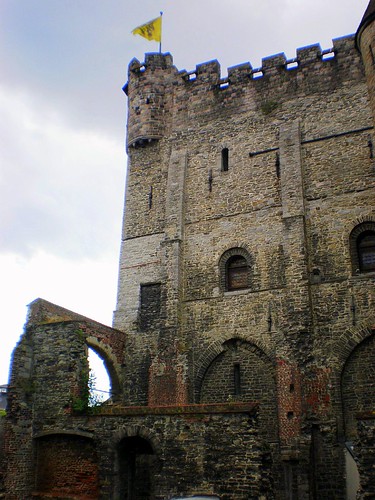 G.K. Chesterton, in his wonderful book, Orthodoxy, writes of this proper Christian approach to life: he likens it to patriotism.
My acceptance of the universe is not optimism, it is more like patriotism. It is a matter of primary loyalty. The world is not a lodging-house at Brighton, which we are to leave because it is miserable. It is the fortress of our family, with the flag flying on the turret, and the more miserable it is the less we should leave it. The point is not that this world is too sad to love or too glad not to love; the point is that when you do love a thing, its gladness is a reason for loving it, and its sadness a reason for loving it more. All optimistic thoughts about England and all pessimistic thoughts about her are alike reasons for the English patriot. Similarly, optimism and pessimism are alike arguments for the cosmic patriot.
That final term—"cosmic patriotism"—is certainly a Chesterton special. In his typical way, he captures all the facets of a very multifaceted reality in a single, poignant phrase. We all know what a patriot is (or at least what one used to be, when the word meant something a little stronger). I assume that "cosmic" is an equally familiar term, although again one with a little baggage in contemporary society. When put together, though, Chesterton's "cosmic patriotism" makes perfect sense; it resonates in the heart of modern man. We must be devoted citizens and lovers of the universe we live in. The more miserable it is, as he says, the less we should want to leave it.
Chesterton had a keen eye for what made certain things resplendent with Christian beauty. Certainly, the cosmos is one of those things: ordered by the Logos and permeated by the logoi spermatikoi, it is the handiwork of God and the manifestation of his glory. Saint Irenaeus added to St. Justin Martyr's thought with the wise insight that Gloria Dei vivens homo ("The glory of God is a living man"). What is often forgotten of Irenaeus' statement, however, is the second part of the sentence: gloria autem hominis visio Dei ("The glory of man is the vision of God"). It is this vision of God in his creative majesty that Chesterton speaks to. It is to the divinely made universe, of which we are all beloved citizens, to which we are in turn called to be patriots. No matter how bad it sometimes seems, and no matter how enticing it can sometimes be, it is nothing other than God's love made known to us. "It is the fortress of our family, with the flag flying on the turret, and the more miserable it is the less we should leave it."
Preference for Poverty is Universal
Posted by Andrew Haines in Church Doctrine, Theology on 11.10.2008
Some may remember a post I wrote a while back concerning the Church's notion of a 'preferential option for the poor.' I think that now would be a good time to revisit this idea, and consider it especially in terms of our current economic and social situation (particularly as they occur around election time). One thing that will never change is the Catholic Church's hierarchy of values—even if individual Catholics might sometimes get it wrong. At the top will forever be the needs of the people of God for the sake of salvation and sanctification. Below that are the needs of the Church, which are not directly concerned or facilitative of those first level priorities. And finally, there are the personal desires and expressions of faith and value, which are integral to the life of each individual Catholic. These last things are good, but not necessary for salvation; perhaps some examples would include art, music, literature, etc.
But that's a pretty rough sketch of things. None of us experiences life as some kind of clearly delineated progress from phase to phase. No one thinks in such stratified categories. The interplay between the three levels I tried to identify above is very fluctuant. But I think most theologians would agree that something like this model needs to be upheld if the Church will be able to function properly and for the sake of its goal, salvation.
With this in mind, where does a 'preferential option for the poor' fit into the schema. I think it is clear: it is a top-level priority, which facilitates sanctification both for the poor and for those who serve them. It is, in other words, something indispensable in the life of the Church, and something well above a personal devotion or private expression of faith and value. The manifold writings in Catholic tradition regarding social justice are evidence of this fact. We cannot, as Catholics, seek to somehow circumvent such a primary and fundamental act of the Church in order to further lower level expressions of our faith. It is precisely our faith that makes a preferential option for the poor what it is.
Perhaps the largest question arises when one considers: 'What things are we to consider as "poverty"?' This is, after all, really the question at the heart of any preference for the poor. Certainly, material poverty makes human beings 'poor'. Just as plainly, emotional and social poverty are a growing cause of 'poor' people in our society today. Finally—and closely connected with social poverty—the depravation of fundamental rights to life is perhaps the most notable form of poverty, especially in most affluent Western countries. All of these are forms of poverty. They deprive the human person of the most basic needs, which must be met in order to survive, and to live in a way that fosters a love of Christ and an appreciation of the faith of his Church. To believe that we, as Catholics, might somehow opt to alleviate one form of poverty at the cost of the others is simply folly. There is no way to bargain between one form of poverty and another: both are poverty, and both represent our highest priority as Christians. For this reason, the Church has always promoted the enactment of laws that protect fundamental human rights to life, while at the same time seeking social justice and economic fairness throughout the world. Different forms of poverty require different approaches, but none of them exclude another.
Finally, perhaps the most important thing to remember when speaking of a 'preferential option for the poor' is that poverty is not something we will eradicate. The poor will always be with you, Jesus tells us. Rather, we would do well to consider poverty as a mystery—as an insight into the life of the Trinity. By seeking to aid those who are poor, we will in turn make ourselves spiritually poor. And it is this holy self-emptiness that most reflects the self-gift of Father to Son and Son to Father by the procession of the Holy Spirit.
'Progress' Achieved?
I think it's funny how many times I've heard the words, "historic moment," in reference to Obama's election as the first black president of the United Stated. A number of US bishops have used the expression to congratulate the president-elect (probably due to the unavailability of other, more genuine compliments). An even greater number of news anchors have uttered the phrase, normally coupled with "progress" and "achievement." This appears to be its fundamental status: an indication of pride that our nation has finally 'achieved' such a level of 'progress' and 'historical momentariness.'
But why is electing a black president an indication of progress? Is it any more an 'achievement'? At the very least, I'll give it 'historic moment' status, but that's it. I'm not content with the notion that simply electing a non-Caucasian national leader is in any way indicative of progress—any more than electing a leader with fiery red hair would be. Who was the last president with fiery red hair? Have we had one yet? Ought we not to aim for such levels of progress as this?
I'm being a little cynical. I do realize that the rights of African-Americans have been jeopardized throughout the course of US history. I am certainly for giving them every equality which they deserve as human beings and as citizens of this country. But I will forever refuse to subscribe to an ideology that says voting for someone who's 'different' is equal to achieving some degree of 'progress' in our political system. Progress ought to be measured not on the basis of appearances, but of actualities. When Obama shows his colors as chief executive of the federal government, I'll be much more willing to hand out titles like 'achiever of progress' and 'bringer-abouter of change.'
But that leads to another question: 'Is all change progress?' In the eyes of 347 electoral votes worth of Americans, the change promised by the Obama camp is nothing but pure, unabashed progress. I think this jump is a little extreme. I think it requires a little more thought.
The 'Soul' of Democracy: Christianity
Posted by Andrew Haines in Church Doctrine, News, The Holy Father on 11.06.2008
 There are, of course, lots of noteworthy things to think about in the wake of the election. Perhaps most germane to this blog are the two letters sent to Barack Obama, one by Francis Cardinal George of Chicago, and one by the Holy Father, Pope Benedict XVI. Both prelates extended words of congratulations to the US president-elect, and stated their continuing prayers for his cooperation in the work of justice, peace and—most pointedly—upholding fundamental human rights.
Dear President-elect Obama [wrote Cardinal George],
I write to you, in my capacity as President of the United States Conference of Catholic Bishops, to express our congratulations on your historic election as President of the United States. The people of our country have entrusted you with a great responsibility. As Catholic Bishops, we offer our prayers that God give you strength and wisdom to meet the coming challenges.
Our country is confronting many uncertainties. We pray that you will use the powers of your office to meet them with a special concern to defend the most vulnerable among us and heal the divisions in our country and our world. We stand ready to work with you in defense and support of the life and dignity of every human person.
May God bless you and Vice President-elect Biden as you prepare to assume your duties in service to our country and its citizens. (ZENIT)
Benedict's letter, unlike the cardinal's, was not published due to its "personal nature." However, I think it's fair to say that it expressed much of the same.
So what does this say about the Church and politics? What does it tell us about our own involvement in the political sphere beyond election day? I think the most reasonable conclusion is that the Church, as it has always taught, does not see political involvement solely in terms of elections and vying for political offices, in the sense that secular society portrays it. In Centesimus Annus, Pope John Paul II writes that the Church "values the democratic system…[which] is possible only in a State ruled by law, and on the basis of a correct conception of the human person." This seems to imply that what seems manifestly 'democratic'—i.e. the electoral and representative process we see in the US—is only possible due to the laws of the state it governs, and the adherence to these laws in cases concerning human dignity. Moreover, the pope goes on to say (in a 2000 letter to Cardinal Vlk) that the Church "has a specific contribution to make; not only can Christians join all persons of good will in the realization of this great project [of political activity], but they are also invited to be in some way its soul by showing the true meaning of the organization of the earthly city."
What John Paul II tells us is clear: political life isn't a once-in-four-years phenomenon. It is a sustaining presence and, in the words of the pope, the very "soul" of a democratic government. It is up to Catholics, with the support of their bishops, cardinals and pope, to maintain the efforts toward life so ardently offered in the time leading up to this year's presidential election. Now is when the moves for the next pro-life changes are initiated. Now is when we take up the task of becoming the "soul" of democracy by our witness to the fundamental dignity of life.
Voting Practice...
It's election day which, incidentally, happens to coincide with the feast of St. Charles Borromeo. Which is more important? You decide!


