Pentecost and the Human Person
Posted by Andrew Haines in Book Reviews, The Holy Father, Theology on 4.29.2008
 In anticipation of the feast of Pentecost, which will soon be upon us, something struck me in my reading that I thought would make for a good reflection. In his book, Christ Our Joy: The Theological Vision of Pope Benedict XVI, Msgr. Joseph Murphy submits a profound understanding of the role of the Holy Spirit in the lives of the Catholic faithful and in the mission of the Church; I am inclined to believe he is onto something here:
Rarely as in our time have people become so dramatically aware of how inaccessible others ultimately are and of how difficult it is to give oneself to another or understand the other in an enduring way.
Pentecost, says Ratzinger, is the response to this situation. The Spirit sheds light on the fundamental human question, “How can we reach one another?” More specifically, how is it possible to remain oneself and yet leave the prison of one’s solitude to encounter the other from within? The answer lies neither in a dissolution of self, after the manner of some of the Asiatic religions, nor in simple activism. Furthermore, the “I” and the “you” cannot be reconciled with each other if the “I” is not reconciled with itself.
The Christian answer is to be found in the Trinity, which is the highest unity. In the Trinity, the oppositeness of the “I” and the “you” is not taken away; instead, a mutual compenetration takes place in the Holy Spirit. (Murphy, pp. 153-4)
Really, this claim on the part of the author—and ultimately the Holy Father—is nothing more than a further articulation of the Catholic belief that man was created in the “image and likeness” of God. In other words, we were specifically designed to be Trinitarian in our relationship with others and with God himself. Just as God communicates himself to himself in the relation of divine persons (e.g. the Father to the Son and vice versa) without losing anything of himself in the process, the human person is hard-wired to do the same; that is, to realize the depth of ‘self’ in the auto-communication of that self to another (by acts of love).
This idea stands in stark contrast to modern philosophy’s notion of self-understanding, which consists in either the “dissolution” mentioned by Murphy as evidenced in eastern religions and Nietzschian nihilism, or the “simple activism” of the scientific positivist, who sees God as nothing more than the totality of material reality. Certainly in the history of his theological and philosophical pursuits, Pope Benedict has considered both of these extremes and weighed them in the balance of authentic and discernable truth. In the end, as the terms suggest, both extremes prove too extreme. For one convicted by a faith in God, who is Triune, a new reality emerges: “The relation of each divine person itself becomes the nature of that person.” In simpler terms, the very and complete giving of self, which defines each person of the Holy Trinity, also defines the human person who images the Trinity in his or her mode of existing. We are created for no other reason than to give ourselves completely to the other. The title of Msgr. Murphy’s book identifies well the result of such a self-donation: “Christ Our Joy.” In fact, true and lasting joy—as Benedict’s continuing theological work suggests—can only come from a deep and abiding relationship with Jesus Christ, joined to God the Father in the Holy Spirit.
Or Tuesday...
Posted by Andrew Haines in Seminary Life
 Well, writing a post on the day of returning from Germany didn’t work out so well. Baden-Baden proved to be so relaxing that it seems to have taken all the motivation out of me. I have to say that of all the cities I’ve seen in Europe so far (which in all honesty hasn’t been as many as some may believe), this one certainly offered the most endearing and captivating atmosphere. Usually, little trips like this leave me more exhausted than refreshed—after the flying, driving, walking—but finally it seems I’ve found a cure to that unfortunate cycle. I would highly recommend Baden-Baden to anyone in the area who is looking for a get-away, and one that isn’t too expensive at that!
In other travel news, some upcoming visitors to Rome will be keeping me quite occupied, and thus will probably incapacitate my posting abilities for a little while. The first group—a pilgrimage from the Diocese of Toledo, led by a priest I know very well—will arrive at the beginning of next week and be here for a few days. Needless to say, I am looking forward to meeting quite a few young people from the university parish of St. Thomas More in Bowling Green, Ohio, who will be joining their pastor in making this trek to Rome, Assisi and Fatima. Right on their heels, the second group of visitors—my parents and sister—will be descending upon the Eternal City for a week’s vacation. Obviously, I’m pretty excited about this too since I haven’t seen them for about nine months. Hopefully, we will get to do some pretty cool things together; and, since neither my mother nor sister has ever left the United States, I’m pretty sure that anything Italian will be eye-opening enough to suffice!
In conclusion, thank you all for reading. I really do appreciate the comments and readership, and I hope that this blog is serving a good purpose in the call to holiness that we all encounter as part of our faith in God. Keep checking back in the next few weeks, and I’ll keep trying to stay on top of the game, but pardon my absences (if they occur). Hopefully the time with friends and family will provide some good meditations for future posting!
Till Monday...
Posted by Andrew Haines in Seminary Life on 4.25.2008
I'll be traveling to Baden-Baden, Germany for the weekend. Hence, no posts until Monday. Please continue to pray for seminarians around the world, and for the success of Pope Benedict XVI's apostolic pilgrimage in the United States. Bis bald...Tschüß!
Confession & the Ecclesial Body
The two bookends of the priesthood—for lack of a more theologically descriptive term—are the Sacraments of the Eucharist and Confession. Really, it is through offering the Holy Sacrifice of the Mass and hearing the confessions of the faithful that the priest does the greatest work in the salvation of souls and the sanctification of the world. Of these two Sacraments, the most written about is certainly that of the Eucharist, which comes as no real surprise given its primacy as the “source and summit” of the entire Catholic faith. In seeing the beauty of the Eucharist, though, we cannot be unconscious of that beauty which flows just as profoundly from the Sacrament of Confession.
In the ‘economy of salvation’ (or the manner by which God has deemed salvation to be achieved through Christ), one could say that the Eucharist presents to us the opportunity to share fully in Jesus’ Passion, death and Resurrection, while Confession affords us the necessary purification required to approach such an august mystery of redemption. The two function in complete harmony with one another and, although they are no more ‘Sacraments’ than are Baptism or Confirmation, they are certainly the most regularly encountered in the life of the ordinary Catholic. Thus, our understanding and appreciation of both the Eucharist and Confession need to be refined time and again, in order that we might most fully share in the Sacrifice of the Mass every Sunday. Here, we can say a few things about Confession in particular that may provide a little further insight into a Sacrament all too often overlooked.
I will assume that the basics of what Confession is don’t need to be explained—it is the normal means by which serious sin is absolved by the authority of the Church, through the priest acting in persona Christi capitis. Even in this small description, however, if we don’t read carefully, it may seem as though everything is overly-apparent; really, there is more than meets the eye, particularly with regard to the “authority of the Church.” While it is true that this authority subsists in the magisterial teaching of the Church that the remission of sins is in fact possible and real when exercised according to the norms of the Sacrament, what may not be so evident is that the Church—rightly speaking—is something bigger than just the Magisterium. Ultimately, if what the formula for absolution says is true—namely, that “through the ministry of the Church, I absolve you…”—there is something happening in every Confession that involves the participation of all the faithful throughout the world. So as not to confuse this ecclesial action with something else, since I am not proposing that it is the Church and not the priest who offers absolution, it is important to look at the words very carefully. “Through the ministry of the Church” is not the same as “the Church absolves you.” The priest still gives absolution, acting as Christ. However, what the words do tell us is that the Sacrament of Confession can, and is, rightly considered to be a liturgical action and not simply a private devotion; Confession involves the participation of the entire Church—of all the faithful—who share in that “ministry” of forgiving sins in a real way. Although the lay faithful cannot efficaciously absolve sins as does the ordained priest, they can and ought to offer prayers for the forgiveness of sins and for the conversion of hearts to the Lord. This is really where Confession ties in most directly to the Eucharist; in addition to Confession providing a sinner the means to be reconciled to the Church and God, it also derives its beauty and power from the Sacrifice of the Eucharist. During the Eucharistic Prayer in particular, the priest prays for the faithful throughout the world, and prays on behalf of those at the Mass who are offering God their own intentions at the same time. The end ‘result’ is one big oblation of petitions to the Father, who in turn delivers his Son to us under the forms of bread and wine.
The “priesthood of the faithful,” which is a resulting character of Baptism for all Catholics, is certainly instrumental in bringing about the forgiveness of sins. What is important is that we all participate properly in the degree of priesthood which we have received—either in Baptism or Holy Orders. “Through the ministry of the Church,” sins can and will be forgiven. That is a magnificent charge, and one that we should not neglect or take for granted.
Enacting "Christ Our Hope"
Posted by Andrew Haines in The Holy Father on 4.21.2008
 As I was sitting in class this morning, I was thinking to myself, “I wonder if the pope gets jetlag…” Really, I wonder if he does? I bet the papal plane is no joke, and I’m pretty sure he doesn’t have the need to resort to earplugs and inflatable neck pillows to get a little in-flight sleep. However, even if it is the case that Pastor Unus provides a bit better trans-Atlantic service than the typical airline, I bet the Holy Father is still rather worn out from having done such an “awesome” job during his recent pilgrimage (to quote the ever debonair American wordsmith, George W. Bush). As the US recovers in its own way—by readjusting to the pre-papal un-hype of the daily grind—Benedict will certainly enjoy some time of convalescence in his Vatican apartment or, perhaps, at Castel Gandolfo. Either way, life is getting back to normal for us all…or is it?
Maybe the better question would be, “Or should it?” As much as it’s necessary to pick up where we left off before the Benedictine visit, appropriately entitled "Christ Our Hope," I think it would be an affront to the sincerity and wisdom of the Holy Father if we all just reassumed whatever we had been doing a week ago. In my last couple of posts I’ve written some about how truly wise and brilliant Pope Benedict XVI really is, and a little about how we should not only hear him out, but take up his cause and implement it in the world we live in. This isn’t meant to be a figurative or ‘fluffy’ lip service to the Supreme Pontiff; I really mean it! All of us, as Catholics, believe that we have a foundational vocation to holiness. Above all else, we are called to be holy. Part of hearing a vocation—be it to holiness, marriage, religious life, the priesthood, or coming to dinner on time—is listening. Perhaps this seems an overly facile concept, but it’s one that needs to be mentioned. If we all listened to the source of our vocation, we would never question what it is that we are called to do. However, the overwhelming degree of doubt, skepticism, mistrust and practical atheism that exudes forth from modern society gives evidence that we are not, in fact, doing enough to listen. Even among Catholics, these same problems persist in greater and greater measure. If we ought to listen, we have to know whom to listen to. If the source of our vocation to holiness comes from one who is Himself holy, then our attention needs to be focused upon that personal God, to whom the angels sing the unceasing and celestial Sanctus, Sanctus, Sanctus, which we are privileged to participate in at each Mass. Really, if we hope to be holy, our lives need to become the very enacting of that Sanctus acclamation. We need to render praise to God with our whole being.
Pope Benedict preaches nothing other than this call to holiness. He says nothing apart from the truth that we are called to, the truth of faith which is a truth higher than all others, and which leads to the ultimate Truth of Jesus Christ. If we desire to hear the vocem calling out our vocation, let us realize that the vox of the Holy Father is perfectly consonant with that of the Lord:
“You are a chosen race, a royal priesthood, a holy nation, a people he claims for his own, to proclaim his glorious works” (1 Pet 2:9). These words of the Apostle Peter do not simply remind us of the dignity, which is ours by God's grace; they also challenge us to an ever greater fidelity to the glorious inheritance which we have received in Christ (cf. Eph 1:18). They challenge us to examine our consciences, to purify our hearts, to renew our baptismal commitment to reject Satan and all his empty promises. They challenge us to be a people of joy, heralds of the unfailing hope (cf. Rom 5:5) born of faith in God's word, and trust in his promises.(cf. Homily from Mass at Yankee Stadium, 20 April, 2008)
I do not intend to simply acknowledge the pope’s goodness of character and move on. I do not hope only that people saw his apostolic journey to America as a good-will voyage. I do not encourage those who seek meaning in the Holy Father’s pilgrimage only in the ostentations and easily-critiqued ceremony, which naturally accompanies his office and influence. Rather, I believe we should be doing something about the Truth he proclaims and the radical call to holiness that he has never shied away from. If we simply go back to doing what we were doing a week ago, then we have failed to receive the true message of hope that Pope Benedict sought to provide us: the Gospel of Jesus Christ.
Benedict to Educators: "Who Are We?"
Posted by Andrew Haines in Education, The Holy Father on 4.18.2008
 In light of Pope Benedict’s recent words on the topic of Catholic education, I thought another post regarding the idea wouldn’t hurt. As I guessed (and as most others predicted, for that matter), the Holy Father’s encounter with the heads of Catholic educational institutions in the United States yesterday was not lacking in either candor or piquancy. His call for reflection in what it truly means to be a 'Catholic' university is, at least in my opinion, beautifully worded, and evidences quite well his intimate association with education, both as bishop and former professor. Below is a brief excerpt from the address:
This same dynamic of communal identity—to whom do I belong?—vivifies the ethos of our Catholic institutions. A university or school's Catholic identity is not simply a question of the number of Catholic students. It is a question of conviction - do we really believe that only in the mystery of the Word made flesh does the mystery of man truly become clear? (cf. Gaudium et Spes, 22) Are we ready to commit our entire self—intellect and will, mind and heart—to God? Do we accept the truth Christ reveals? Is the faith tangible in our universities and schools? Is it given fervent expression liturgically, sacramentally, through prayer, acts of charity, a concern for justice, and respect for God's creation? Only in this way do we really bear witness to the meaning of who we are and what we uphold.
From this perspective one can recognize that the contemporary “crisis of truth” is rooted in a “crisis of faith.” Only through faith can we freely give our assent to God's testimony and acknowledge him as the transcendent guarantor of the truth he reveals. Again, we see why fostering personal intimacy with Jesus Christ and communal witness to his loving truth is indispensable in Catholic institutions of learning. Yet we all know, and observe with concern, the difficulty or reluctance many people have today in entrusting themselves to God. It is a complex phenomenon and one which I ponder continually. While we have sought diligently to engage the intellect of our young, perhaps we have neglected the will. Subsequently we observe, with distress, the notion of freedom being distorted. Freedom is not an opting out. It is an opting in - a participation in Being itself. Hence authentic freedom can never be attained by turning away from God. Such a choice would ultimately disregard the very truth we need in order to understand ourselves. A particular responsibility therefore for each of you, and your colleagues, is to evoke among the young the desire for the act of faith, encouraging them to commit themselves to the ecclesial life that follows from this belief. It is here that freedom reaches the certainty of truth. In choosing to live by that truth, we embrace the fullness of the life of faith which is given to us in the Church.
Clearly, then, Catholic identity is not dependent upon statistics. Neither can it be equated simply with orthodoxy of course content. It demands and inspires much more: namely that each and every aspect of your learning communities reverberates within the ecclesial life of faith. Only in faith can truth become incarnate and reason truly human, capable of directing the will along the path of freedom (cf. Spe Salvi, 23). In this way our institutions make a vital contribution to the mission of the Church and truly serve society. They become places in which God's active presence in human affairs is recognized and in which every young person discovers the joy of entering into Christ's “being for others.” (cf. ibid., 28)
As I read this earlier, I remember thinking, “Wow, he is no dummy!” It really does amaze me how well he is able to synthesize and articulate such a vast issue as the “crisis of truth,” which encroaches not only upon America but also upon the entire developed world. Hopefully Benedict’s message sunk in with at least a few of those present; I honestly don’t see how it could be taken less-than-seriously by anyone. Nevertheless, we should continue to pray that his words come to bear fruit in the holy actions of those in positions of authority at Catholic institutions. If the Holy Father’s ideals were put into practice, people would undoubtedly be amazed by the increase of faith, hope, charity and intellectual precision that would burst forth from Catholic universities the world over.
Benedict XVI: The Disciple, The Teacher
Posted by Andrew Haines in The Holy Father on 4.16.2008
While other bloggers are milling over the pope’s current expedition to the States, someone has to keep the stream of consciousness flowing. Incidentally, that someone would be me. Nevertheless, I’ll succumb to some of the pressure, but in a different vein than is likely being presented elsewhere.
Being in Rome, Pope Benedict XVI is a pretty staple figure. Although I can certainly never get enough of him—I know that becoming ‘accustomed’ to his presence would be a very bad thing—I do feel that being here has given me a wonderful chance to grow more and more familiar with his large body of work. Our current Holy Father’s writings span a more-than-substantial portion of the theological gamut, and I believe it won’t be for years until anyone really has a true grasp on his overall sensus theologicus. However, with sustained and continual study (not to mention the occasional audience or Angelus meditation), Ratzinger’s theology is becoming for me a clearer and more profound topic of thought.
I once heard an in-the-know priest say—probably here at the College—that Benedict has become so comfortable in his ability to defend the Catholic faith that he is truly unafraid to face opponents on the intellectual battlefield. First of all, I can’t even imagine being so sure of defending my ideas that I wouldn’t at least be a little fearful of making some sort of mistake. Then again, that is precisely what separates me and the Holy Father…that and about sixty years of academic rigor. The fact is that Pope Benedict is not only a man of superior mental clarity, but more importantly a man of intense prayerfulness and admirable personal holiness; in the end, holiness along suffices in warranting fearlessness in the presence of adversaries. Unless a man is absolutely sure of Christ and the Truth he presents us, how can he be sure of anything?
Really, that question may be better asked in reverse: unless we are sure of something, how can we ultimately be sure of Christ, and of the Truth he is and presents? While the former query is useful in demonstrating why Benedict is able to be a man of conviction, this latter question is helpful in understanding how he goes about transmitting that certainty. Although it is all too easy to think of the papal office as a legislative, authoritarian one, a true exercise of papal influence is inevitably pastoral; after all, the Supreme Pontiff is rightly called the ‘Bishop of Rome’ and ‘Pastor of the Universal Church.’ Indeed, Pope Benedict XVI has thus far done an exemplary job of living out this vocation to shepherd Christ’s entire flock, and it is precisely by providing a surety about God that he has done it. His catecheses as pope have been filled with references to the Early Church Fathers, drawing upon the foundations of the faith and elucidating the intricacies of that same faith, which we still profess. His writings as Joseph Cardinal Ratzinger are rooted in a deep tradition of philosophical and theological firmness, always seeking the integrity of a human person in relationship with the ever-transcendent yet infinitely-knowable Triune God. He presents to us a certainty about the Catholic faith, present in a vast corpus of writings and addresses that is arguably unsurpassed in modern times.
While my fellow countrymen are gearing up for a few days of papal bliss, I’ll be continuing my studies of the Holy Father’s contribution to the theological world here in Europe. Hopefully his American appearance will inspire many more in the US to do likewise. Really, Pope Benedict’s message is theological in the deepest sense—in the sense of coming to know and understand who God really is, and in learning to love him with our whole heart, mind and soul.
The Quest for a "New Humanism"
Posted by Andrew Haines in Church Doctrine, Philosophy, The Holy Father, Theology on 4.15.2008
One idea that is very evident in my own personal study of philosophy and theology seems to be the question of ‘humanism’: what is it and why is it important? The exaltation of the human person, as pagan as it has often become, is nevertheless an integral part of Catholic thought, specifically insofar as Jesus Christ presents to us the perfection of human nature as manifested in a divine person. Moreover, in addition to my private interest in this question of humanism, it also appears to be one of the foundational points in the thought of Pope Benedict XVI, and certainly one of the most talked-about ideas in modern Catholic academia; writers like Luigi Giussani and Henri De Lubac do wonders in presenting the challenge as one both of importance and feasible consideration. But how imminent is the need to reflect upon such an issue that oftentimes seems forever aloof and ultimately unattainable? The Holy Father tells us precisely that: in a recent letter to Cardinal Renato Martino, Benedict writes that it is “ever more vital…to promote a ‘new humanism.’” The pope here is speaking with principal regard to the place of peace and justice in the modern world. He identifies that, as part of a true exaltation of human dignity and worth, technological and scientific advance cannot be the sole benchmarks by which we measure success. “[H]uman development,” he says, “cannot be reduced to simple economic growth, it must include the moral and spiritual dimension. A truly integral humanism must, at the same time, also express solidarity.” In contrast to the ever-popular notion that success demands efficiency, the Holy Father seems to side more with Blessed Mother Teresa’s famous axiom, that God does not require success, but fidelity. Certainly, fidelity to God in understanding the value of the individual human life far supercedes any economic or technological progress that discounts the individual for the sake of the whole. This latter model is not Christian, since it is not concerned with salvation but efficiency.
“True and lasting peace is unimaginable without the development of each person and of all peoples,” writes Benedict. “Nor is it conceivable to think of reducing arms if first we do not eliminate violence at its roots, if man does not first turn decisively to searching for peace and for what is good and just,” namely the meaning of human life. Like all things Catholic, the answer to the question is bigger than the question itself; realizing how to promote true justice and peace is something only captured in the fullness of the Catholic Tradition, and in a deep-seated love for Christ in the sacraments and in the people of God. The Holy Father agrees, that “it will be difficult to find a solution to the various technical problems [of national security and disarmament] without man’s conversion to good on a cultural, moral and spiritual level.” We must not be primarily concerned with security, but rather with our vulnerability before the Almighty God. In recognizing our weakness as human beings—in need of salvation through Christ—the prospectus of viable solutions to more tangible problems becomes clearer and ever more achievable.
This is precisely the import of the ‘new humanism’ called for by Catholic intellectuals the world over. “The future of humanity depends upon a commitment on everyone's part,” concludes Benedict. “Only by pursuing an integral and solidary humanism…can humanity progress toward the true and lasting peace for which it longs.”
[cf. Vatican Information Services article for a full report on the pope's letter to Cardinal Martino.]
A Pontifical Farewell
Posted by Andrew Haines in News, The Holy Father on 4.13.2008
In typical NAC fashion, "anything worth doing is worth over-doing." Thus, an improvised procession with American and Vatican flags down the Janiculum Hill to St. Peter's Square for today's papal audience wasn't really too far-fetched. At least the pope noticed!
In just a couple of days, the Holy Father will set out upon his long-awaited visit to the United States of America. While no one is really and precisely sure what the Holy Father will choose to talk about during his American sojourn—not even Archibishop Pietro Sambi, the Apostolic Nuncio to the US—there’s certainly no doubting that Benedict will use this visit as a platform to boldly challenge Catholics and non-Catholics alike. While some reporters have been sticking with the traditional themes of “peace,” “justice” and “healing,” other have proposed that in fact the Pontiff will submit an entirely new teaching during the course of his time abroad. Obviously, the balance is somewhere in the middle; presenting the truth always requires an equilibrium between sticking with what people already know and pushing them to consider that reality in a new light, from a new angle. If I had to make a guess at what the pope will be focusing on, that would be it. As for the more specific addresses he is scheduled to deliver, a few rank right at the top in terms of significance. Certainly, the Mass homilies in both New York and Washington will provide the cornerstones of the entire visit, since he’ll have his biggest crowds by far at these two events. The address to the United Nations will probably come in at a close second as far as notability goes, and will likely focus on humanitarian efforts, as well as the ever-debated war in Iraq, which has thus far claimed the lives of a number of Catholic clerics and countless Catholic faithful; this is a matter very close to Benedict’s heart. Nevertheless, the speech I am most interested to hear—and which I think will subsequently provide the most ‘entertainment,’ for lack of a better word—is the Holy Father’s scheduled address to the presidents of the two-hundred-and-some Catholic universities in the United States. Speaking to the assembly in Washington D.C., I think the pope’s background as a professor and his deep appreciation for learning and holiness will spark an instigating speech, and probably fuel a heated and ongoing dialogue amidst Catholic intellectuals for some time. That’s just me though…we’ll see.
In the end, the same thing always happens: the pope comes, people get excited—the pope leaves and the excitement wanes. Ultimately, the lasting effect of a papal visit comes from those who take his words and actions seriously, both Catholics and non-Catholics alike, and who work toward the goals that he presents. Pope Benedict is clearly a man of great personal holiness and incredible wisdom and charity. I believe that only good can come out of this trip, and the task will be for us to recognize that good and run with it. The world is most notably broken in these days, and now is a wonderful chance for us to pick up a few of the pieces and start building up the City of God.
Sanity in Common Sense
Posted by Andrew Haines in Book Reviews, Philosophy on 4.10.2008
When we think about what makes a person ‘sane,’ most would conclude that the distinction arises primarily from the person’s ability to reason, and to function properly within the context of mental exercises. The dictionary definition does not seem to provide for much more: it speaks of sanity as “1. (of a person) of sound mind; not mad or mentally ill / 2. reasonable; sensible.” “Sanity”—in these terms—simply equals the ability to reason logically…and who would disagree with such a fundamental definition? One who certainly finds such an answer less-than-satisfying is the 20th century British author, G.K. Chesterton. In one of his most popular works, Orthodoxy, Chesterton writes precisely in contradiction to this popular definition: “Exactly what does breed insanity,” he says, “is reason.” And what evidence does he provide for this seemingly preposterous claim? “Poets do not go mad,” he continues, “but chess-players do. Mathematicians go mad, and cashiers; but creative artists very seldom.” In Chesterton’s understanding, there is something much more profound than the ability to reason, which ultimately allows the human person to remain within the realm of ‘sanity.’ All madmen, according to him, have “the combination of an expansive and exhaustive reason with a contracted common sense.” “The madman is not the man who has lost his reason. The madman is the man who has lost everything except his reason.”
At first glance, such a proposal seems ludicrous; how can we believe that sanity subsides in man’s creative and commonsensical capacity and not in his logical one? But Chesterton (very much in union with one of my favorite philosophers, Gabriel Marcel) states precisely why this is the case. “There is a notion adrift everywhere,” he writes, “that imagination, especially mystical imagination, is dangerous to man’s mental balance.” However it is precisely this mysticism, he continues, “that keeps man sane…The ordinary man has always been sane because the ordinary man has always been a mystic. He has permitted the twilight…He has always left himself free to doubt his gods; but (unlike the agnostic of today) free also to believe in them…The whole secret of mysticism is this: that man can understand everything by the help of what he does not understand. The morbid logician seeks to make everything lucid, and succeeds in making everything mysterious. The mystic allows one thing to be mysterious, and everything else becomes lucid.”
This insightful approach to reality coincides perfectly with Marcel’s problem/mystery distinction—i.e. that some human experiences are problematic while others are mysterious, and the difference between the two ought to be maintained and thoroughly appreciated in our understanding. In the end, man is a creature intended to remain as such; he is not a god, although he aspires to be in union with the True God—the Creator himself—and will only be fulfilled once he has attained such communion. Here, the significance of ‘mystery’ in our lives comes into perfect clarity. We simply cannot approach the mysterious existence and life of God from a completely logical point of view; that constitutes insanity. Instead, if we approach God with the faculties of human and common sense, we will find him much more quickly and clearly than if we had approached him strictly intellectually. God is more than Truth, he is also Beauty; he is certainly the convergence of logical truth, but at the same time the confluence of meaning and beauty in our human experience.
If we desire to be sane, holy Christians, we need look no further than our lives as they are: completely human and utterly permeated by the emotional, beautiful, painful and meaningful. If we learn to appreciate and love the fullness of humanity in which form we have been created, we will eventually learn to love the fullness of human redemption in Jesus Christ. Loving Christ is the goal. Being sane is the inevitable medium.
Benedict's Video Message
Posted by Andrew Haines in News, The Holy Father on 4.08.2008
In case you haven't seen it yet, here is Pope Benedict XVI's recently released video message to the Church in the United States. It sounds like he's been practicing his delivery, auf Englisch.
I'm pretty excited about this trip, and even though I won't be able to be around for any of it, I'll be doing my part to hold down the fort back here in Roma. By the way, expect a hugely positive response from the hispanic community; if the hispanics around Rome are any indication of how they'll treat the Holy Father in the States, it'll be a heck of a welcome!
Architecture: Our Disposition Toward God
Posted by Andrew Haines in Church Doctrine, Liturgy
Church architecture has a major role to play in the way we experience the Lord. When we walk into a church that draws our attention toward his magnificence, we can’t help but be somewhat mystified by the beauty of our glorious God; his eternal splendor is shown in some small part through the earthly edifice. However, when we walk into a church that has been constructed not necessarily to give glory to God, but rather to the exaltation of the human person, and toward human progress in autonomy and ‘creativity,’ the difference is immediately clear; we immediately realize the elements of transcendence and mystery are lacking. Although beautiful and prayerful churches can and have been built in almost any style under the sun, the simple and fundamental fact—which we know through these basic experiences—is that some styles are just better suited for showing God, and some better suited for showing man. Most likely, no one here will be building a church anytime soon (and if you will be, by all means I hope this isn’t the first time you’ve thought about this sort of thing). However, I think it’s entirely appropriate to reflect some on why certain elements are critical in building churches that are specifically suited to Catholic prayer and liturgy, and ultimately in drawing attention toward the focus of all existence: God himself. Unfortunately for those seeking quick answers, knowing how to best draw the mind and heart to God requires a preliminary understanding of who this God is, and how he is known by his Church in her teachings and dogmas. As the culmination of all this, the liturgy—which means the ‘work on behalf of the people’ in Greek—is the concrete yet mysterious expression of all such understanding in a mode both expressive and faithfully receptive. A Catholic church, then, ought to incorporate not simply the proximate whims of an aspiring architect or adventurous parish building committee, bur rather the fullness of the Catholic faith to which it will serve as a home and a means of articulation.
Understanding the faith means understanding the “source and summit” of the faith: namely, the Eucharist. Jesus Christ present in the Eucharist is not only the highpoint of the faith, but most obviously of the liturgy; this has been the teaching since Apostolic times and will surely never change. Thus, the primary consideration one must make in deciding on a church design is, “Will this design reverence and express our belief in Christ’s True Presence in the Holy Eucharist?” I would be so bold as to guess that the feeling we get when entering a church and realizing either God’s or man’s exaltation has much to do with this one point. If the Eucharist is not central in the construction of a Church, what does that say about our theology as Catholics? Both Christ present in the tabernacle and Christ present in the consecration of the Mass need to be given prime place if a Catholic church hopes to achieve its mission of correctly articulating the faith, and the true ‘work of the people’ to adore and worship the Son of God. On the flip side, what happens when this principle is abandoned? I think nothing speaks more strongly than that feeling of cold emptiness present in churches uninhabited by Our Lord in the Eucharist. Something is missing. If Christ is not at the center of the house, in vain do its builders labor. Jesus Christ is the cornerstone of the Church, and although he was “rejected by the builders” (of old, as well as quite literally in recent times), he ought to be recognized as the cornerstone of every Catholic church in the entire world. Putting souls in close proximity with the Eucharistic Lord puts them into contact with the infinite mystery of the Godhead, and ultimately with the mystery of their own lives. Instead of expressing our human mystery in unintelligible shapes and gyrating, deconstructionist images that scarcely represent reality as we know it and require a guidebook to appreciate in any depth, why not rely on the infinite beauty of Jesus Christ to adorn our churches?
Really, the question of the human person and its pronouncement in places of worship ought to instead be considered as a question of the person of Christ, and his presence in the place of worship. By turning in on himself, man ultimately idolizes himself. However, by turning toward the Lord—Conversus ad Dominum, as the ancient Church prayed—we find an expression of humanity much more beautiful and meaningful than anything we could muster on our own. So too do we find a way to integrate that humanity with the humanity of the Son of God, giving great glory to God, Father, Son and Holy Spirit, and living out most eloquently the faith that we profess in the liturgy of the Mass.
Saint Justin Martyr on the Trinity
Posted by Andrew Haines in Church Doctrine, Saints, Theology on 4.07.2008
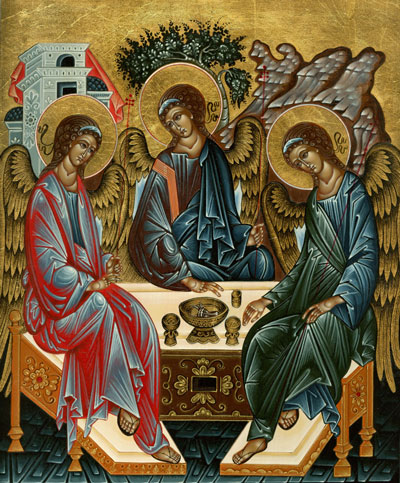 Looking for ways to articulate the mystery of the Holy Trinity is perhaps the single oldest quest in Catholic theology. No metaphor or analogy comes close to capturing such a transcendent yet necessary reality of our faith in God the Father, Son and Holy Spirit. However, some images serve us better than others; generally the simpler the better, since simplicity is truly the substance of God, whose essence is his very existence. One of my favorite analogies for the Trinitarian procession—the inherent relationship between Father, Son and Spirit—is St. Justin Martyr’s image of light. Even in the Nicaean Creed, which Catholics profess every Sunday at Mass, this basic yet profound metaphor is retained and proclaimed as a fundamental articulation of the Trinitarian mystery: we believe in Jesus Christ as “God from God, Light from Light, True God from True God, begotten not made, one in being with the Father.”
I think St. Justin’s analogy draws its force from our primal fascination with fire, the same fascination that wound up granting fire a key place in the high celebrations of the Catholic liturgical life (i.e. the Easter Vigil, baptisms, and at every Mass in the candles on the altar and in the procession). We obviously see fire as something bordering on the transcendent: it destroys yet brings life; it is a glimpse of the redemptive suffering of Christ on the Cross. There is just something mesmerizing about fire and about light. Even Jesus says that he is the Light, and that he has come to set the earth on fire. How fitting then that Justin uses this foundational element of human existence in expressing the mystery of Trinitarian existence.
In Justin’s analogy, just as one can light a second flame from a first, so too the Son is begotten of the Father. The Son’s existence, like the second flame, does not diminish the brilliance of the first Flame; both shine just as brightly as the other. Similarly, the Holy Spirit is a third flame, formed form the first two and shining just as brightly. While we can distinguish between the ‘flames’ proper—that is between their function as individual tongues of fire—we cannot distinguish between their substantial composition: they are all three fire. This relationship of ‘consubstantiality’ between the three flames is directly related to the consubstantial relationship of Father, Son and Holy Spirit; we can distinguish their function as Persons, but never their substance, since they share in one substance and are therefore one God.
Saint Justin Martyr, an early Father of the Church, was steeped in the tradition of Greek philosophy, so using earthly elements to convey transcendental truth was not uncommon. What amazes me about his analogy is the beautiful clarity with which we see a reflection of the divine in the spatio-temporal world. Although we cannot capture the mystery of God in words or even in thought or analogy, we must inevitably see the image of the Trinity in our daily experience, just as a reflection is seen in a mirror. If we capture the reflection, we have destroyed its nature, for then it is no longer a reflection of a higher reality but an independently existing one that is tangible and ‘real.’ The same is true of our perception of the Trinity in the world; if we were to capture it completely with our minds, it would no longer be a mystery, which is essential to its nature as the transcendent and divine being. Justin saw this clearly, and he expressed it beautifully. Hopefully his brilliant reflections and humble submission to the almighty power of God—Father, Son and Holy Spirit, consubstantial with one another yet distinct in their personhood—will inspire us to further submit our own intellects and wills to so great and majestic a Deity as the Holy Trinity.
Another Pitch for Dostoevsky...
Posted by Andrew Haines in Philosophy on 4.04.2008
Lately, I’ve been reading a bit more philosophy than usual. One of the books in my backpack on a regular basis has been Henri De Lubac’s work, The Drama of Atheist Humanism. I may have posted about this book before (probably quite a while ago), but it continues to give rise to new ideas in my mind, which I think are worth writing down for others to consider.
In his exposition of atheist humanism’s rise and sustenance, De Lubac draws primarily from four thinkers: Feuerbach, Comte, Dostoevsky and Nietzsche. Although background in all four schools of thought is preferable in understanding the full depth of De Lubac’s argument and synthesis, there is a very evident and consistent truth that pervades the entire work, and which has struck me profoundly. In the end, the author certainly sees, the intellectual environment of both the nineteenth and twentieth centuries has been formed almost exclusively by an overwhelmingly atheistic outlook on reality; with Marxism as the social ideal of progressive countries and existentialism as the predominant literary style moving the hearts and minds of the world’s citizens, the atheistic ambiance is unmistakable. Contemporary art becomes formless, a Nietzschian Wille zur Macht manifests itself in the human spirit, and Humanity is shown as the ruling deity, and ultimately one constituted by its very disciples. In fact, the power of secular and atheistic humanism has become so strong, it seems, that can no longer be seen as the marginal practice of a few, but rather as the diametrically opposed alternative to classical religion. In other words, there is no middle ground; there is only belief or unbelief. What strikes me most about such an insight into this “drama” of modern times is precisely the irreconcilable nature between faith and faithlessness. As a fan of Dostoevsky, I’m particularly fond of De Lubac identifying the great Russian novelist as a “prophet” of this whole phenomenon. Indeed, Dostoevsky’s work characterizes exactly the rift between faith and despair—between hope in God and hope in one’s self—most perceptibly in what De Lubac calls the author’s treatment of the “torment of God.” The characters in Dostoevsky’s books ultimately add up to a complete sketch of himself; he is the faithful Alyosha, the blasphemous Ivan, the murderous Raskolnikov and the truly Nietzschian “underground man.” His novels bear not only the burden of conveying a comprehensible plot, but also of imbuing that plot with the struggle of life, doubt and ultimately hopelessness. Truly Dostoevsky depicts in his work, as no other has, precisely what it is that defines the modern age.
Although it is difficult to tell where the noble author redeems his characters—since all of his work is really one big portrait of the human psyche—perhaps the most beautiful and telling realization of his own redemption can be found in a private journal entry, penned just before the end of his life. “The dolts have ridiculed my obscurantism,” writes Dostoevsky concerning The Brothers Karamazov, “and the reactionary character of my faith. These fools could not even conceive so strong a denial of God as the one to which I gave expression…The whole book is an answer to that. You might search Europe in vain for so powerful an expression of atheism. Thus it is not like a child that I believe in Christ and confess him. My hosanna has come forth from the crucible of doubt.” (cf. De Lubac, p. 296) Here the fullness of the atheistic problem is summed up: it is not a degree of disbelief, but rather the antithesis of belief and the antithesis of hope and love. Dostoevsky realized in his heart—after waging an all out war with his doubts—that faith alone suffices in giving man hope. De Lubac points to this in his work as well, concluding finally that Nietzsche, the most superlative proponent of atheism, “does not need anybody to refute him. He takes care of this task himself.”
In the end, “love alone is credible,” as Hans Urs von Balthasar states; and as Pope Benedict XVI so auspiciously reminds us, “God is love.”
Fides Quae & Fides Qua
Posted by Andrew Haines in Church Doctrine, News, The Holy Father on 4.03.2008
The faith of the Church does not change.
After talking to a number of fellow seminarians and priests having been recently interviewed by the news media regarding Pope Benedict’s upcoming visit to the United States, I was not surprised to hear the continuation of an age-old fallacy regarding the Tradition of the Catholic Church. It seems to be the opinion of many (and often proposed as a foundational tenet of reality) that the Catholic faith can and ought to change, based on its societal context and the progress of modern man. Many reporters believe—as it seems from my conversations—that the Holy Father will devise a new and unique element of the faith upon his American journey, somehow radically redefining how and what is meant by “Catholic faith.” Quite obviously, this is not the case; the Tradition of the Church has always preached the same Jesus Christ as the fullness of Truth, and that truth is both unchangeable and unchanging. However, no matter the constant doctrine of the faith that has subsisted for 2,000 years in the Catholic Church, and the same Church’s recognition that such a faith is unchanging and forever based in the person of Christ, something still eludes the grasp of those who believe and teach otherwise. What is it? The ‘answer’ is twofold. First, it is spiritual; there is no ‘answer’ to the ‘problem’ of faith in the modern world, only resolutions to the mysteries it presents us. This basic point is absolutely necessary in being able to articulate and teach correctly the faith of the Catholic Church. The Church has always been a mystical institution, one formed not only by an earthly component—the ‘Church militant’—but also by celestial components—the ‘Church suffering,’ in Purgatory, and the ‘Church triumphant,’ in heaven. The this very definition of “Church,” something more than human is automatically and immediately understood; there is no Church without the mysterious participation of Christ and his saints in the eternal kingdom of heaven. Thus, making a ‘problem’ out of faith, which is in some manner ‘solvable’ by intellectual or moral progress is ultimately un-Catholic and completely opposed to the Tradition of the true Church.
The second part of this ‘answer’—which we now see as more of a resolve to contemplate a greater mystery—is that we are to use our human capacities of thought and action not to change the faith, but to develop our understanding thereof. There is a huge difference between changing something and developing a capacity for it; one transforms the objective reality of faith (the fides quae in Latin: “the faith of” the Church) while the other increases the understanding ability of the subjective faith (or fides qua: “the faith with” which one believes individually). This tension between fides quae and fides qua is one of the great beauties of the Catholic Tradition, wherein objective reality in Christ and subjective reality in the Christian life are held in life-giving tension. One cannot look to the fullness of Truth without being convicted of that Truth in his or her own life. One serves the other, and both serve the glorification of God.
Needless to say—particularly in relation to my post about objective reporting and the media’s proper capacity to convey events and not higher truths—the misunderstanding that Benedict will somehow redefine Catholic teaching is simply unfounded. A basic understanding of the faith shows this. But a basic understanding of the faith requires a basic submission to the faith, and this is what is lacking for most secular critics. The great mystery of the Church is precisely the fact that knowledge only comes through submitting the intellect to the Love of God, namely in the person of Jesus Christ, who gives perfect understanding of the Father in his own Paschal mystery: in life, death and Resurrection. The Cross, in the end, is the only way to life and to knowledge.
Building "A Civilization of Love"
Posted by Andrew Haines in Book Reviews, The Holy Father on 4.02.2008
 Just yesterday at the North American College, we seminarians had the privilege of hearing the Supreme Knight of the Knights of Columbus, Sir Carl Anderson, give a brief talk on his new book, A Civilization of Love: What Every Catholic Can Do to Transform the World. Although at first the title may seem a bit nondescript, Anderson's presentation of the book certainly caught my attention in a bold way. His effort to break open the dialogue among Catholics regarding the place of love in society is certainly a timely one, and one very much in line with Pope Benedict's effort as the Roman Pontiff.
The name of the book, as Anderson noted, stems directly from St. Augustine's magnum opus, the ever looked-to City of God. In this work, the eminent Augustine seeks to draw a comparison between the earthly city of Roman rule (which proved to be crumbling heavily at that point in history) and the heavenly city, present at least in its seminal stages within the framework of the Catholic Church. Whereas the ancient Father drew on the barbarian invasions from the north as an occasion of courageous resistance to decadent powers, Anderson utilizes the recent 9/11 attacks in the US to showcase a similar truth; namely, that it is in time of trial that we truly possess the ability to construct the Civilization of Love. "We are talking about a revolution of virtue," he said in a recent interview, "but of the theological virtues: faith, hope and love...And this is the message Benedict XVI has given us with his two encyclicals, Deus Caritas Est, on love, and Spe Salvi, on hope." In fact, in his presentation at the NAC, the Supreme Knight even likened Pope Benedict to his favorite theologian, St. Augustine, saying that the current pope's work resembles an Augustinian approach to this type of societal theology.
Although I haven't read the book yet, I would certainly endorse it. Carl Anderson's reputation as a solid Catholic teacher stretches beyond his time as Supreme Knight; he was formerly a professor at the John Paul II Institute on Family Life in Rome, as well as a delegated member of various Pontifical Commissions over the past decade. The message of the Knights of Columbus has always been that of a culture of life, and Anderson certainly supports this in his new work. In addition to supporting causes for life, the Knights are also avid supporters of religious and priestly vocations, and for this Sir Carl will receive, on behalf of the Knights, the Rectors Award at the North American College's annual Rector's Dinner tomorrow evening.
Objective Reporting & Objective Truth
 Many recent news items, particularly those regarding the Church or religion, have caused me to ponder the role of the media in view of its larger capacity. It seems simple enough: the role of the media is to convey news to the masses. Moreover, I think most would agree that objective reporting is something indispensable in accurate and reliable media coverage; no one wants news tainted by strong biases or personal convictions, particularly if those biases are opposed to the convictions of the reader. If one desires news with a bias in one’s favor, he is simply disillusioning himself and separating himself from the objective facts at hand. Either way, it seems, the ideal role of the media is an impartial, dispassionate reporting of current events in a manner conducive to objective understanding.
When the objectivity of the facts being relayed is tinkered with, the result is biased reporting. However, a graver error is still possible. Here, one might begin to consider the capacity of the media as informing a public perception of the truth. Just as journalists can alter facts by overly subjectivist reporting, news media en masse can alter the criterion of truth by subjectivising what is ultimately and necessarily an objective reality.
Perhaps this seems a bit abstract; I will try to explain. The entire idea can rightly be summed up in the statement, that the media is responsible and capable of dealing with reporting facts, and not in applying meaning to them in light of a greater moral and dogmatic worldview. While all humans are bound to realize meaning, to some degree, in every encounter with the world we live in, there is a vast difference between apprehended meaning—based on the experience itself—and an applied meaning, which categorizes and pre-forms an event for public digestion. The first is necessary in reporting, the latter is not. In fact, the latter is in many ways harmful to the authentic apprehension of truth on the part of the viewing public; how are unsuspecting and distant readers and viewers to know the difference between foundational, realistic meaning, and a dogmatic meaning imposed after-the-fact by a reporter or company seeking to further a larger agenda? Doesn’t the slope of biased reporting quickly wind up dumping into the pit of biased truth?
Certainly, not all media is bad media, despite human error and natural bias. However, when encountering the world by way of the mass media, responsible citizens need to be aware that truth is not and cannot be dictated by those who report facts—even if they are true facts. ‘Truth’ is something much larger than facts; it pervades facts and gives them their meaning and note vice versa. Reporting the truth is done only when one reports facts and allows them to speak for themselves. Otherwise, something human is being superimposed upon something super-human. The capacity of the media is a human one, and therefore we ought to be weary when writers and journalists use such a platform to critique dogmatic and moral institutions over which they truly have no authority.
It seems obvious here, but how often are we duped into such media-discipleship? Particularly with the upcoming elections in the US, more and more care needs to be taken to ensure that what we subscribe to with our minds, hearts and votes is not just some proposed truth, but rather the objective truth, which underlies and gives value to reported facts. As Catholics, this responsibility has always been preached loudly and clearly by the Church and continues to be treated as a paramount facet of civil duty. Now more than ever we see the need to be vigilant. Fortunately, now more than ever we have the knowledge and capacity to do something about it, and to preach Christ boldly even in the face of societal darkness and uncertainty.


