Princes & Patriarchs: Pallium Mass 2008
Posted by Andrew Haines in Feasts, The Holy Father, Theology on 6.29.2008
 Today, the Feast of Sts. Peter & Paul, marks not only the liturgical commemoration of the two 'Princes of the Church,' but also the conferral of the pallium upon the Church's new metropolitan archbishops. The pallium, signifying the pastoral role of the new archbishop over his particular 'see,' is bestowed directly by the Holy Father in an annual Mass, celebrated in St. Peter's Basilica in Rome. The primacy of juridical authority proper to the pope as Bishop of Rome is thus (symbolically) passed on to the newly appointed leaders of metropolitan archdioceses throughout the world. Although the pallium celebration is merely an outer sign of a much greater and interior reality, the solemnity of the celebration is certainly one of the most renowned in the liturgical year.
The imposition of the pallium coincides with the Feast of Sts. Peter & Paul for a very good reason: Peter is the 'rock,' upon which the entire Church was constructed by Christ; and Paul is the great preacher of that Church's faith. Together, Peter and Paul symbolize the founding and expansion of the Christian faith. In particular, Peter is understood to be the faith's representative to the Jews—he was present in Palestine from the time of Jesus' Ascension, through the events of the Acts of the Apostles, participating in the Council of Jerusalem, and finally leaving later to establish the Church in Rome. Paul, on the other hand, is called the 'Apostle to the Gentiles'—although he was present in Jerusalem for some time, his missionary efforts were predominately focused upon Greek-speaking areas of the Mediterranean, and finally Rome, where he was martyred and buried. The joint testimony of Peter and Paul truly accounts for the faith of the early Church. This same faith—which is today entrusted to the new metropolitan archbishops from around the globe—is especially present in the Church in Rome, and in the teaching and pastoral office of the Bishop of Rome, Pope Benedict XVI. This year's celebration of the Pallium Mass is particularly important, since the Ecumenical Patriarch of Constantinople, Bartholomew I, is present in Rome for the beginning of the 'Pauline Year.' His All Holiness Bartholomew I, as head of the Orthodox Church in Turkey, holds a distinct position among the Orthodox bishops. Precisely one of the main reasons for the Great Schism between the Catholic and Orthodox Churches in 1054 AD, the primacy of one bishop over others has been a key point of theological disagreement throughout history. The Ecumenical Patriarch of Constantinople is considered, in the East, to be primus inter pares ('first among equals'). Thus, while he is not seen as "higher" than other bishops, he is given the privilege of presiding at synods involving other Orthodox bishops. In the West, however, the 'Patriarch' or Rome (i.e. the pope) is seen not as a 'first among equals,' but rather as the head of the entire Catholic Church, with a distinction of office and dignity that truly sets him apart, over and above the office of other bishops. This ecclesiological distinction resulted in the mutual excommunication of both the Bishop of Rome and the Patriarch of Constantinople in the year 1054. Although the excommunications were lifted in 1965, the difference in theological outlooks endures to this day.
In light of this great historical difference between East and West, the presence of the Ecumenical Patriarch of Constantinople at a Roman Pallium Mass should inspire more than a little awe. As the Pallium Mass signifies so clearly the Western belief that the pope can and does dispense, through the authority of Peter, a shared authority to the rest of the Church's bishops, the presence of the principle Eastern Patriarch indicates some level of mutual respect and hospitality between the two Churches that has not always been so noticeable. Benedict XVI has long been identified as a diligent laborer on the ecumenical front, and today's events are evidence of that fact. It is no doubt that the rift between East and West is getting smaller and smaller, due in no small part to the theological and pastoral adeptness of our current Holy Father. The Pallium Mass of 2008 should be the cause of much hope and rejoicing for Catholics and Orthodox alike. Never before—since the Great Schism of 1054—has reconciliation between the Churches seemed so feasible. How fitting that it should occur on this day, marked specifically by its commemoration of the two ancient Princes of the Church. How pleased the Lord must be to see that his one, holy, catholic and apostolic Church growing closer and closer to perfect unity.
Gender & Essence: A Critical Distinction
Posted by Andrew Haines in Philosophy on 6.27.2008
 After watching a 20/20 special about cases of transgender children in today's world, I was lead to reflect upon the significance of meaning present when one says the word, "gender." So much is hidden in this one word—even the fullness of reality conveyed in a person's proper name is coincidentally bound up with some gender identity. It is quite undoubtedly impossible to speak of any animate object without in turn applying some gender-specific pronoun: "he," "she" or the specifically neuter, "it." Nothing within the realm of human speech—at least in the English language—falls outside these categories. Gender seems to permeate the entire world of human experience. We cannot escape it.
A problem arises, though, when 'gender distinctions' begin to blur. This happens in a variety of ways, especially in modern society, but all such cases result in similar outcomes. A loss of gender-based clarity occurs in everything from inflated gender identity to transgender self-identity. The fundamental consequence of blurred gender distinction, it seems, is the inability to further view the human person as an individually created and objectively important reality. Separating 'gender' from 'who-ness' is a dangerous business; it supposes the self-assumed identity to be the objectively-assigned identity. In other words, it presumes that the subjective apprehension of self suffices in articulating the divine and objectively ordered meaning present in the individual human person.
The case which comes to mind right now is that of 20/20's transgender children. It seems to provide a good example. Although I don't profess to know much about the hormonal and biological aspects of opposite gender identification, merely looking at the issue through the lens of philosophy tells us much about the realities hidden below the surface. To begin, an objective and observable reality (one of primary import to human life) is disregarded as 'false.' The ostensible sign of masculinity or femininity is dubbed insufficient for discerning whether or not the person in question is truly masculine or feminine. Hereafter, a quest for self-identity ensues which is no longer rooted in the empirical observation of facts, but rather in the subjective experience of 'self,' and that self's assertion of what it is that truly constitutes its own essence. The observable facts are thrown out all together. The outcome is that the essential qualities of the individual subject seem thus to be consequents of the self's autonomous pre-existence. The ultimate result: an existentialist notion of reality, wherein overarching human essence is meaningless until actualized in the individual person—a person identified not by his or her notable qualities, but rather by means of an Enlightenment-esque, epistemologically grounded mindset.
While this syllogistic line of reasoning may be lacking a full exposition of its implicit premises, the deduction should appear quite clear: the basis of gender distinction cannot originate in the subject. At the same time, it cannot originate completely in the object. Rather, full account of the objective facts surrounding the individual subject must be made, and the subject ought then rightly to conclude that the physical phenomena of gender, present in the body, point to the truth of gender present in him or herself. In this way, neither the existence or essence of the human person is isolated from the other, and a more integrated, organic approach to personhood is maintained. This integration is foundational to the Christian perspective of what it means to be a "human person," formed in the "image and likeness of God," and tending toward likeness with Christ, who is the fullness of Truth and Self-Knowledge.
Poor Protesting Etiquette
Posted by Andrew Haines in News on 6.24.2008
I'm not opposed to protests. In fact, in many cases I am a big supporter. Protests have been the basis of many good social developments over the course of human history. Small groups working in unison can make a difference in the world at large. Nevertheless, the fundamental principle of any protest, though, should not be the devaluation of the party being protested against, but rather the positive promotion of a value or truth currently unrealized by the majority group. Negative tactics cannot bring about positive truth. With that in mind, I've found a scenario which appears to go precisely contrary to the form of 'good protesting': demonstrators handing out condoms to youth attending a Mass at this year's World Youth Day. The seemingly-loving-yet-pompous battle cry of the "NoToPope Coalition," antagonists at this summer's demonstration: "We don't want to condemn Catholic youth for being Catholics. We want to condemn the pope for being homophobic and anti-condom."
To the modern ear, such a line seems downright logical; "We can condemn one man for being something, and leave the entire group he is in charge of untouched. Clearly, what Catholics believe en masse has nothing to do with the theocratic egoism of the one who claims to be the Vicar of Christ on Earth. That's just pompous." On the other hand, though, and for the more astute listener, the fallacy hidden in the reasoning becomes ever more apparent; "How can one 'condemn the pope' and not 'condemn Catholic youth for being Catholic?'" This is perhaps more degrading than simply condemning the youth flat out. In this way, since they admit to being in line with the pope's teaching, they are assumed either to be irreconcilably obsequious or completely unaware of the faith they profess. Either reality seems far worse than being 'condemned.'
I have a suggestion for those self-assumedly gentle protesters in the NoToPope Coalition: condemn the kids too.
Why leave unscathed a myriad of young people who clearly disagree with those 'values' the NoToPope people are seeking to promote? Why not touch the fact that the innocent and supposedly indoctrinated Catholic youth present at this papal Mass will understand all too well the lie that "the pope's teachings contributed to 67,000 women dying every year from backyard abortions." What about the contribution made by pro-abortionists to the death of millions of babies each year? Why not call a spade a spade? Why not at least venture to posit some truth in the midst of clearly biased and uneducated slander? The protesters themselves admit to this bias by their manifest aggression toward one man and not toward a contested understanding of truth. They admit their unwillingness to fight on the grounds of reality, and their desire to remain confined to the sphere of idealizations and 21st century sophistry.
While 'good' protests depend on the positive articulation of truth, the witness of the Catholic faith depends on this principle even more. To witness to the faith means to express with one's entire life the positive reality of Christ in the world; the positive presence of the Truth among men. If profane society seeks to show the world the truth, let them begin by demonstrating that truth. But if they fail at that, let them at least begin by attacking well the Truth which the Church possesses. "All men, by nature, desire to know," writes Aristotle. It is, then, part of our very vocation to holiness as Catholics and Christians to give evidence of the Truth to be known via this desiderium naturale by the example and testimony of our entire lives.
To the faithful remnant that is still keeping up on the blog, thanks! Count on more posts in the near future. I know I keep saying that, but really this time! After getting all of my stuff together and finalizing plans to leave for more English-speaking shores early tomorrow morning, I will make sure to fit in some blogging whenever I can. It is exciting to know that my return to the "land of steak and potatoes" is imminent. For now, however, I must leave just another short 'filler' post and continue packing. I have definitely had some good ideas brewing in my mind over the course of these exams, and hopefully they will soon be unpacked and articulated for all ya'll to consider. In the mean time, please continue praying for me. Thanks!
The Church: Essential Unity
Posted by Andrew Haines in Church Doctrine, Church Fathers, Theology on 6.15.2008
Thanks to all of you who commented and/or promised your prayers for my continued discernment of God's will. I truly appreciate being so joyfully commended to the Lord's loving Providence. I do not doubt that he will manifest himself all the more clearly now that he has lead me to this new nexus of prayer and study. Again, thank you. Strangely enough, this entire occurrence ties in seamlessly with what I've been studying for my exams, and what I wanted to post about today: the early Fathers of the Church and their view on ecclesial unity. Studying the Fathers has always been one of the key elements of studying the Catholic faith; without them, unlocking the wisdom of the scriptures becomes impossible, and seeing the faith through the indispensable lens of Tradition becomes something totally unthinkable. One theme the Fathers stress continually, and in many different contexts, is the invaluable and ultimately indissoluble nature of unity in the Church. Unity is the fundamental characteristic of the Catholic Church, for if it were not of one spirit and mind it would in fact no longer be ecclesial (from the Greek, ekklesia, meaning "assembly, church"). All the early writers agree on this one point. The question one might ask, though, is just what is intended when one says, "unity of the Church?"
Viewing the "Church" as some external, inanimate object is a basic stumbling block for many. Clearly, the Catholic Church is not the brick or wooden church where we celebrate Mass. Neither is St. Peter's Basilica in Rome. Nor is it the college of bishops or Cardinals. It isn't even the pope. While all of these are indispensable elements of an authentic "Church," none alone suffice in constituting it. In addition, it is wrong to think of the Church as the mere ideas professed by the Church; i.e. the moral and doctrinal teachings which we understand to be Catholic are not the Catholic Church itself. While ideas are 'spiritual' and not simply material and inanimate, they nevertheless derive their significance and 'dynamism' from those who profess to hold them.
In the end, the true "Church" is constituted by the whole body, or assembly, which calls itself and is authentically attempting to be Catholic. The Church is formed in the "image of God," just as man: Saint Irenaeus or Lyons explains the bishops as having the role of God the Father, giving life to the rest of the community under their care. The assembly, then, as the "Body of Christ," partakes in the role of God the Son. Binding the two in unitive love, finally, is the Holy Spirit, functioning in the Church just as fully as he functions in the intimate life of the Triune God. Not only is the Church the image of God, the Catholic Church is truly the "mystical body of Christ." We come to know the Trinity by realizing the saving mission of Jesus Christ, and in his establishing the Church to continue that same purpose. As such, the unifying role of the Holy Spirit is utterly essential to the existence of the Church. Without unity in the Holy Spirit, there is no Church.
Seeing all of this, it gives me great comfort to know that so many are praying for me. Likewise, it should comfort each one of us to know that we are in union with so many others in the one Body of Christ, and that our bond is nothing less than the Third Person of the Trinity himself! We ought never to forget the obligation we have, then, to pray ceaselessly and to do all things in order to strengthen and manifest that bond, which God himself has graciously entrusted to his Church.
It's Official...
Posted by Andrew Haines in Seminary Life on 6.12.2008
Sometimes the Lord works with us in mysterious ways. This past year of learning, prayer and discernment at the North American College has been an incredible chance for me to learn more and more about how the Lord is calling me to serve him with my own life. He has first of all invited me to a deeper interior life, and poured grace into my heart that I might see him as the central and ultimate focus of my entire being. He has shown me a profound beauty in the Catholic priesthood that truly appeals to my heart. He has also shown me the eminent mission of service in the Church and to the Church, and the joy that can flow from loving care and compassion for the poor and sick.
Fortunately, God does not only manifest one 'side' of his saving mission, though. He presents to us all the options, in order that we might make a free and peace-filled decision to serve him with our entire life. In addition to the joy of priesthood, the Lord has also used this year to show me the beauty of the vocation of marriage, and the life-giving capacity of conjugal chastity. In short, God has surpassed my expectations, which is not uncommon, and has prompted my heart with desires I never foresaw a year ago.
In order to take the time to discern well what the Lord is calling me toward, and as a result of the helpful guidance of my spiritual director and many close priests and friends, I will be taking a "leave of absence" from the Diocese of Toledo in the coming year and pursuing graduate philosophical studies in the States. During this time I will continually be seeking to understand God's will for me, and how he intends me to serve him most fully.
In light of this rather large decision, I've considered a few things that I'd like to share here. Perhaps the most beautiful thing about the spiritual life is the tension between "call" and "choice" that exists in our vocation. If our fundamental vocation is to holiness, as the Second Vatican Council says, then our vocation in life should ultimately reflect that movement toward sanctity. Although God calls each of us to a particular way of service within the Church, there is no doubt that he leaves the entire decision free for us to pursue as we will. The continual aim of prayer and discernment is to pursue the vocation God is calling us toward, not because it is harder or impossible, but because we begin to realize there is a level of peace in it which is inexplicable in human terms and which has been put into our hearts by our Creator from before our birth. We are all created to serve God in a particular manner, and it is our goal to freely choose that vocation through ceaseless prayer and loving pursuit of God's will.
No doubt I will continue to write this blog, and perhaps with greater frequency than before. Seeking the Truth of the Catholic faith is a vocation to which we are all called. I hope that this blog can be a source of fruitful meditation and discussion for as long as I am able to write. Please continue to pray for me and know that I am praying for those of you who read this!
Eminent Mission for Chinese Catholics
Posted by Andrew Haines in Church Doctrine, The Holy Father on 6.10.2008
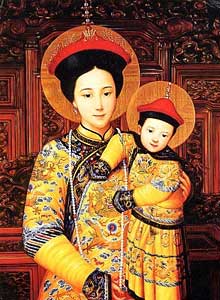 After talking with a Chinese-American seminarian at breakfast the other day, I realized that one aspect of the faith most Americans don’t hear enough about is Catholic Church in China’s struggle for autonomy. Although being in Rome has heightened my senses to this phenomenon, the fact is that China’s Communist government every day is suppressing millions of Catholics, and that the authentic Catholic Church in China continually fights for independence from the state-run ‘Church,’ backed by Beijing. Pope Benedict XVI has taken considerable steps this year in working on behalf of his oriental flock, most notably releasing a Letter to Chinese Catholics in May of 2007. In the letter, the pope speaks of his compassion for those Catholics suffering at the hands of the government, and assures them that their struggles do not go without notice. He also vows his pastoral care and imparts his fatherly wisdom to the suffering community:
I wish, therefore, to convey to all of you the expression of my fraternal closeness. With intense joy I acknowledge your faithfulness to Christ the Lord and to the Church, a faithfulness that you have manifested “sometimes at the price of grave sufferings,” since “it has been granted to you that for the sake of Christ you should not only believe in him but also suffer for his sake” (Phil 1:29). Nevertheless, some important aspects of the ecclesial life of your country give cause for concern. Without claiming to deal with every detail of the complex matters well known to you, I wish through this letter to offer some guidelines concerning the life of the Church and the task of evangelization in China, in order to help you discover what the Lord and Master, Jesus Christ, “the key, the centre and the purpose of the whole of human history” wants from you.
And what is it that Christ wants of his Church? Be it in China or elsewhere—America included—the mission of the Church “is to proclaim Christ to men and women, as the Savior of the world, basing herself—in carrying out her proper apostolate—on the power of God.” (Letter, 4) Specifically notable of the case of the Church in China is the issue of atheism, which no doubt permeates modern thought, society and culture, and is the fundamental obstacle of the Catholic Church (in my opinion) in the twenty-first century. This apostolate to preach Christ as Savior, relying “on the power of God,” speaks strongly of the effects of atheistic thought. The ‘power of God’ has been all but forgotten, and the power of governments and man has been assumed as the summum bonum toward which we ought to strive. In short, modern atheism (as I have written about before) is not so much an absence of the divine as most would believe, but rather an imposition of something finite and base into the realm of divinity. For Feuerbach, it was man’s absolute qualities; for Comte, it was ‘Humanity’; for Marxists and the Chinese government, it is the will of the state.
Struggling against the god of Communist ideology, the Church in China is in a perfect place to show the rest of the world just what it means to truly be Catholic. Not only is the Enemy utilizing the Beijing government itself to suppress authentic Catholicism, but also the officially sanctioned ‘Catholic Church’ of China, whose doctrines and clergy are both subjugated to the authority of the state. In addition, the authentic Church is battling the centuries-old mentality of the East, which has always been highly critical of all western influence, and in particular western religious and moral views. Catholic martyrs in China—particularly Jesuit and other religious missionaries—give evidence to the gravity of this situation. Nowadays, the martyrs are much less known, but without doubt there are still great amounts of blood being shed for the faith each day. As Tertullian writes, “the blood of martyrs is the seed of Christians,” and the fruit to be borne from such suffering and struggle will certainly show forth the glory and Providence of God, just as the blood of the old martyrs has given abundant life in the countries where they preached.
We ought not to lose focus on the goal of the Christian mission: to teach Jesus Christ as Savior of all men and women, and to rely in all things on the power of God. This charge of Pope Benedict is particularly relevant in today’s relativistic and consumeristic world, and no doubt will be the labor of the Church until Christ comes again to reclaim all things for himself.
Healthcare & Natural Law
Posted by Andrew Haines in Church Doctrine, News on 6.08.2008
The recent case of an Oregon woman whose cancer medication fell outside the bounds of her healthcare coverage shocked me a little. I suppose its only to be expected that insurance would not cover something altogether necessary for healthy survival, that's just the way things often work. But to hear that the same coverage would pay for "palliative care," including assisted suicide, caused me to question just what precisely is meant by the term "healthcare" anyway. If there is one thing I can do, it's find synonyms and verbal equivalents. I've had to take a battery of tests to prove my ability to do just such things, and was not able to apply for college until this skill was demonstrated outright. Thus, I am lead to believe that understanding the non-synonymous relationship of the words "health" and "death" is a rather facile project. In fact, the astute third-grader will tell you that these words could even be called "opposites" (or "antonyms" for those of us who've taken the SAT). As it seems, "health" and "death" have nothing to do with one another, other than that the failure of the former results in the actualization of the latter. The contradiction in terms alone should be enough to demonstrate how unfitting it is to place assisted suicide under the provision of a healthcare plan. Maybe the ones in charge of this particular plan didn't have to take college entrance exams. That seems like the only logical conclusion. Either that or they cheated.
But at any rate, and even if they did cheat, there is another level of truth that is far more fundamental than opposition in terms that needs to be considered. That truth is called "natural law," and has always been the constant guide of the Church in matters of morality. Saint Thomas Aquinas says that natural law is "nothing else than the rational creature's participation in the eternal law." In other words, it is man's natural involvement in the divine Wisdom that created and rules all existence. By virtue of his own existence, the human person is subject to the laws of all existence, which for the Christian (and I dare say any theist) are the laws of God. Moreover, they are not the laws of God as promulgated in the Ten Commandments or other revelation, but rather the underlying law of God written on the human heart from its very conception. Natural law is just that: "natural."
The case of healthcare providing coverage for assisted suicide is a stark contrast to the natural law. Almost anyone would agree that killing innocent human life is a moral evil. Even the most radical murderers view their killings as in some way vindictive toward a supposed evil present in the their victims, or else the achievement of a higher good through the death of innocent life. Assisted suicide falls under this final category; those murdering innocent persons believe they are accomplishing a higher good for them in the end. This, however, is not natural law. Natural law seeks the good of the person in the natural order, i.e. the preservation of life. Assisted suicide presupposes a sort of divine act on the part of the killer, wherein they feel it is their responsibility to supercede the natural order and take all life into their own hands. In short, they assume the role of God, and essentially deem it appropriate to judge between life and death. Assisted suicide, as it completely opposes the possibility of "health," might rather been seen as a "mercy killing." The problem here is that all mercy, if it is authentic, is dispatched from the throne of the Almighty. Nowhere does God condone such action. In no way can 'mercy' be achieved through murder. It is another fundamental contradiction in terms, and one that ought to be taken into account when "healthcare" providers hire new executives. Just look at their SAT scores.
Exams
Posted by Andrew Haines in Seminary Life on 6.06.2008
And the race is on yet again. Another rousing exam-period at the Pontifical Gregorian University, and another two-week-semester at the North American College. For those who presume my virtuosity in study, let it be known that the "two-week-semester" is not a reference to upped prayer intensity, but rather the initialization of exam cramming. All that I should have learned in a semester, I will now learn in two weeks...
Perhaps that's a bit of hyperbole, but not by much. Unfortunately, students are students, and seminarians are students too. So, pray for me that I might study well and ultimately offer it all up for the glory of God. On the plus side, this semester's classes have been some of the best I can remember: Trinity, Christology, Patristics, etc. All things that are fundamental to knowing and loving the Lord, all in one semester! I suppose studying for these classes is just as much a prayer as anything else, and I've been able to see that more and more as time goes on.
At any rate, pray for me and keep checking back for updates. When exams finish, I hope to blog much more frequently. I know it's been an oft-repeated theme but, "stay tuned!"


