Sacramental Aesthetic: Part III
Posted by Andrew Haines in Philosophy on 5.31.2008
III. Knowing in the Sacraments
To understand how knowing occurs in the Catholic sacraments, one must first realize the basic and essential composition of a sacrament. Surely, however, a broad venture into sacramental theology here would over-shoot our aims and would call to mind many factors that have nothing to do with our primary investigation. For us, then, it is important to clarify only a few items, thus ensuring that we not overstep the orthodox bounds of what does, in fact, constitute a sacrament in the Catholic sense.
A satisfactory articulation of the Church’s position regarding the essential composition and function of the sacraments can be found in Thomas Aquinas’ discussion of the topic in the Summa Theologiae. Taking into account the Aristotelian rationale that man naturally tends toward knowledge and understanding, Thomas writes thatit is part of man’s nature to acquire knowledge of the intelligible from the sensible…Consequently, since the sacred things which are signified by the sacraments, are the spiritual and intelligible goods by means of which man is sanctified, it follows that the sacramental signs consist in sensible things…And hence it is that sensible things are required for the sacraments. This necessarily sensible and experiential character of the sacraments accordingly presumes that we might treat them as instances of meaningful and aesthetic encounter, as discussed above. Moreover, in the sacraments we find as well the transmission of an objective truth by means of subjective fact—the Person of Christ, who is Truth, positively transmits himself to his Church by way of an efficacious sign—again permitting us to treat the sacraments as meaningful and aesthetic experiences.
In addition to being simply signs of an intelligible reality, though, we must assert strongly that the Catholic sacraments are also avenues of grace, which function in a manner beyond simple ‘significance.’ For Thomas, the sacraments can be seen as fonts of grace in two ways: “First, as in its sign; for a sacrament is a sign of grace. Secondly, as in its cause; for…a sacrament…is an instrumental [efficient] cause of grace.” Here, it seems the diffusion of grace to the faithful completes what is begun in the diffusion of truth via the ‘meaningful experience.’ Both halves of the sacramental whole, as it were, function concurrently and necessarily in order to bring about the fullness of divine auto-communication proper to each sacrament in particular. One sacramental function cannot exist without the other.
If all this is true, what can we say then about the aesthetic quality of the sacramental experience? More precisely, how can we articulate the mode and manner of knowing, which must occur as part of an authentic experience of the sacraments? Initially, and certainly on the most fundamental level, it seems that we should treat the issue from the standpoint of Christ’s self-revelation, and with regard to his identity as “Truth” and “Logos.” Since that objective truth conveyed in the sacraments is not one subjugated to a higher truth, but is rather itself the ultimate Truth (existing in the divine person of Jesus Christ), the meaningful character of sacramental knowledge assumes an entirely unprecedented gravity vis-à-vis all other meaningful and aesthetic experiences in human reality. In fact, the involvement of the person of Christ, who is the truth conveyed as well as the possessor of divine life—a participation in which is conveyed as grace—raises sacramental meaning to an entirely new level of superiority. Nevertheless, despite this unique conveyance of absolute Truth on the part of the divine, the sacraments cannot be seen as conforming to the second (mis)understanding of “aesthetic” discussed above—i.e. one wherein the truth conveyed is meaningful and beautiful even prior to its being experienced by the human subject. While it must be admitted that God in se is both Truth and Beauty—even prior to his being experienced by the external subject—those properties are, by their very qualification, transcendental properties, and are not to be classified in the same manner as the reality of truth or beauty being conveyed through the sacraments. Thus, while God himself does possess an a priori meaningfulness, that reality is not the one encountered in sacramental experience. Rather, it is the self-gift of God to man which is understood in the sacraments, and to that phenomenon we can rightly apply all the criteria of our solid and most accurate definition of “aesthetic” as something neither completely subjective nor objective.
In fact, the means of sacramental knowing seems to exemplify perfectly the synthetic and proper understanding of “aesthetic,” and its ultimate application in the ‘aesthetic experience.’ Nowhere else, it seems, does such a pure form of the aesthetic encounter become manifest as in the sacraments of the Church. There is certainly a precondition for this transmission of knowledge, however, that has not yet been explicitly mentioned: that condition is that the one encountering the Lord in the sacraments must first believe that the God he is encountering is real, and that such a God has the power to efficaciously act within the human world of time and space, namely by way of the Incarnation. Moreover—and really as part in parcel of such a faith—the sacramental participant must be in communion with the Body of Christ in the Catholic Church; otherwise, true knowledge of the Jesus Christ who is found in the Church cannot be the object of such a sacramental encounter. Thereby, sacramental participation loses its genuine meaning from the subjective viewpoint, and its fullness of beauty in the more objective, cooperative sense. Coming to know God sacramentally is only possible if it is the exercise of an authentic fides quaerens intellectum; it is both the ultimate intellectum of the mind and essentificatio of the heart in coming to understand and realize the presence, power and love of the Almighty God for his human creation.
IV. Conclusion
“I shall know the fullness of joy when I see your face, O Lord.” These words from the responsorial of the Divine Office come to be understood most beautifully in the sacramental ministry of the Catholic Church. Although the Christian must always keep as his aim the beatific vision of God in heaven, and therefore a knowing that surpasses all experiential and earthly human knowing, he must nevertheless be willing to realize that such knowledge is indeed prefigured to a great degree through faithful participation in the sacraments. The primary vehicle for this active knowledge of the divine life is the aesthetic value inherent in the sacraments, when properly received; this ‘aesthetic’ reality is also a meaningful one, as we have seen, insofar as absolute truth is being conveyed to the finite subject by way of a factual yet ever-mysterious means. The coexistence of both fact and meaning is precisely the context for true beauty, which is neither completely objective nor subjective, but rather depends on the confluence of both in order to be fully manifested. As the image of God the Father, Jesus Christ, who himself is Truth, Beauty and Logos, appears most substantially to us in the sacraments of his Church; it is by means of the Church that he has chosen to be made present to the world, and by way of the Church that he desires to be actively known in his sacramental presence. Thus, we can see that the Catholic sacraments convey a real and sure knowledge of God that is unparalleled anywhere else in the world of human experience.
Sacramental Aesthetic: Part II
Posted by Andrew Haines in Philosophy on 5.28.2008
II. ‘Meaningful Experience’ in the Real World
i. ‘Meaningful Experience’ as ‘Aesthetic Experience’
For the human person, it seems that ‘meaningful experience’ can accurately be associated with ‘aesthetic experience.’ In fact, it seems not only that the two can be associated but that they can perhaps also be equated in many ways, so that the meaningful experience of man always in some way manifests a sort of aesthetic character. To make such an allegation one must first, however, be intensely aware that the definition of the word, “aesthetic,” has been shown to elude philosophers’ grasp for centuries. Rather than assume a pre-established definition of “aesthetic” here, it would serve us well to examine the issue in some depth, coming to an autonomous yet plausible realization of aesthetic experience as it relates to the meaningful.
First, let us begin with the elemental definition of “aesthetic” as being concerned with the beautiful; this assertion is a safe one (inasmuch as we can see, and with the intention of avoiding a protracted and meticulous discourse on the topic), and provides a necessary platform upon which to erect a subsequent conception of the word. If this holds, that authentic aesthetic experience is therefore essentially an experience of the beautiful—or perhaps more plainly, an experience in some way concerned with the beautiful—then we have already completed a considerable portion of our work; we have identified that insofar as man is interested in the beautiful, he is interested and involved in aesthetic experience. Thus, we have ascertained a definition of “aesthetic” that is strongly correlative with our understanding of ‘meaning,’ insofar as meaning is concerned with the beautiful, itself a viable expression of the truth. What is left is to distinguish the degree to which meaningful and aesthetic experiences find equivalence in human understanding. In other words, we must come to know if meaning per se (i.e. the subjective fact which conveys truth) can be transmitted by way of beauty, for only if this reality holds can we justly equate ‘meaningful’ with ‘aesthetic.’
ii. Three Forms of Aesthetic Experience
Here, it will be helpful to examine three types of aesthetic experience that occur in human world-interaction. Each of the three forms communicates a different level of beauty and truth, and each is bound to a respective matrix of functionality, within which it must be seen and interpreted for fear of mistakenly generalizing ‘aesthetic experience’ as being something universal and mathematically quantifiable.
The first application of the word, “aesthetic,” to which we will pay attention has already been assumed in our discussion to be a misappropriation of the term, but nevertheless it must be included as a popular and oft-exercised understanding thereof. This basic and colloquial perception of an aesthetic experience as something completely subjective—that is to say, as an experience whose complete and total value arises as a result of the application of value on the part of the experiencing subject—vastly overlooks the profound depth of meaning present in any experience of the beautiful. In this proposed type of aesthetic encounter, the object of experience itself is attributed its ‘aesthetic’ or ‘meaningful’ quality not by virtue of the character of the experience (i.e. a transmission of truth in a manner conditioned by human perception), but rather by the acting subject, who himself deems independently to ascribe to the encounter some level of value. Here, there is a circumvention of the experience itself, which is replaced instead by an exaltation of the knower and the known; as such, a void remains where the nexus of the experience should have been, and we are left with an encounter that in itself retains no worth, not even on the ontological level. Bankrupt of significance, this application of the term, “aesthetic,” is quite obviously unconcerned with the relationship we first established between fact and meaning, and might therefore be considered inconsequential in further considerations.
A second conceivable application of the term in question is located at precisely the opposite end of the spectrum as the first; that is, in an ‘aesthetic experience’ ontologically constituted as such and totally uninterested in the existential aspect of the human experience. In other words, in this instance the object of the experience—the ‘aesthetic object’—is not attributed the substantially augmenting characteristic of aesthetic value, but rather possesses it, as it were, as part of its own composition. In such a conjecture, the import of the human experience is utterly irrelevant; no subjective encounter with such an object could alter or add in any way to the pre-existent value inherent therein. However, taking into account our earlier reflection on ‘fact’ and ‘meaning,’ we realize that the transmission of truth is never a completely a priori reality, and must inevitably occur within the framework of human experience. As with the first example, the point of convergence for fundamental truth and subjective interpretation in this model is bereft of significance. Whereas in the previous example absolute subjectivism precluded further serious reflection, here a sort of metaphysical absolutism—one which may rightly be called realism, but in the most extreme sense—presents an entirely new yet equally debilitating obstacle.
A third probable function of the term, “aesthetic,” seems to articulate best what most likely occurs in an ‘aesthetic experience’ as it has been constructed here. While the two abovementioned investigations have uncovered either a markedly subjective or exceedingly objective template for aesthetic experience, it should be clear to see that a more reasonable solution lies somewhere in between. Calling to mind what should therefore already be obvious, in this last understanding the phenomenon we mean something where the experiential nexus itself is finally found to possess value in and of itself; i.e. the value of the aesthetic experience is no longer imposed by the objective or subjective element of the event, but rather is formed upon the convergence of the two in the experience per se. Here, the aesthetic object is not such before being experienced, but instead is ascribed (rightly, it would seem) the substantial attribute of ‘aesthetic’ only once it is encountered by the subject. Similarly, the subject does not compel this value upon the object by any power of its own but, on the contrary, permits the object to be augmented in meaning by submitting it to active experience. Therefore, the objective and subjective elements of the experience work reciprocally to provide one another with value. What is more, this third treatment of the ‘aesthetic experience’ also provides a most reasonable account for the aim of all such experiences: the transfer of fundamental truth by way of the subjective fact (i.e. in a manner conditioned by human experience). In the end, this understanding provides evidence in answer to our primary inquiry in this section—namely whether or not the ‘meaningful’ and the ‘aesthetic’ can be somehow equated—since such a model of ‘aesthetic experience’ appears to rely heavily upon ‘meaning’ for final recognition of its basic yet communicable truth.
Thus, it seems we can once again step forward with confidence, this time into the final consideration of our topic and the one toward which we have been aiming all along: the fundamental relationship of the ‘aesthetic experience’ and the reality of knowing in the sacraments of the Catholic Church.
Sacramental Aesthetic: Part I
Posted by Andrew Haines in Philosophy on 5.25.2008
Below is the beginning to a 3-part-post of an article I intend to submit for publication. The title is, Sacramental Aesthetic: The Reality of Knowing in the Catholic Sacraments. I will be curious to hear what you all have to say on the matter...
__________
Introduction
For Catholics, the ultimate goal of all human life is knowledge and love of God. Man was created in God’s image and likeness so that he might come to see him as he is. Accordingly, all human effort tends toward this telos—the natural end of man, which finally capitulates unto his supernatural and heavenly end in the beatific vision. Realizing man’s need for aide in such a monumental task, however, the Father offers his children, as a window into that blissful vision, a chance to penetrate the supernal mystery of God via the person of Jesus Christ, and in particular through the sacraments he entrusted to his Church. These same sacraments have endured until today—fonts of grace and knowledge for the believer—and serve man in his earthly quest for Truth and Love.
A reflection that must be considered then, in light of this basic apprehension of the economy of salvation, is how exactly man comes to know God in the sacraments of the Church. Certainly, the sacraments cannot be wholly personal and subjectively valuable realities, since their essence consists in the transmission of divine reality into the world of human existence. The sacraments must necessarily provide an objective and incontestable knowledge of God whose image man, as a consequence of his created nature, is capable of understanding and recognizing to some notable degree. Their value cannot simply consist in assigned properties of significance, but must be clearly and fundamentally objective, even if there does remain a great element of subjective participation in that truth on the part of the faithful.
For such an investigation as this to occur—namely, one seeking to identify the essence and locus of sacramental truth and its transmission—one must ask preliminary questions of an eminently epistemological nature; particularly, the question of factual knowledge versus subjective and ‘meaningful’ knowledge must be raised. Having been discussed, this groundwork will provide a more precise basis for recognizing ‘value’ in the sacraments, and thereupon an entire philosophy of sacramental knowing might find its footing.
I. ‘Fact’ & ‘Meaning’ in Human Knowing
In human knowing, there seems to exist a reciprocal dependence between facts and meanings. By ‘fact’ here we mean those things, which express truth in an incontrovertible fashion; facts are concrete and thus possess a definite and realistic value, upon which judgment may rightly and rationally be based. In short our lives as human beings, always seeking to know, as Aristotle indicates, seem properly aimed at the acquisition and utilization of facts in making logical choices. However, if one takes daily life as an indication, it seems a matter of fact that the human person is not concerned with facts alone. What drives the human soul to know things if it is not solely the objective facts? How often do we make decisions informed not by an unquestionably impartial reality, but rather on a personally interpreted and more proximate version of truth? The human soul is impacted by nearly countless phenomena each minute, and it is probably true that most of these instances are of a non-objectively factual nature. In this way we find ourselves often concerned with ‘meanings’—those truths conveyed in our experience of reality, both in objectively factual and subjectively factual situations, and which find existential quarter only within the human person. In the end, although a fact-like knowledge of things alone seems suited for the task (from the rigidly Aristotelian perspective), meaning prevails as the object of man’s truest desire, and becomes what enables him to function properly and competently within society. To think of a world where humans do not endeavor to see facts as pregnant with meaning would be to imagine a world where the realistic human telos would seemingly be abandoned. On the other hand, the subjective facts we encounter—i.e. meaningful objects, with which we will primarily be concerned here—are ultimately grounded in the reality of an absolute and indispensable fact, which lies beyond them. What pragmatic significance can there be in the purely meaningful? Can it even exist? In a word, can the ‘meaningful’ itself provide the human soul with a basis for concrete understanding?
A preliminary consideration takes us back to the initial definition of “fact”: do meaningful objects possess a ‘realistic value,’ or is this character reserved to objective facts alone? At first glance, strictly meaningful experiences seem not to possess the same realism as that of the objective fact; they are, after all, only meaningful since they have been tempered and distilled by human understanding, leaving them in some manner devoid of the purity present in empirical, demonstrable facts. However, since the nature of man’s existence and capacity to reason is truly ‘realistic,’ we are bound to admit that meaning, as a sort of human by-product, is also full of this same realistic value. Such realism cannot be understood as being the same as that proper to objective facts, though, which may rightly be attributed a more a priori position. Rather, the meaningful object attains its meaning precisely as a result of man’s interaction with the world, and in light of his personal history and past experience. In other words, the meaningful object is not ontologically constituted as such, but instead acquires this sort of ‘substantial attribute’ only after human consideration.
Although succinct and hardly exhaustive of all tangential possibilities, this crucial exposition of meaningful experience as it relates to strictly and demonstrably factual experience gives rise to a final effect that seems not to be one of dichotomy, opposing one type of experience against the other, but rather of cohesion, wherein the two are intimately linked and by which ultimate and objective truth might eventually be understood. If this is indeed so—and chiefly, if this reasoning should later be applied in terms of the sacramental knowing—then we must ask a further question of meaningful experience that will enable us to see rightly where the sacraments truly fit into the complete epistemological schema. Namely, our question must consider two items: to what degree is the fundamental and objective truth knowable in the meaningful object, and in what worldly instances do we actually recognize these objects of meaning. While the second query will constitute an entire section in itself (one which includes a proper investigation of each subsequent, perceivable instance) and form the crux of this essay, the question concerning the degree of man’s knowledge as a result of meaningful objects can be suitably answered here.
Again, even if the scope of this matter far exceeds what is treatable at present, we might at least say enough to enable an authentic study of the reality of knowing in the sacraments. To be sure, we must begin by stating that objective and fundamental truth is positively present in the meaningful object insofar as the latter exists, and therefore exists in truth and objective reality. In other words, the mere existence of an object demands its sure participation in the fullness of truth and in the fullness of objectivity, ontologically speaking. Thus, there is inevitably an internal connection linking the deeper, more primary truth which man seeks and the proximate truth of the object of his understanding, i.e. the ‘meaningful object.’ At this point, there is a temptation to separate the two truths—one objective and the other subjective—as they are present in each object independently. It is important to note, however, that we cannot separate truth, even though we can separate the degree to which it appears as ‘fact’ (viz. objective fact and subjective fact); “fact” and “truth” are not equivalent terms. Therefore, while the factual nuance of a ‘meaningful experience’ may be less unequivocal than that of the objective experience, the truth encountered is one in the same. It should not go without saying, though, that the degree of truth apprehended by the human subject may be considerably less in this context than in a purely objective-factual situation; in the order of knowing, the prevalence of a more doctrinal assimilation of truth must be upheld.
To find the exact and numerical degree of truth present in the subjective and meaningful experience, then, appears not only impractical at this point, but also quite unnecessary; for our purpose, it suffices to say simply that there is a definitive participation in ultimate truth within the meaningful experience precisely because its object is true and real. Consequently, we are now able to permit ourselves a further investigation upon the second part of our above inquiry, namely as to what real-world experiences constitute ‘meaningful experiences.’
Hiatuses
Posted by Andrew Haines in Seminary Life on 5.22.2008
Never having thought I'd use that word in the plural...ever...it seems to fit here due to the large number of commitments that have been coming my way, and the subsequent breaks in writing that have occurred. My only petition: stay with me. I assure you more fruitful and regular posting in the (hopefully immediate) future. But again, for now, be prepared for the sporadic blogging that comes along with visitors, studying and exams. Thanks!
"Greek Wisdom" in Service to Faith
Posted by Andrew Haines in Church Fathers, The Holy Father, Theology on 5.16.2008
At this week’s Wednesday Audience, Pope Benedict took the opportunity to talk about a “mysterious figure” in the history of Catholic thought, Pseudo-Dionysius. The real man-behind-the-name is a hotly contested topic in intellectual circles, but the pope sided with the opinion that Pseudo-Dionysius was in fact “a theologian of the sixth century, whose name is not really known, and who wrote under the name of Dionysius the Areopagite,” an early disciple of St. Paul. Pseudo-Dionysius, in addition to being the most often referenced thinker in St. Thomas Aquinas’ Summa Theologiae (a hefty feat in and of itself), is also author to some of the most fundamental works in early Catholic philosophic and theological thought: The Divine Names is probably his most notable work, and details the application of Neo-Platonic ‘emanation’ within the realm of early Trinitarian theology. It is precisely in this Hellenic conception of God for Pseudo-Dionysius that Pope Benedict XVI finds such great value. “If the author of these books,” he said, “chose five centuries afterward the pseudonym of Dionysius the Areopagite, it says that his intention was to put the wisdom of the Greeks into the service of the Gospel, and to aid in the encounter between Greek culture and understanding and the Christian message.” This certainly outlines Benedict’s entire theological approach—putting secular reason and science at the service of the Gospel—and serves as a basis for the development of such unification in the Church throughout the years. Undoubtedly, the confluence of the two schools of thought, both Greek and Christian, was not always seen as tenable. Tertullian, the prominent Latin writer of the second century after Christ, is credited with the ever-famous question, “What has Athens to do with Jerusalem?” That is to say, “What does reason have to do with faith?”
Fortunately for us, an articulate synthesis of the answer to such a question can be found almost two thousand years later in the work of our current Holy Father, and also in the work of his predecessor, Pope John Paul II. The late pope’s encyclical letter, Fides et Ratio, discusses this very topic in great detail and provides the core for most contemporary discussion of it within the Church. Pope Benedict’s synthesis on Wednesday of what it means to hold together the two tenets of theological faith and human reason was equally beautiful, yet a bit more constricted to the realm of Platonic philosophy and its relation to Jesus Christ. The Holy Father put the whole project in terms of “negative theology,” a classic means of keeping the tension between the absolutely sure and the absolutely unsure. “The face of God is our incapacity to really express who he is,” said the pope. “It is, so to say…a ‘negative theology.’ We can more easily say what God is not than express what he truly is. Only by way of these images [which we attain through our interaction with the world] can we gauge his true face; yet on the other hand his face is very concrete: he is Jesus Christ.”
Keeping the productive tension between faith and reason is precisely the task at hand for budding Catholic intellectuals. If we hope to provide a credible witness to our faith—one that is not simply ‘fideist’ (i.e. non-rational) nor completely intellectualist—we must always strive to maintain the interdependence of both faith and reason with one another. In the Letter of St. Peter, the author writes that the Christian should “always be ready to give an explanation to anyone who asks you for a reason for your hope.” (1 Pt 3:15) How this is! And how well is it manifested in the teaching and ministry of Pope Benedict XVI? Surely, we have as our earthly Vicar of Christ a great teacher and student of the Catholic Tradition, and it would do us well to pay attention to his insights and to stress in our own lives the truths he so beautifully articulates.
Justin Martyr & Rational Religion
Posted by Andrew Haines in Church Doctrine, Church Fathers, Theology on 5.12.2008
 In my reading today, I came across a great exposition of the Catholic faith by the second century apologist, St. Justin Martyr. Certainly, understanding the Church Fathers is one of the most important ways we have of understanding authentic Catholic doctrine and how it has developed. The topic I note here, 'faith and reason,' is no exception. Among other topics, Justin writes in one of his letters to the Roman emperor about the nature of the Christian religion, which was still enduring heavy persecution. Perhaps not surprisingly, the persecution of the faith nearly two millennia ago does not differ so much from the opposition to the faith posed by society today. In both cases, cultural mindsets of emotionalism and licentiousness present a grave obstacle to the truth of a belief in Jesus Christ. However, much like Pope Benedict XVI is working to accomplish in the twenty-first century, St. Justin Martyr sought in his works to appeal to the deeper, rational nature of the human person. The excerpt below, from the First Apology of Justin Martyr, shows precisely that; namely, how it is that Christians worship God by virtue of their properly rational capacity:
But we have received by tradition that God does not need the material offerings which men can give, seeing, indeed, that He Himself is the provider of all things. And we have been taught, and are convinced, and do believe, that He accepts those only who imitate the excellencies which reside in Him, temperance, and justice, and philanthropy, and as many virtues as are peculiar to a God who is called by no proper name. And we have been taught that He in the beginning did of His goodness, for man's sake, create all things out of unformed matter; and if men by their works show themselves worthy of this His design, they are deemed worthy, and so we have received of reigning in company with Him, being delivered from corruption and suffering. For as in the beginning He created us when we were not, so do we consider that, in like manner, those who choose what is pleasing to Him are, on account of their choice, deemed worthy of incorruption and of fellowship with Him. For the coming into being at first was not in our own power; and in order that we may follow those things which please Him, choosing them by means of the rational faculties He has Himself endowed us with, He both persuades us and leads us to faith. And we think it for the advantage of all men that they are not restrained from learning these things, but are even urged thereto. For the restraint which human laws could not effect, the Word, inasmuch as He is divine, would have effected, had not the wicked demons, taking as their ally the lust of wickedness which is in every man, and which draws variously to all manner of vice, scattered many false and profane accusations, none of which attach to us…
What sober-minded man, then, will not acknowledge that we are not atheists, worshipping as we do the Maker of this universe, and declaring, as we have been taught, that He has no need of streams of blood and libations and incense; whom we praise to the utmost of our power by the exercise of prayer and thanksgiving for all things wherewith we are supplied, as we have been taught that the only honour that is worthy of Him is not to consume by fire what He has brought into being for our sustenance, but to use it for ourselves and those who need, and with gratitude to Him to offer thanks by invocations and hymns for our creation, and for all the means of health, and for the various qualities of the different kinds of things, and for the changes of the seasons; and to present before Him petitions for our existing again in incorruption through faith in Him. Our teacher of these things is Jesus Christ, who also was born for this purpose, and was crucified under Pontius Pilate, procurator of Judaea, in the times of Tiberius Caesar; and that we reasonably worship Him, having learned that He is the Son of the true God Himself, and holding Him in the second place, and the prophetic Spirit in the third, we will prove. For they proclaim our madness to consist in this, that we give to a crucified man a place second to the unchangeable and eternal God, the Creator of all; for they do not discern the mystery that is herein, to which, as we make it plain to you, we pray you to give heed.
'Personhood' & Divine Love
Posted by Andrew Haines in Philosophy, Theology on 5.09.2008
The question of what ‘defines’ the human person is certainly not a settled issue. At least not from a philosophical vantage point. For the more empirical thinkers, sustained consciousness of self is enough to denote personhood. For Kant, the “transcendental unity of apperception” is the “I” with which each person associates. In modern pop-culture, “mistakes are the only things which we can truly call our own,” and thus inevitably become the measure by which we can rightly be called human persons. All together, it seems that the history of what it means to be a ‘somebody’ is defined completely from the subjective, singular vantage point: we are what we do.
Unfortunately, ‘we are what we do’ turns out to mean that our very existence is equivalent to our essence (i.e intrinsic nature). In other words, the manner by which we function defines the fact that we exist as human beings. This is certainly the underpinning of modern existentialist thought, and a pervasive mentality throughout the world. Fortunately, it cannot be true… God alone, being perfect and completely self-sufficient, can have for his existence his very essence: who he is and how he ‘works’ are one in the same; they are quite inseparable, except in idea. For us humans, however, to claim that our activity defines our being is to in actuality claim a sort of divinity; it is to presume that we are capable of defining ourselves and sustaining ourselves based completely on our own activity. This is evidently non-Christian and, to be sure, non-theist. One cannot believe in an all-powerful God and posit the self-definition of the human person. They are mutually exclusive and contradictory statements. In the end, if we were in fact defined in our being by our (sinful) actions, the possibility of salvation would not be for us, since we would be incapacitated from freely responding to the generous gift of Christ on the Cross; we would be hard-wired to turn against his gift of self and would perpetually refuse his merciful love. To be self-determining is to be self-effacing.
On the contrary, when we realize the truth of what it means to be a ‘human person’ in the Catholic mindset, salvation becomes not inaccessible but rather most palpable. The human person, in this view, is defined not by personal action but by the love of God, through which it remains in existence and apart from which it cannot exist or function. Instead of viewing personal action—sinful or loving—as the defining characteristic of the self, the Christian definition of person allows for a free ascent to the redemption offered by Christ through the knowledge that we are loved, and that such profound and divine love alone facilitates our being. Even our own acts of love cannot be separated from the divine Love, which created us and sustains us. In all things, we are inseparably related to and dependent upon the Holy Trinity. Keeping this reality in mind, the power of the Paschal Mystery becomes all the more evident for us, and the salvation offered through Jesus Christ attains a realism that is otherwise hidden and undesired.
Synthesis and Truth
Posted by Andrew Haines in Education, Philosophy, Theology on 5.05.2008
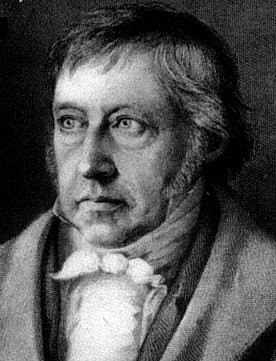 Despite all the consequential drawbacks of his philosophy, the German thinker, Georg W. F. Hegel, leaves us one very fundamental and useful approach to ‘truth.’ For Hegel, all activity participates in the perpetual cosmic cycle of “thesis,” “antithesis” and “synthesis.” In short, one reality emerges first; he calls this the thesis. Then, an opposite reality arises to counter a balance against the already existing thesis; this he names the antithesis. In the tension between these two polar opposites, a final consequence materializes from the midst of the struggle: the synthesis. This synthesis then, standing alone as the sole product of the whole operation, will assume the role of ‘thesis,’ and the whole process begins anew: thesis, antithesis, synthesis.
Although that is an overly simplistic view of Hegel’s truly groundbreaking philosophy, it is enough to at least prompt some basic questions. While I’m not lobbying for a neo-Hegelian upswing in contemporary philosophy, perhaps considering this proposed lifecycle of truth and reality, so to speak, would be helpful in our own perception of truth, and particularly of the Truth of Jesus Christ present in the world around us. If the purpose of philosophy is to aid us in understanding reality, then surely utilizing such critical reasoning in seeking to understand the fullness of reality present in the divine Logos—the Son of God—is well within the scope of dutiful Christian activity. Oftentimes, it is all too easy for us to forget that the history of the Catholic faith is laden with just this sort of ‘thesis, antithesis and synthesis.’ Undoubtedly, the process will continue for as long as humans are unable to articulate perfectly the mysterious reality of a Triune God. However, we cannot fail to see the importance of such productive argumentation in the academic forum. After all, it is what has given us the faith we possess today.
One critical aspect of this dialectic, as it is called by Hegel, and with specific regard to the faith of the Church, is that the fundamental principle for all synthesis and understanding must be an appeal to the already accepted dogma of the Catholic Church, and an ascent to rightly informed reason. Without these two cornerstones, all dialectic will inevitably become flawed, and more focused on self-interest than on an interest in the objective and ultimate Truth we ought to desire. This being said, the freedom to thoughtfully and challengingly process the depths of our knowledge about life and God should be the primary focus of academic pursuits, for those serious about coming to understand the fullness of truth and reality as best as possible.
While we all encounter the fundamental “vocation to holiness” as the basis for our own lives, we ought to consider that calling in relation to our inherent human vocation to engage the world in which we live, and the thoughts and mentalities that compose it. If we look at our desire for truth as a dialectic of positions, ultimately resulting in the beautiful synthesis of Catholic Truth, we should not be afraid to venture into the deep—to duc in altum—and to mine the riches of the reality that surrounds us. This is precisely the importance of authentic academic freedom, and the forum to discuss such sensitive yet compelling topics in a manner oriented toward true growth and the pursuit of knowledge. So long as our quest is always guided by an ascent to the Truth as we know it and the Church professes, and we maintain the discipline to fully hear all possible considerations before making conclusions, our labor will prove fruitful and our lives and intellects will benefit greatly.
"No Vacation From A Vocation"
Apologies again for the delay in posting. Like I mentioned last week, things are getting a little hectic here. Stay tuned for more, but expect infrequency for a bit.
In the meantime, something good to consider…
As the school year comes to an end for us students (sooner rather than later for those in the US—I’ve still got 2 months!), the prospect of summer looms ever closer. We can almost smell the upcoming bout of freedom. At first it smells sweet, like the springtime that ushers it in. But inevitably our freedom to be free will grow unbearable as the summer grows unbearably hot and—without a doubt—long. All that we had planned to do will go out the window in the end, and we’ll be back to school in the fall without much of a sense of achievement. Almost suddenly, it seems, our summer evaporates from us and all we are left with is a lessened vigor for studies and work come September. This might be a bit dramatic, I admit, but such sentiment is what usually defines my summers and I’m sure most can relate…
Two things become evident in such a reflection as this: first, the place of ‘freedom’ in our lives and its true and false implications; secondly, the import of the age-old maxim that “You can’t take a vacation from your vocation.”
Although one could talk about human freedom to no end, a critical point of what it means to be truly ‘free’ can be seen in the summer experience above. In the beginning, we equate freedom with being able to choose something (e.g. not studying, laying on the beach, drinking margaritas, etc.). Then, we suddenly find that through our free choices we have somehow become entangled in a web of laziness and inactivity which, although it was formerly serving the good of mental and physical refreshment for the coming year, is really keeping us from wanting to work at all. We go from being ‘free’ to being quite enslaved and somnolent. In the hope of attaining true freedom, we completely miss it.
The resolution to this simple mystery of summer-time planning—and surely life in general—comes when we consider the “no vacation from a vocation” idea. If our fundamental vocation in life is to holiness, which we recognize as the unchanging teaching of the Church and of its Head, Jesus Christ, then we can quickly affirm that anything making us fail in virtue or our acquisition thereof is not an appropriate means of relaxation and, therefore, will hinder us from being truly free. Certainly this means not doing things that are objectively evil just because we have the time. But it also means not doing things that are good and right in themselves to an excessive degree. This is all pretty commonsensical, I’m sure, but no matter how many times you hear it, how often do you just blow it off?
With a couple whole months of time to either grow or slacken in our primary vocation to holiness, it’s worth considering just how we will plan to avoid instances of laziness and to encounter opportunities for genuine Christian growth throughout the summer. Certainly, the Sacraments provide a sure foundation for any discipline; in them we encounter Christ himself, who is the divine Logos and Understanding of the Father. The summer is surely a time to deepen our appreciation of Christ’s role as the mediator of all truth and revelation, which will in turn deepen our resolve to learn and study well when school time does pick up again. If summer is meant to refresh our minds and bodies for the work of the Lord, then we ought not to forget the Lord in the midst of our relaxation.


