Freedom and the Acting Person
Posted by Andrew Haines in Seminary Life on 2.25.2008
As classes keep on keeping-on, I've been getting pretty hammered with theological insights and talk about scriptural hermeneutics and exegesis. But, I don't really want to think about those things right now, much less write about them. In fact, perhaps the most meaningful thing I've heard in the last few weeks came in during a day of retreat last weekend when a priest, in addressing the seminary community, reminded us that "the only reason [we] are here is because [we] think that the priesthood is necessary for [our] sanctity." All the theological debate in the world really can't hit you quite as hard as something so basic. And what is so poignant about it? Precisely the fact that I know he's right.
Father's comment strikes me particularly because it reveals two levels in the essential quest of the human person toward his or her finality. Even with all the philosophy, theology, science and history you can muster, the ultimate question that has to be asked is, "Why?" Why am I doing this? Why am I here, committing my life to this or that thing, to a wife and children, to studies, to service to the poor, to prayer, or to self-indulgence, to living the fast-life, to corporate expediency... why? The simple answer to all these is, "Because I think it's what will bring me happiness." Indeed, all of these things do bring us happiness, in some degree or another, and we can't deny that; the human person, by its very nature, desires to be fulfilled and happy. We crave it more than we crave air, since we really only want that because it makes us happy. Realizing that we were created to be happy is the beginning of realizing a lot more. It is certainly the first step toward realizing how to find that happiness; it is the first level of our understanding our true finality.
But, we need to dig a little deeper. "Why am I really doing what I'm doing right now?" While the first "why" was more concerned with the nature of the acting subject, this inquiry pertains more to the nature of the action in question. In other words, it is concerned with the "what" that I'm doing. If it takes a long time to understand the first question, it takes inestimably longer to really comprehend the second. In fact, the two work in great harmony with one another; if you don't understand your own human nature, you can't understand your acting potential as a free individual. Likewise, if you don't understand the effects of free decisions, it's impossible to really grasp what it means to be a 'free person.' If we truly desire happiness as our ultimate goal in life, then it would be logical that we choose individual actions that are consonant with that desire. Obviously, though, we are not always as logical as we might like, and so discerning the value of our actions for our ultimate goal becomes a big part of what we do each day.
Father's statement that I am here because I think priesthood is necessary for my sanctity shows precisely that. By principle of extension, I could also say that you are doing what you're doing because you think it's essential for your happiness. In the end, nothing short of sainthood is demanded of us, for that is exactly what it means to be in heaven: sanctity. Taking some time to consider that there is literally nothing standing in the way of us and holiness at this very moment, we might be able to gain a better perspective on what our true finality really is; it's not something out of reach, but instead a life very rooted in prayer, passion, and hopefully a continuation of the direction we find ourselves moving in at this very moment.
"Faith, Reason & Freedom"
Posted by Andrew Haines in Philosophy, Theology on 2.22.2008
Below is a small excerpt from an article by Fr. John M. McDermott, SJ. I was fortunate enough to have Fr. McDermott as a professor at the Josephinum a few years ago; he specializes in Thomistic and neo-Thomistic thought. This article is on the place of reason and love in knowing the infinite, transcendent God. The following is his conclusion and demonstration of the ontological primacy of love over reason:
__________
Catholic theology recapitulates in theological terms the perennial epistemological conundrum: how may the finite intellect know the infinite? How may the relative know the absolute? The same problem re-emerges in ontology and ethics: how can the finite exist alongside the infinite? How can man be free when God is omnipotent? In short, how does one reconcile the finite with the infinite in knowing, being, and acting? Faced with this conundrum, atheism short-circuits thought. Denying God only intensifies the problem. There remains another infinity resisting thought’s penetration: the ‘base infinity’, which the ancients identified with prime matter, the principle of individuation. The human mind cannot comprehend the individual as such, and since reality is composed of individuals, the mind cannot apparently know reality as such. Human beings have identity crises, being opaque to themselves. But if you do not know who you are, who can tell you your identity? Unless there exists an infinite God who comprehends the base infinity of matter and calls individuals by name, the intelligibility of this world is lost. Many existential and deconstructionalist thinkers draw such a nihilistic conclusion, destroying the very reason by which they draw their conclusion. Faced by man’s inability to grasp the infinite, other philosophers support a ‘faith’ in reason. But a faith in something finite is idolatry and doomed to disappoint. Pope John Paul II is more intelligent and sane. Following Vatican I, he recognises the need of faith and reason. Precisely because of his faith in God he affirms the validity of reason. A good God does not destroy man’s ability to know and love Him. Analogy must exist between God and the world. Without finite intelligibility perceptible to human reason, God cannot be known and freedom is reduced to a useless passion constructing human projections of which, like a spoiled child, it soon tires and destroys.
God can be known by human reason. But how? Here we propose our solution: not by absolutising reason but by love. Human beings primordially accept that existence has a meaning not because a philosopher convinced them at the age of three by irrefutable arguments, but because their parents loved them. Without love babies die. Their parents’ love mediates a meaning which harsh experience and rational conundrums later put into question. Love is the basis of morality because the love bestowed creates the obligation of a response. As one does not choose one’s parents but is called to love them in return, so obligation precedes right. Five main characteristics of the moral experience can be enumerated: it is absolute, suprarational, personal, free, and liberating. Absolute signifies that the doing of the good involves total dedication; one must be prepared even to die, to go to apparent non-being rather than to deviate from what is right. All the attractions of this world are as nothing before the claims of duty. Such absolute commitment cannot be effected merely by a rational argument; one person cannot be argued into loving another person; for every argument can be relativised in view of the infinite-finite conundrum; so the commitment must be suprarational, transcending reason. Then it must be personal, i.e., both the moral subject and the one loved must be endowed with intelligence and freedom; human ideals exist only as abstractions elaborated by reason, and no one should give his life for something sub-human. The moral experience is free because it depends upon a should, not a must, and experience quickly testifies to human failures. Finally it is liberating insofar as every finite reality and value is relativised by the commitment unto death; nothing else matters but fidelity to the moral summons. Such moral commitment can be found in antiquity in the conduct of Phintias and Damon, Achilles’ acceptance of death for the sake of Patroclus, and Socrates’ self-sacrifice for his fellow citizens. It is manifested most clearly in Jesus’ teaching and death: ‘Greater love no one has than to give his life for his friends’ (Jn. 15:13).
Philosophers can find the fly in this ointment: how can a finite man perceive something absolute? Do not values exist only in relation to individual men? As relational, they are limited by the one perceiving them. Sartre considers love an illusion, only a subjective projection designed to make oneself loved. Is love only an illusion designed to warm and cover our cold, naked loneliness? Is there no hope of a meaning transcending us? After rejecting love as an absurdity, Sartre rejects reason as absurd. But if reason is absurd, its judgment on love cannot be valid. Cannot then the tables be turned on Sartre? Love manifests the structure of Infinite and finite: an absolute claim made on a finite freedom. Through so many philosophies, the same tension between infinite and finite appears in the structure of reason. Man needs some absolute in order to think at all, but his intellect is finite. Instead of employing reason to judge love and then fall into hopeless confusion, cannot love save reason? The structures of love and reason manifest the same polar tension between absolute and relative, infinite and finite. If love is reality, then the structure of reason reflects the structure of love, which is the structure of reality. Truth is the correspondence of reason and reality, and it is attained in the acknowledgment of love’s reality. Of course love can be recognised as real only by the person who gives himself over to love and runs its risks. Praxis and theory go together as do freedom and thought. Here the Greek notion of truth as conformity is synthesised with the Hebrew notion of truth as fidelity. ‘He who does the truth comes to the light’ (Jn. 3:21). Only the one faithful to love can affirm its truth.
Since no finite person can ground the absoluteness of love’s demand, God is revealed as the One calling men to Himself through the other finite person, His image. Men reflect the love of God to each other and in their love God is present. Thus is established the sacramental structure of reality, i.e., in and through a finite figure the infinite God makes Himself present, calling men to the total dedication of love, and upon man’s response depends his eternal salvation or damnation. Marriage is the ‘sacrament’ of creation in which Adam and Eve mediate God to each other. This structure entails its perpetuation not only in its openness to children as love’s superabundant, self-sacrificial fruitfulness but also in everlasting life. The life God intends for men cannot be limited to this earth. In such a case, merely carnal propagation would result in the frustration of death and the destruction of all personal values; then, without a wider vision of significance, life in the world might too easily be interpreted as a continuous subjugation of man to pain and frustration so that death, in a strange reversal of perspective, would be seen as a release. But the very call of fidelity unto death, in which the absoluteness of God’s power is manifested, cannot involve the annihilation of the person. For in it the God of endless love is revealed, and He does not wish the death, but the life of those whom He calls to respond to and out of His power of love and so to share His everlasting life. God has all power over moral men and it is exactly this divine omnipotence that awakens man’s freedom and makes him live the life of Love, which is God. Dr. Johnson once remarked, ‘When a man knows he is to be hanged in a fortnight, it concentrates his mind wonderfully’. So much the more does the acceptance of death in free fidelity imply the greatest self-awareness as well as mark the greatest realization of freedom. In that God does not destroy what He creates, the one who entrusts himself to God’s love and shares in that love shares God’s triumph over death; for he shares in the very communication of God’s eternal life, which is infinite Love.
The ‘proof’ of God’s existence briefly sketched here is not a rational demonstration. A rational demonstration presupposes an absolute, undeniable premise. Otherwise no conclusion follows necessarily. The conclusion of an absolute God’s existence cannot be deduced from a contingent premise. There is no finite absolute. Were there such a reality or principle of reason, there would be no need of God as the necessity grounding contingency. Our ‘proof’ consists merely in laying open the structure of reality. If God is not present at the beginning of an argument, He will not be present at all. God does not force Himself upon man’s reason through an irrefutable rational argument. One must have the eyes of love to perceive the God of love. One must recognise existence as a gift and an obligation. One must have faith in love’s reality in order to recognise the validity of reason. There must be a faith in reason, which derives from the more fundamental faith in love, and in the Love that is God. Without faith in God, human reason becomes meaningless, a mere sophistical tool to deceive the unwary and protect oneself against love’s reality. Unless reason acknowledges love’s reality and interprets itself as called to reflect love in truth, it falsely absolutises itself and lends itself to all types of manipulation.
On the basis of creation it would be possible to affirm God’s love. But creation no longer breathes forth its pristine freshness and love. Looking around this world, we see so much lovelessness: man’s exploitation of man and its justification in terms of economics, psychology, evolutionary theory, politics. Children are abused, promises unfulfilled, oaths broken, lies told, marriages destroyed, people repressed, tortured, and killed, and there is so much indifference as we are bombarded with horror stories by a media intent of making a profit and pushing an ideology. Is love real? Who can assure us of love’s reality? Once the idealistic enthusiasm of youth, so blind to its own failings, has given way to reality and we are forced to look at our own twisted hearts, can any of us, on the basis of our experience, testify authentically and authoritatively to the reality of love? We need a witness who surpasses our broken condition. Such is Christ. The Infinite was made man in order to renew the image of God among us and testify infallibly to Love’s reality. Incarnate Love testifies in His own person to the reality of Love, which He has from the Father in the Holy Spirit. This testimony occurs not only in word but also in deed. Jesus gives His life in obedience to His Father and out of love for us. In going to death, heeding the command of Love, He is not abandoned. On the third day He rises to show us that Love is stronger than sin and death. That is the basis of Christian faith. Jesus is the concrete, historical proof of our ‘proof’ of God’s existence. In His death and resurrection, we know that Love is a concrete reality, a reality that transcends our ambiguous experience. Because Jesus died and rose we can have a faith in Love that is stronger and surer than any faith in love and reason based on our experience of a fallen creation. Hence Christian faith is more certain than the certitude of reason.
Virtue: It's in the Big Stuff
Posted by Andrew Haines in Church Doctrine, Philosophy, Theology on 2.19.2008
Everyone knows about the ever-popular theme of 'Catholic guilt'—the popular portrayal of the Church and her doctrine as being so oppressive that even the smallest transgressions are worthy of the greatest shame. While it is certainly true that any sin is to be avoided at all costs, there is definitely a spectrum of gravity (i.e. seriousness) that we acknowledge; mortal sin cuts off all sanctifying grace from the life of the sinner, while venial sin does not. In other words, the further someone moves toward the extreme of sinfulness, the graver the consequences and more profound the effect on the relationship with God. That’s enough about sin, but it was an appropriate and helpful little prologue to the topic I really wanted to talk about: virtue. Saint Thomas Aquinas writes that “human virtues are habits,” and not only that but “good habit[s], productive of good works.” (cf. Summa Theologica, 1a 2a, Q. 55) Although he says much more about the subject (which you’ll notice if you hit the link...) his main thrust is nevertheless that virtue is not something accidentally stumbled upon, but rather something acquired through learning and repetition. Incidentally, if virtue is defined as a habit, vice (or ‘sin’) must also be defined as a habit, but a bad one as opposed to a good. Thus, through Thomas’ argument, virtue and vice—sin and good works—are opposed to one another even on the philosophical level. If this is the case, that both virtue and vice are habits, then it must be true that virtue is not something isolated (e.g. a one-time occurrence of charity by an otherwise uncharitable person); thusly, neither is vice (e.g. a one-time lapse of goodness on the part of an otherwise holy person). While both sin and good works can occur in singular instances, virtue and vice cannot. Rather, singular instances are often a good indication of the direction a person is moving, toward one of the two extremes.
Back to the original example of mortal and venial sin. While even a truly holy person can indeed lapse into the most serious of sin, the likelihood of this happening is rather slim; true holiness (in a real, Catholic sense) is partly defined as a detachment from all things not of the Lord. However, if it were to happen, we could not assert a lack of their prior virtue based on the one fall. The same is true for virtuous acts: while a person typically unconcerned with the Lord’s will may perform the most heroic of virtuous acts (motivated by a true love of God), the likelihood is slim; the same logic applies.
I hope this little run-around has been helpful in illustrating both the nature of virtue and the nature of individual good works (and their opposites). Ultimately, the topic seems to be important since the term virtue is often thrown around in a way that really devalues the true meaning of the word; we cannot simply fall into virtue, we need to practice it. Because virtue is a habit, it also has the character of replacing other habits (since we only have enough room in our lives for a certain number of things). Thus, again, virtue and vice can be seen as diametrically opposed; if you have one, you can’t have the other. Really—as the title of this post suggests—virtue is in the bigger picture of our lives. We ought not to preoccupy ourselves with a solitary sinful instance as if it were an indication of our imminent damnation (although if it is a mortal sin, we need to approach the Sacrament of Confession immediately to restore our relationship of sanctifying grace with the Lord). In like manner, we ought not to be too elated by a single good work, but instead should thank God for his grace in allowing us to move one step closer to him. In the Christian life, there is no sitting on the fence—we are moving either toward God or away from him. The most important part is to realize that we are moving and to always stay aware of which direction we are moving in. Virtue is the constant and consistent motion of the human person toward his divine Beloved.
Toledo in Toledo
Posted by Andrew Haines in Seminary Life on 2.18.2008
 They are pronounced differently, hence the italics. However, the whole time my diocesan brother, Philip, and I were in the namesake of our local church, I never really got the whole Spanish thing down. Nevertheless, spending the last four days in Madrid and Toledo [above], Spain was an unforgettable experience and well worth the effort. Any number of things are worthy of posting—Spain is a really beautiful place, if even just for the orderly nature of their Metro system (a reoccurring theme in my writing, in contrast to Italy, I’ve noticed...) However, the most amazing thing about Spain, in my opinion, was the deep-seated reality of the faith in the country’s foundation and history.
 Certainly, Spain has been recently portrayed as a place where the Catholic faith has been taking a severe beating, especially in terms of political policy, cultural secularization and the ever-vivid odium fidei of the early twentieth century (which, incidentally, has produced a great number of martyrs for the Church). In contrast, though, I found the faith to be surprisingly alive—at least in my own experiences with the people of these two cities in central Spain. Madrid [left], which is now the national capital, is a very modern city with a very royal background; the coexistence of both is still reflected in the culture and architecture of the city. Toledo, on the other hand, was the original capital of Spain under the Visigoths, and provides a real glimpse of the royal power of King Ferdinand and Queen Isabella, who ruled (in the 1400’s) after an eleventh century reconquista of the city from the Moors. In short, Toledo and Madrid are two totally different places separated by a mere 70 kilometers.
 In both cities, the presence of stunning, intricate and altogether lavish Spanish-Gothic architecture was probably one of the most memorable features of the trip; it was a real testament both to the credibility of the faith in medieval times and the devotion of an entire nation to the faith of the Church. It only takes seeing one or two of these massive and beautiful churches to become convinced that something real and powerful must have moved whole kingdoms to build such things—it’s just amazing. The cathedral in Toledo [right] was probably the best example of all this rolled into one edifice. The entire building is a flowing mix of soaring vaults, intricate stone carvings, life-like statues, frescoed plaster, medieval woodcuts, baroque extravagance and anything else you can imagine; it really is a glimpse of the beatific vision in earthly terms. [As a side note, our cathedral in Toledo, Ohio is modeled in many ways after this church in Spain, and although it is not nearly as ornate or illustrious, it does truly evoke the same reverence and awe to a great degree.] I would have to say that next to St. Peter’s Basilica in Rome, the cathedral in Toledo, Spain is the nicest church I’ve ever seen in the world; a highly recommended visit!
Ultimately, the nature of the trip was a pilgrimage; I had made that a priority even before we left. In this sense, it was also far from disappointing. Having the chance to pray in such historically significant surroundings—and most of all in front of Our Lord in the Blessed Sacrament, reserved in the finest of chapels and tabernacles—cannot be disappointing. If it had just been a sight-seeing tour, I’m sure I wouldn’t have been nearly as moved. However, the Lord did show himself to me in a very real way during our Masses and holy hours in Spain, and that was by far the most beautiful point of the entire weekend. It was enough, I’d say, to at least provide a good start for the next few days here in Rome...where the rigor of class and seminary formation will soon make me realize that it’s not me who chose this vocation, but the Lord who chooses us all!
Tolerance Requires Truth
Posted by Andrew Haines in Church Doctrine, The Holy Father on 2.14.2008
In a quasi-recent item of Vatican affairs, Pope Benedict XVI has decided to re-word a prayer for Good Friday in the 1962 Missal concerning the conversion of the Jews. For those who may not be aware, the pope’s permission to celebrate the ‘extraordinary form’ of the Mass thus includes the republication of the Missal of 1962, wherein the prayers of that Mass can be found. One of the prayers—the one voicing a petition of hope for the conversion of the Jews to the truth of Christianity—was the subject of much scrutiny, both by Catholics and non-Christians, particularly Jewish authorities. The motivation on the part of the Catholic Church to pray for this conversion seems to many audacious, and to some simply scandalous. Certainly, the freedom to believe what one chooses to believe needs to be respected. However, I would ask, isn’t fighting against such a prayer just silly?
First things first: the Holy Father has deemed it prudent to re-word part of the phrasing—as I mentioned above; the word referring to the “blindness” of the Jews has been omitted, however the rest of the prayer has been left largely intact. This less-than-total revamping of the prayer has caused some religious activists and Jewish leaders to criticize the pope even more heavily than before. They view the decision as casting “a harsh shadow over the spirit of mutual respect and collaboration” between Catholics and Jews. In reality, however, perhaps the question we should be asking is, “What does mutual respect mean if total respect for one another’s belief is not also fostered?” In other words, don’t we need to just simply realize that Catholicism is not Judaism, and that the two really are quite irreconcilable?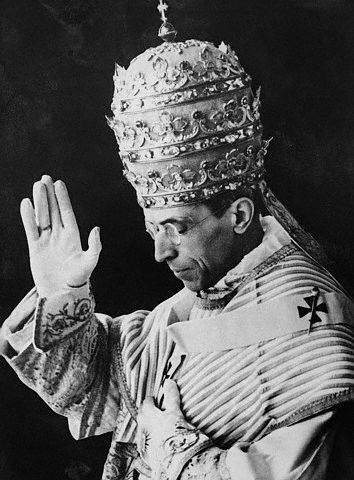 All this is not to say that we cannot live together in peace; I think that Pope Pius XII’s disposition toward the Jews during the Nazi years is a great testament to what it means to peacefully and mutually coexist, even without a total surrender of one’s own beliefs; his support and sheltering of Jewish Italians during the German occupation of the 1940’s was commendable, and is prompting many to pursue his cause for canonization. Oddly enough, the change in prayers is meant to reflect the post-Vatican II increase in mutuality between the two religions, but unfortunately this pre-conciliar relationship is so easily and quickly overlooked. To me, this seems a better example of what religious tolerance and respect entail: risking one’s life to save brothers and sisters, even if they do not share our same beliefs.
This is all really just an archetype for the bigger state of world affairs. The relationship between Catholics and Jews is a speck on the map, but this same misunderstood mentality of ‘religious tolerance’ seems to be encroaching ever more boldly into mainstream cultural life. Particularly of interest in Europe is the growing influx of Islamic peoples into formerly and originally Christian countries. If our mentality of inter-religious respect is a concession to another’s belief for fear of violating some superficial principle of non-disagreement, then the future of Europe as the home of Christianity is grim indeed. However, if true religious tolerance and respect stems from a desire to see the truth, and to help others see that same truth—which must always, as Christians, be rooted in Christ, who is both Truth and Peace—then we need to seriously re-evaluate our approach to dialogue and ‘collaboration.’ If no objective truth is put forth, dialogue between religions is fundamentally incapacitated from ever reaching any level beyond mere bickering. Prayer from the 1962 Missal: case and point.
More Breaks...
Posted by Andrew Haines in Seminary Life on 2.12.2008
A brief reprise of the post I put up last week: I have a guest in town until tomorrow, and thus my writing has been considerably lessened for the past few days. Moreover, I will be making a little pilgrimage to Toledo, Spain with one of my diocesan brothers this weekend and will obviously be unable to post then, too. Thanks, nonetheless, for your continued interest. I will be back at it in full swing by this time next week. Ciao.
Rejoicing in Suffering
Now that I've finished my exams (and all in one week, at that), I'll have a little more time to devote to writing and keeping this thing up-to-date. It seems like I've had a lot of great ideas floating through my head lately, but most of them seem to have been subsumed into the amalgamated blob of studies, which has ruled me for the past 7 days. Thus, something I can write about without much research (and no doubt should, seeing how this is a Catholic blog after all) is Lent; it seems like Christmas just happened! Alas, our great rejoicing has quickly turned into mourning and penance...or has it? When talking about Lent, it's hard to avoid cliches; almost anything you could think to say has been said before, and probably better by someone else. However, at Mass the other day I caught a line from one of our fifth-year student priests that struck me as original and truly insightful: "The burden of sin is most easily aleviated by charity." What hit me about this perfectly Catholic saying was precisely the way it drew together both penance and charity into one unified effort. Really, it is the perfect 'both/and' for the Lenten season; our penance means nothing if it is not both rooted in and expressed by acts of charity. After all, as this same priest mentioned, it is not by piling up heavy burdens on ourselves that we rid the world of sin, but rather by helping to aleviate the burdens of our fellow men. Charity.
If the goal of Lent is to see the Lord more and more clearly in our daily lives, then this seems to be precisely the way to start. After all, as St. John writes (and Pope Benedict XVI cites), "Deus caritas est ('God is love'), and he who abides in love abides in God, and God abides in him." (1 Jn 4:16) What better way to God than love? And what better model of love than the Son, who is the visible image of the Father and who 'abides' perfectly within his heart? Moreover, the same Son even gives us the exact formula for his own great love: "To lay down one's life for one's friends." (Jn 15:13) Indeed, if all this is true, "the burden of sin is most easily aleviated by charity."
This all comes as no affront to the significance of penance. Instead, it augments the importance of penitential sacrifice, giving it a telos ('end') that is otherwise unrecognizable; the goal of penance is charity, nothing less. No matter what penance we choose to offer during this season of Lent (even the classics of 'no sweets' and 'no TV'), we ought never to forget that the ultimate goal is Christ himself, and bringing about the kingdom that he so passionately desires for us. It's also worth mentioning that if this goal to bring about the removal of sin in our lives and the world is sincere, we should really consider a Lenten penance that will cause us some notable level of sacrifice. We hear from the prophet Joel an admonition to "rend your hearts, not your garments." (2:13) Heart-rending is not pain-free and neither can our penances be; how can something be 'penitential' if there is no sacrifice? Even more, the degree to which we empty ourselves in sacrifice is directly translatable to the level of space we have for God in our freshly rent hearts. The love he pours out to ease the pain diffuses into all our actions, thereby making them acts of charity; the telos is recognized and the burden of sin is most easily aleviated. All of this, though, requires dedicated prayer, for without some significant time in quiet prayer to the Father our penitential hearts become callused, and the sin we hoped to aleviate returns in even greater measure.
"The burden of sin is most easily aleviated by charity," and all things in prayer and Christ-like humility before the Father. Lenten penance entails mourning, but to an infinitely greater degree it requires rejoicing in the fact that, when united to the sufferings of Christ on the Cross, our small efforts really can make a huge difference.
Exam Week
Posted by Andrew Haines in Seminary Life on 2.05.2008
Sorry for the slowdown in posts lately. As the title of this post suggests, exams are here (ending the first semester in the Roman system) and I have to make some time to study. Thus, when I'm able I will write here, but for the next week or so I wouldn't count on much. Thanks again for all the readership and please pray for us!
"Take courage, for I have conquered the world." (Jn 16:33)
Posted by Anonymous in Church Doctrine, Philosophy on 2.04.2008
 I had the privilage of taking a couple from Hungary around St. Peter's Basilica the other day, during the tour this Hungarian man asked me many good and profound questions that strike the heart of the human person, religious or not. One of these questions that I will reflect on briefly is the question of evil.
Almost every person, no matter his or her religion, admits to a mysterious part of human existence called 'evil.' The Catechism of the Catholic Church speaks thus: "Every man experiences evil around him and within himself." (#1606) The questions remain, however, "What is evil? Does it have the last word? How can evil exist if God is good?" Anyone of these questions alone could be the topic of an upper level academic course, which would still only scratch the surface of the issue. Here I would just like to make some comments on evil with respect to the Catholic Tradition and in view of our faith in Jesus Christ.
The first and most pressing question, "from where does evil come," is layed out beautifully in the Catechism: "I sought whence evil comes and there was no solution," said St. Augustine, whose own painful quest would be resolved only by his conversion to the living God. We must therefore approach the question of the origin of evil by fixing the eyes of our faith on him who alone is its conqueror [Jesus Christ]." (#385)
So where does evil come from? Certainly, we believe that God created all things out of nothing and when He saw what He had created, "indeed it was good, very good." (Gn 1:31) If God did not create evil, then evil must be the result of something else. What though? How does evil exist if God is all powerful and all good? The answer we receive from the Tradition of the Church is that we were created in the image and likeness of God, Who is Love - which demands freedom as nothing forced is Love - and because we have been created in the image of the God Who is Love we must be free. Thus in allowing man freedom (the potential to love), man is also free to act in contridiction to his nature: not loving, or evil. The Church teaches that evil doesn't exist as its own substance (something created by God), but rather is always a deprivation of the good. It twists that which is good and thus evil is incurred. For example, when someone drinks water, that is a good thing. People can drink too much water however, and kill themselves by water poisoning. Someone could despair of their life and use water to kill themselves. Cocaine is still used today as a topical anesthetic, even for children, for eye, nose and throat surgery. This certainly is a good thing. However, as we know all to well, people abuse cocaine all the time and in many cases it ends up costing them their life.
Lastly, the Church teaches that God allows evil to happen so that He may bring about a greater good. The greatest evil humanity has ever committed is the rejection of the Son of God, Jesus, through our sins. You and I, the people who came before us and the ones that will come after us, we are all responsible for the death of Jesus because of our sins. God in His infinite goodness, however, brought the greatest human good and triumph out of the greatest evil: our salvation, the ultimate conquering of sin and death.
Although it often appears that evil has come away victorious, the Good God has won the game by the death of His Son Jesus Christ; we just have to run the clock out with style.
Praised be Jesus Christ!
Back in the U-S... S-A!
Posted by Andrew Haines in The Holy Father on 2.03.2008
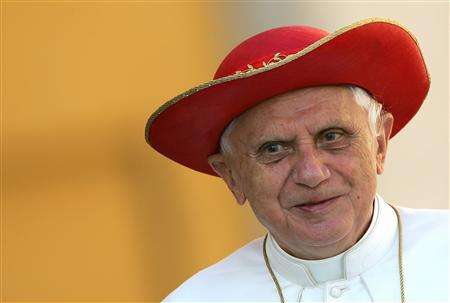 Well, not really 'back' either. But, Pope Benedict XVI's plans for an initial trip to the US have been confirmed, and here's the itinerary as made manifest by the Catholic News Agency (for those who haven't yet seen):
The Pope will arrive in Washington on Tuesday, April 15. Upon arrival he will meet with President George W. Bush and First Lady Laura Bush, and the next day he will visit the White House.
On April 16, Pope Benedict will also hold a prayer service and meeting with the 350 bishops of the United States at the Basilica of the National Shrine of the Immaculate Conception.
Thursday morning, the Pope will celebrate Mass at the Nationals Park in Washington, the first non-baseball event in the park. Later that day, he will visit Catholic University of America to deliver an address both to the heads of more than 200 Catholic colleges and universities and to school superintendents from 195 Catholic dioceses.
After the address to educators, the Pope will meet with Jews, Muslims, Buddhists, Sikhs, Hindus, and representatives of other religions for a prayer service at the Pope John Paul II Cultural Center near Catholic University.
Pope Benedict will leave for New York City on the morning of April 18. He will address the United Nations at 10:45 a.m. and at 6 p.m. he will hold a prayer service at St. Joseph’s Church in Manhattan.
The next day, the Pope will hold a 9:15 a.m. Mass for priests and deacons at St. Patrick’s Cathedral. He will meet with Catholic youth, including 50 disabled children, at St. Joseph’s Seminary in Yonkers.
On the morning of April 20 the Pope will visit ground zero, the site of the destroyed World Trade Center buildings. Following the Ground Zero stop, he will celebrate a Mass with 60,000 people in Yankee Stadium at 2:30, and will leave New York for Rome at 8 pm.
Also of note, the USCCB has put up a website here, which you can check out for further details on the trip. Tickets to the events will be hard to get (and are probably already sold out for some occasions, if I had to make a guess), so get your groups together quickly and get in while you still can. Go figure that the pope would make a trip to the States once I come to Rome. Although, I can't be too sad since I do pretty much live next-door to him...
Translations in Due Time
Posted by Andrew Haines in Liturgy on 2.02.2008
It seems that we’ve received a lot of site traffic concerning the upcoming release of the new translation of the Roman Missal (à la English). While I know nothing new—at least nothing newer than the rest of the general public—I do know that the wheels of progress turn ever-so-slowly in the Vatican, and this matter will certainly be no exception. The latest is that the International Commission on English in the Liturgy (ICEL) announced its plan to have the translation finished by its next meeting in September of this year. The commission’s last meeting in January was a continuation of translations and revisions on certain texts, which had earlier been commented upon by bishops around the world, as well as the Vatican’s Congregation for Divine Worship and the Discipline of the Sacraments. Ultimately—in September—when everything is finalized with the translation phase of the operation, the definitive text will then be re-submitted to local bishops’ conferences for “further processing and eventual publication.”
Now, what this really means I have no idea; I am a mere seminarian and the intimate workings of the universal Church far supercede the scope of my commentary. Certainly, the time it takes to translate, re-translate, edit, submit and finalize all these texts of the Roman Missal has some out there absolutely befuddled. Perhaps you are asking yourself: “How on earth can an organization like the Catholic Church—which has endured for 2000 years—be so absolutely inefficient in dealing with such simple matters?” If this sounds like what you are thinking, know that you are not alone. However, I would submit a spiritual element to these comments, which may help us all to understand the situation a little better.
There is a great little line from the Second Letter of Peter that speaks precisely to this occasion: “Consider the patience of our Lord as salvation.” (3:15) In fact, the reason that the bishops are re-translating the English version of the Missal again has to do with the hasty translation the first time around. Had we as English-speakers been more patient and prudent then, this second translation would likely have never come about. It’s easy to become impatient, especially when what’s happening is something we really care about (i.e. the an encounter with God in the liturgy). However, if what is truly at stake is our salvation—and it is nothing else that we ought to be concerned with when speaking of the liturgy—then St. Peter’s words ought to pervade our dispositions here especially. There is nothing worse than people up in arms about the liturgy, which is per se such a manifest act of unity in the Church. All we need to do is follow what the Church teaches us, open our entire selves to the Lord and adore his glory as he pours forth his grace through the Holy Sacrifice of the Mass. But, just as much, we need to give the same Church the time she needs to rightly present these mysteries, and to be as faithful as possible to the deposit of faith which she guards so carefully.


