What Idol?
Posted by Anonymous in Biblical Commentary, Theology on 10.31.2007
 “Little children, keep yourselves from idols.” - 1 John 5:21
What is an idol? When we think of idols today, normally we think of, as a standard dictionary will say, "An image or representation of a god used as an object of worship." This definition is dealing with something already theoretically conceived of as a god. However, practically there is a more subtle form of idolatry that makes a created thing an end in itself. Put simply, everything on earth is only to be used or sought in as much as it allows us to give glory to God. When we use things for a reason other than to give glory to God, we make them idols. Thus, practical idolatry, is the making of creatures into ends.
Certainly there are many who claim to believe in God, yet the real driving force in their life and their actions is the attaining of power, or money, or sex, or pleasure, etc. Does not someone who makes extraordinary sacrifices for money that would be more than what is sufficient for food, shelter, clothing, education of children, not make money his God? What do we say of the one who is overly preoccupied about how much pleasure he will receive from this food, having this piece of clothing, having this car, or getting this job? Are not pleasure and power his gods?
This passage of Scripture has certainly caused me to step back and evaluate my life and check whether my thoughts, actions and words are aimed at giving glory to God, thus a means to a greater end, or whether my thoughts, actions and words really just indicate that something or someone has taken the place of God and thus become my idol.
"When the people became aware of Moses' delay in coming down from the mountain, they gathered around Aaron and said to him, 'Come, make us a god who will be our leader; as for the man Moses who brought us out of the land of Egypt, we do not know what has happened to him.' Aaron replied, 'Have your wives and sons and daughters take off the golden earrings they are wearing, and bring them to me.' So all the people took off their earrings and brought them to Aaron, who accepted their offering, and fashioning this gold with a graving tool, made a molten calf. Then they cried out, 'This is your God, O Israel, who brought you out of the land of Egypt'... They said to me, 'Make us a god to be our leader; as for the man Moses who brought us out of the land of Egypt, we do not know what has happened to him.' So I told them, 'Let anyone who has gold jewelry take it off.' They gave it to me, and I threw it into the fire, and this calf came out." - Exodus 32: 1-24
Benedict & Beethoven
Posted by Andrew Haines in Prayer, The Holy Father
 A few days ago, Pope Benedict was treated to a live performance of Beethoven’s 9th Symphony by his very own (in some sense) Bavarian Radio Symphony Orchestra. [A brief aside: for those unfamiliar, let me personally urge you to listen to this piece of music. It is absolutely amazing.] Beethoven wrote the symphony—his last—toward the end of his life, after deafness “threatened to suffocate his artistic creativity,” as the Holy Father put it. For this reason, the “extraordinary finale of optimism and joy,” which provides the finale for the work, is all the more astonishing.
The pope applauded the composer’s “new way of listening that went well beyond a simple capacity to experience in his imagination the sound of notes read or written.” “God—sometimes through periods of interior emptiness and isolation,” said the Holy Father, “wishes to make us attentive and capable of ‘feeling’ His silent presence, not only ‘over the canopy of stars’ but also in the most intimate recesses of our soul. There burns the spark of divine love that can free us to be what we truly are.”
These comments are very fitting, especially in light of the last post on the form of Catholic liturgy; the tradition of the Church has always had a special place for beautiful music within its liturgy, and continues to hold one even today. Benedict’s inspiring words about the secular work of Beethoven’s 9th Symphony, which was based on Schiller’s poem, An die Freude, are even more applicable to music specifically composed for the Mass. If one can write music so beautiful about natural things, all the more can it be written about the mysterious life of the Holy Trinity and the gifts of grace that flow hence into our lives.
[Father Adam Hertzfeld, on his own blog in recent days, addresses the topic of ‘sacred music’ in much more detail. Click here for the link.]
Why Liturgy According to Tradition?
Posted by Andrew Haines in Prayer, The Holy Father, Theology on 10.30.2007
 Concerning things in Rome, and the pope in particular, the recent appointment of a new papal emcee (Master of Ceremonies) strikes me as something worth posting. Granted, I’m sure most of you could care less who the papal emcee is—it happens now to be Guido Marini—but there is a definite beauty about the mentality he brings to his job, and that seems to me very worth mentioning.
In a recent interview, Marini, who oddly enough is replacing another Piero Marini (that’s Italy for you…), describes the way in which he views his upcoming duties. In stating what he has planned for liturgies at the Vatican, Marini says: “What the Church wants and teaches, no more, no less. I am not the sort of person who looks for novelties or oddities. I might seem banal, but the liturgy needs respect for the rules dictated by the Church, and I don’t see any reason why I should ignore them… The Mass is a gift, a grace, not a show.”
I think this is right on—not from the vantage point of some supreme, totalitarian attitude, but with regard to the Catholic liturgy being a sort of ‘primary theology.’ In fact, within the context of the liturgy (i.e. the Mass, Liturgy of the Hours, Eucharistic adoration, Marian devotions, etc.), we encounter the fullness of revelation and the fullness of our Catholic faith. Jesus Christ, who is truly present in the Eucharist, especially, but also in the readings from the Gospel and in the presence of the community, constitutes the fullness of revelation; nothing is revealed which is not contained in the person of Christ. Also he is the fullness of our faith, because all we have to believe and practice is contained in the very life of this one God-made-man. The liturgy, then, where Christ is made present through the mysterious sacrifice of the altar, is precisely a theology accessible to all the faithful in the fullest sense.
For this reason, when the liturgy is celebrated by the ordinances of the Church—using the formulas provided and performing them with true and heartfelt devotion—the greatest good is incurred for both the parish and universal Church. The bishops in union with the Holy Father, in the grace and wisdom provided them by their important offices, do not intend to give us anything less than what we need to be good and holy servants of Christ on earth. Monsignor Guido Marini seeks to show us this in his role as papal emcee, and it is a lesson that we all ought to consider in our own ‘full and active participation’ at the sacred liturgy.
'Problem' vs. 'Mystery' in Daily Life
Posted by Andrew Haines in Philosophy on 10.29.2007
“In the last two or three centuries, and indeed since much more remote periods, there has been a great deal of critical reflection on the subject of truth. Nevertheless, there is every reason to suppose that, in our everyday thinking, we remain dominated by an image of truth as something extracted... It is, however, this very image of truth as something smelted out that we must encounter if we want to grasp clearly the gross error on which it rests.” (Gabriel Marcel, The Mystery of Being)
This is the quote with which I began my capstone paper for my undergraduate B.A. in philosophy. In short, I think it captures very well the prevalent situation of most modern thinking: namely, that our view of ‘truth’ is most usually of some scientifically accessible reality, upon which we found our daily actions and opinions. On the contrary, though, Marcel implicitly suggests here that truth really ought to be considered from a much more objective and, ultimately, less ‘problematic’ vantage point. Hopefully I can explain what I mean…
I would venture to guess that most of us view the major social phenomena in the world—such as poverty, for example—as problems to be solved. In other words, we see great and intricate occurrences as composed of parts, which can be solved, and that are projected toward us (in Greek, «pro» = toward; «blemenos» = thrown) by the world we live in. With this mindset, we eliminate automatically the possibility of a mystery higher than ourselves, and thereby limit truth to something we can dissect. On the contrary, Marcel suggests that we make room in our minds for truths that are not problematic (i.e. able to be solved by reason), but that are mysterious, and therefore must remain always somehow ‘unsolved.’
While this might initially seem inhuman—viz. it is not relegated to the function of reason—in reality, it appears more human than anything else. Human nature, if we look at it fully, is something quite mysterious; we cannot ‘solve’ the complexities of our own being by reason alone (for those who are familiar, one only need look to philosophers such as Descartes or the empiricists to realize this). Thus, making a place for mystery in our lives is simply allowing room for the realities that we cannot and will never explain by rational processes. In a word, we only realize the dignity of our humanity when we realize our deficiency in light of the greatness of the creation around us. Anything less is demeaning and ultimately destructive of what it means to be ‘human beings.’ Once we establish this base of ‘truth’ in our lives, our further analyses will appear much clearer, and we will be much better disposed to encounter reality in a productive and non-frustrated manner.
Some Thoughts on Blogging 'Ethics'
Perhaps it isn’t in total compliance with the aims of this blog to state the following—opinion/editorial isn’t what I’m about—but as a Catholic seminarian who desires to give his life to the Church he loves, I need to say it.
Alas, I find the Catholic corner of the ‘blogosphere’ to be decidedly and regrettably inundated with lots and lots of filth. All too often we, as Catholics, are all too quick to jump at some mundane and inconsequential event or statement and—for lack of a better term—make a mountain out of a molehill. For those who don’t realize what I’m talking about, you are perhaps better off because of it. However, if you happen to be a proponent of such ‘orthodox’ movements, please allow me to offer my two cents.
First off, there is nothing wrong with voicing opinion where it can be rightly treated, namely in an atmosphere permeated by mutual charity and good will; when we urge one another on to betterment, we serve the Lord and his greater glory by more definitively enunciating the mission of the Church. Thus, I am all for discussing important (and even sometimes trivial and esoteric) topics in the public forum.
That being said, my second point is that this must always be done in a spirit of genuine Christian charity. Unfortunately, it seems that many of the Catholic bloggers on the internet today seem to quickly forget this basic principle. My intention is not to point fingers at anyone in particular (since this is obviously a pretty general post), but instead to simply state that, in any discipline of study or discussion, the benefit of the doubt must always be given to the object of one’s criticism; hiding behind anonymity online is no substitute for good ole’ fashioned decency. We ought not say anything on a blog—which is in print, nonetheless—that we would not be able to rightly defend in the face of our opponent.
I’m not sure who constitutes the readership of In Umbris Sancti Petri, but if some of you other bloggers(?) care to weigh in on the issue, I’d welcome your comments. The internet is a great medium of discussion and catechesis, but can also serve to shoot the Catholic faith in the foot if used inappropriately. I hope that I am furthering the positive end of blogging instead of the negative.
Papal Message for the New School Year
Posted by Andrew Haines in Seminary Life, The Holy Father

Sorry for the interruption in posts; lots of reading and little time to write. However, a couple nights ago (Thursday, October 25th), I had the chance to go and hear the Holy Father speak at the Mass for the opening of the academic year of the Roman universities. The liturgy was held at St. Peter’s Basilica, celebrated by one of the Cardinals working in the Vatican, and the pope appeared at the end to give a little talk. Although the message was specifically directed to those studying in Rome, it no less has a distinct value for anyone studying at an institute of higher learning (or independently for that matter), in that we are all called to use our education for the 'greater glory of God.' Here are some clips of what the Holy Father had to say [pardon any translation errors/cumbersome language on my part]:
“This annual meeting—which gathers here, in the Vatican Basilica, the entire academic family of the ecclesial Roman universities—permits you, my dear friends, to better notice the remarkable experience of communion and fraternity which you will partake in this year: an experience which, to be fruitful, requires the contribution of each one of you. Together, you have all taken part at the celebration of the Eucharist, and it is together that you will spend this new year. Seek to create among yourselves an atmosphere where the commitment to study and fraternal cooperation provides a common enrichment not only concerning aspects of culture, science and doctrine, but also human and spiritual ones.”
“In effect, this period of permanence in Rome can and should serve to prepare you to better carry out in the world the work that awaits you in different fields of apostolic action. The evangelical mission of the Church in our age asks not only that the message of the Gospel be preached everywhere, but that it profoundly penetrate the ways of thought—the principles of judgment and behavior—of all people. In a word, it is necessary that all contemporary human culture be permeated by the Gospel… The possibility to study in Rome, the seat of the Successor of Peter and thus of the Petrine ministry, will help to reinforce this sense of membership in the Church and the commitment of fidelity to the universal magisterium of the pope.”
“I assure you that I will remember you in prayer and, wishing you a peaceful and fruitful year, confer this promise upon you with a special Apostolic Blessing.”
Scientia Dei: Mysteria Dei
Posted by Andrew Haines in Theology on 10.23.2007

The title ‘theologian’ is something thrown around quite a bit today; almost any Catholic university—and many other religious and non-religious universities—have some sort of ‘theological faculty.’ The impression given is that a theology department should be something as commonplace as one of economics or communications. While I wholeheartedly agree with this notable importance placed on the study of theology, I strongly disagree with the way it’s been presented in most modern universities.
Theology, as defined by theologians, is the ‘science of God’; in other words, the intellectual study of God in order to better understand his being and presence in the world by means of looking at divine revelation. (N.B. This differs from philosophy, which also seeks after a First Principle [i.e. ‘God’], in the fact that theology concerns itself with God’s revelation and not his metaphysical and naturally recognizable ‘make-up.’) The popular opinion seems to be that anyone can do theology, believer or not. However, as much as I’d like to agree (since then we’d all be theologians!), it simply is not true.
In order to ‘understand’ something—in the proper sense—that ‘something’ must first exist; I think we’d all admit that. However, a non-believer doing theology is just the opposite, i.e. a person trying to understand a reality that they do not admit to be real. In the end, it’s simply an absurd thing to admit! On the contrary, faith must always be present if true ‘theology’ is to be done. Theology is more than just the ‘science of God’; it is the study, as St. Paul writes, of the ‘mysteries of God.’ Theology is fides quaerens intellectum, or ‘faith seeking understanding.’ Faith must inevitably be the grounds for theology. Period.
Keeping that in mind, then, we ought to take a look at many university ‘theology departments’ and say: “Well, maybe it isn’t so right to call those professors theologians, en masse. Perhaps it would be better to call those faculties ‘departments of religious history,’ or ‘religious anthropology,’ but not ‘theology.’” Preserving the meaning of the term theology is just as important as doing theology itself, since a misapprehended term can lead innumerable people to draw wrong conclusions about the nature of what it means to study the ‘mysteries of God.’ Don’t get me wrong—we need to study religion as a whole, and religious anthropology, but they need to be identified properly, even for their own sakes as disciplines of study.
The more one understands what it means to study theology, the more they should grow in an intense love of God and His revelation, offered through the natural order of creation, but most fully in the salvific mission of Jesus Christ.
A Bit About the 'Greg'
Posted by Andrew Haines in Saints, Seminary Life on 10.22.2007
Whilst in class today, one of our professors was giving us a brief history of the Pontifical Gregorian University. Although I knew a few things about the school, he told us some interesting facts that I thought would be worth sharing… after all, I’ll be here for 4 years, and I hope you’ll be reading my blog during that time, too!
The Gregorian—or ‘Greg’ as we call say—is the result of the original ‘Roman College’ founded by St. Ignatius of Loyola over 450 years ago. Now, it has one of the largest faculties of theology of any university in the world, and has over 1600 students from around the globe. (cf. Wikipedia)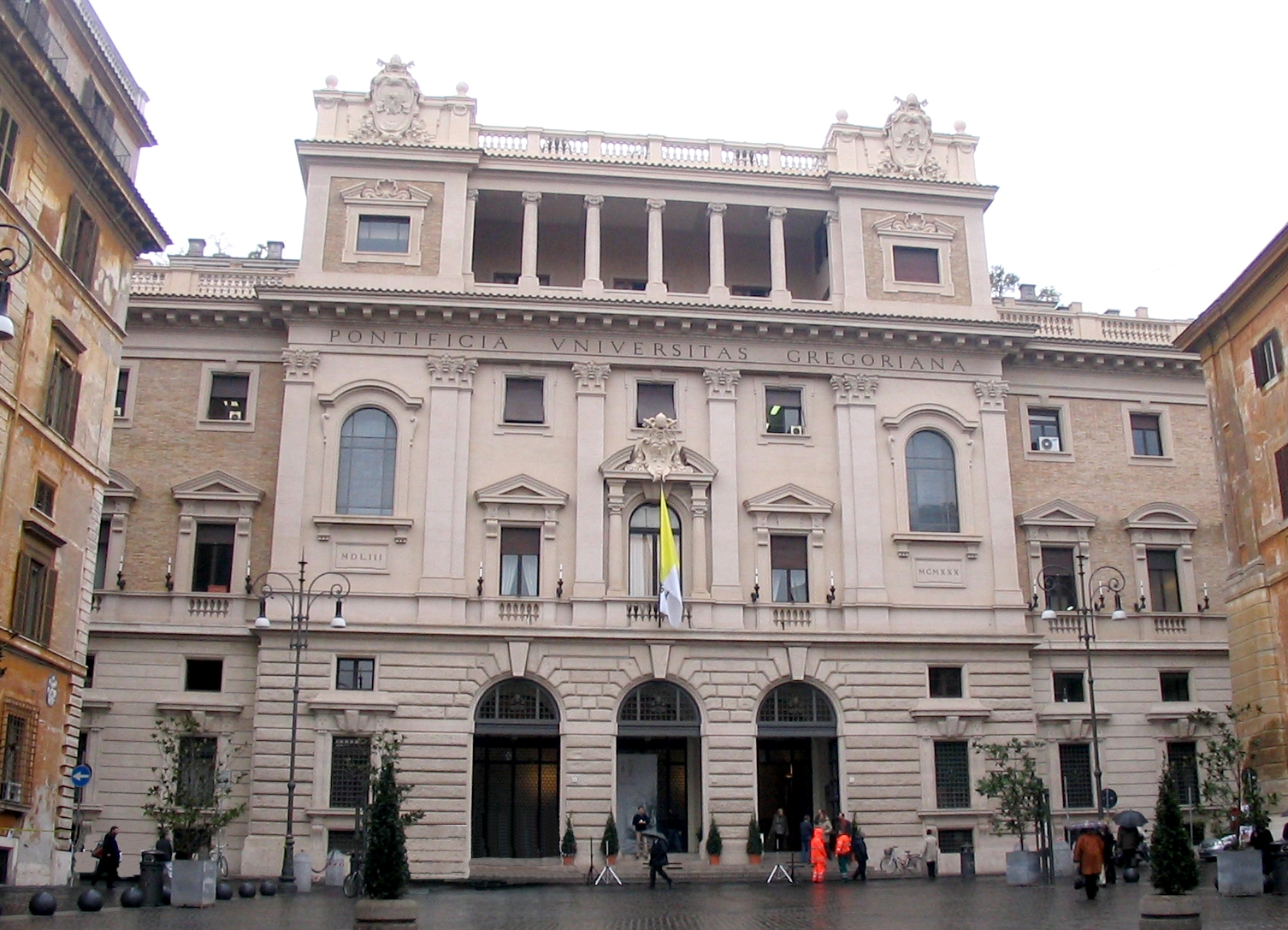
Although it was originally begun as a small institute, Ignatius’ Roman College eventually found a grand home in a new building on the Piazza Collegio Romano in Rome (across from the Palazzo Doria Pamphilj downtown, for those who might care…). Pope Gregory XIII provided gracious funding for this school, and ever since it has retained the name of Gregoriana. When the Kingdom of Italy—the first unified kingdom in quite some time—took over the city of Rome, the Church was forced out, and the College was confiscated and relocated. At this time it was granted ‘pontifical’ status, simply meaning that it was placed under the direct care of the Vatican and thereby protected from ultimate destruction. In 1930, the Gregorian was given its present home on the Piazza della Pilotta, which is very near to the heart of the ancient city, and the place I take classes today. [The picture above is of the current façade.]
Throughout the college’s history, many important people have passed through its halls: St. Ignatius of Loyola (founder), St. Robert Bellarmine (rector, Cardinal), St. Maximilian Kolbe (martyr of the Holocaust), over 15 other canonized saints and, in total, 14 popes. In short, the university has been the seedbed of many of the Church’s doctrines and teachings, having provided a basic theological education to many of history’s greatest thinkers. It goes without saying that I feel about as small as dust when I walk into the classroom each day and remember those who sat in the same, uncomfortable seats before me. For my brother seminarians and myself I ask for your continued prayers, that we might gain what we can from this amazing experience of theology and faith, and someday be able to convey the Church’s mission of salvation and charity to the entire world.
Sant’Ignazio, prega per noi!
Radical Holiness Conquers Evil
Posted by Andrew Haines in Theology on 10.20.2007
I’ve been doing a pretty poor job of keeping up on making posts lately. Sorry. We’ve been really busy here at NAC and writing blog entires has been unfortunately demoted to next to last on my list of things-to-do… right above exercising. Nevertheless, I will continue to try and post on a (quasi)daily basis, and attempt to make them interesting and relevant at that.
Recently, I’ve been quite struck by the impact that we can make on people’s lives in very small and often overlooked ways. That being said, I am also greatly aware that making statements like the one I just made has become absolutely cliché—and I don’t intend to flatter you with humble platitudes…
Here’s the deal: we are all called to be radically holy. Radically holy! I mean being holy, period, is pretty much off most people’s radar screen—how in the world are we supposed to be radically holy? Certainly, we hear the word tossed around at Mass on Sundays, we sing about it in songs, and some actually even ask God to make them such, but what do we intend?
God understands our weakness—our continual self-absorption and ego-driven, consumeristic mindset; after all, he is God. But, saying that he understands us does not mean that he desires us to continue being that way. Maybe I can word that even more strongly and say that he actively and passionately desires us to be otherwise, even to the point of sending his Son to die for those sins we indulge in each day. This distinction is precisely the difference between pop-psychology and real religion: popular ‘spirituality’ says, “God understands and won’t judge us harshly”; true faith says, “God understands and expects us to change, so that when just judgment is offered, we might be granted the good he also desires to give us [i.e. eternal life].”
In the first case, God judges lightly, but at the same time is really devoid of offering any real good to us since we aren’t willing to concede that he actually has the power to do anything. In other words, most popular modern notions of God’s mercy fail to see him as God, and instead project an idea of human ‘mercy’ (full of its inadequacy and finitude) onto the divine, simply allowing him to overlook evil. God can overlook evil—in fact he can destroy its power—but to do so man must be willing to cooperate, since we are the creators of evil, and thereby continually subject to it until we allow God to take it from us.
I say again, we are all called to be radically holy, and to offer others the small and often overlooked acts of charity that provide such a huge impact on their lives. However, I mean it in light of this greater scope of the reality of God’s mercy. Our charity provides more than simply a cozy feeling to someone in need; it is an assent of our will to the will of God in overcoming the evil that permeates this world, and thereby launches us—with divine assistance—toward the ultimate and achievable end of true sanctity and eternal life.
Novi Cardinali Sanctae Romanae Ecclesiae
Posted by Andrew Haines in Church Doctrine, The Holy Father on 10.18.2007
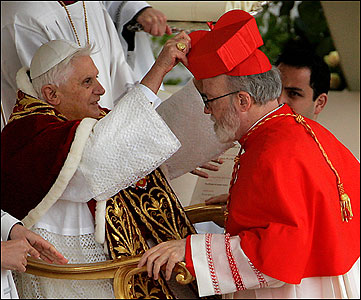
Yesterday, at the general audience in St. Peter’s Square, Pope Benedict XVI announced the coming appointment of 23 new Cardinals of the Roman Catholic Church. What a perfect chance, I thought, to clarify a bit about what it really is to be a Cardinal; in the media, all the governing structures of the Church are something often cited but rarely explained. The Code of Canon Law—the law governing the Church—gives the authoritative definition of what it means to be a ‘Cardinal’:
“The Cardinals of the Holy Roman Church constitute a special College, whose prerogative it is to elect the Roman Pontiff in accordance with the norms of a special law [i.e. the approved practice upheld by the pope at the time]. The Cardinals are also available to the Roman Pontiff, either acting collegially, when they are summoned together to deal with questions of major importance, or acting individually, that is, in the offices which they hold in assisting the Roman Pontiff especially in the daily care of the universal Church.” (Codex Iuris Canonicis, Can. 349)
In a more colloquial (and less juridical) manner, one could say that the Cardinals of the Church are those priests and bishops summoned by the Holy Father to dedicate themselves even more so to the Church’s mission of evangelization and salvation. Some of the most noticeable characteristics of the Cardinals—their red cassocks and hats—signify their willingness even to shed their blood for the faith. Unfortunately, this meaning has been all but lost in our modern world, and contemporary media, which almost never seeks to understand the origin of traditions, but simply their utility in modern culture. In reality, Cardinals are generally chosen from among the more prominent dioceses around the world, in order to provide both a visible symbol of the faith and a dominant spiritual leadership for multitudes of people in every socio-economic situation. Even in China, where today priests and bishops are shedding their blood for the Catholic faith, Cardinals have taken the lead in sustaining their local churches and preserving the faith from a government-lead genocide.
Far more than simply being the ‘red-robed Princes of the Church,’ as they were commonly (and no doubt tauntingly) referred to during the last papal election, the Roman Cardinals are a visible symbol of the 2000-year-old tradition and faith of the Catholic Church. Although they are human—and thereby just as much sinners as you and I—they hold a very profound responsibility, and we ought to continually remember them and their mission in our prayers.
"Little Things with Great Love"
Posted by Andrew Haines in Seminary Life on 10.16.2007

This post really falls far from my recent and more philosophical ones, but I had the coolest experience today. Rome is full of surprises, and I was the recipient of a couple all in the course of a few short minutes.
I was on my way over to St. Peter's today to visit the basilica (something I definitely don't put enough time into on a regular basis), and I happened to pass a girl and her little son sitting in the tunnel to the parking garage, begging for money. It's not really that unusual to see, and I've taken to trying to start a little conversation with most of them, if I can, instead of just simply walking by them. As a seminarian, I don't have much money to give, but I do have a few months of Italian at my disposal, so taking a minute to talk is something I can do.
Anyway, I asked if I could sit down and talk and she said, "sure." So, for a few minutes I talked with her and her little boy, who I found out was about a year-and-a-half old. While I was sitting there talking, another man walked by and offered the girl a bag of "cheese curls," which she accepted gratefully. It must have been providence because Mario, her son, was getting a little restless and obviously needed a snack. So, she opened the bag and gave him a few. Well, no sooner had he eaten one or two than he was offering me some of his cheese curls! Imagine my surprise when the poor little boy, whose mother dragged him out into the streets everyday to beg for money, was offering me some of his beloved snack.
I suppose I can't really say much to describe what I'm trying to convey here; I was profoundly humbled by the selfless love of a little boy and his mother, themselves intensely humbled by begging in the parking garage day in and day out. Mother Teresa's words came to mind while writing this post: God desires us not to "do great things, but to do little things with great love." Mario definitely showed me that today.
The Meaning of 'Belief'
Posted by Andrew Haines in Philosophy, Theology on 10.14.2007
As part of my seminar course at the university this fall, I was given a great article to read: On Faith, by the German philosopher, Josef Pieper. The essay is a beautiful summary of what we should mean when we say ‘I believe.’ “To believe,” writes Pieper, “always means: to believe someone and to believe something… The believer—in the strict sense of the word—accepts a given matter as real and true on the testimony of someone else. That is, in essence, the concept of belief.”
In this simple diagram, a key distinction of belief is laid out, namely that faith requires belief in both someone and something. “These twin elements [however]…are not to be taken as a structureless parallel, a mere coordinate existence of the two elements side by side. It may very well happen that one person can accept as true something another says without necessarily believing the other.” For example, in a courtroom, the jury believes what a person says not because the witness has integrity, but because the report of the situation aligns with demonstrated evidence. This, however, is not ‘belief’ in the pure sense. Instead, it is a scientific knowledge based on facts that simply coincide with someone (i.e. the witness) attempting to persuade with mere words. “Thus this certainty has nothing to do with belief.”
Instead, if a believing person is asked to indicate what he believes, “he would not need to name the individual items of his creed; but if he wished to be perfectly precise, he would have to point to his authority and reply: ‘I believe what that person has said.’… If we pursue this consistently, it follows that belief itself is not yet ‘purely’ achieved when someone accepts as truth the statement of one whom he trusts, but only when he accepts it for the simple reason that the trusted person states it. That, of course, is an extreme position, which seems almost to verge upon unreality.”
In short, the basis for faith on the human level can be neither factual (since that is simply ‘knowledge’) nor completely blind (since that is not rational). However, I would venture to say that we all desire a pure belief in something, since it is a beautiful thing to believe whole-heartedly in a reality that we cannot prove; really, it seems to be an innate desire of the human person (viz. friendships, love, etc.).
It is precisely this intersection of something super-rational—pure belief—and something absolutely human—the desire for pure belief—that is reconciled in the person of Jesus Christ: God-made-man alone is sufficient in fulfilling both desires, which would otherwise oppose one another and frustrate us to no end. Even in strictly philosophical terms, the utter necessity of a Savior is demonstrated, precisely because of his ability to announce the Father’s will and subsequently uphold his own credibility: through his Passion, death and Resurrection, but also through his necessary, metaphysical reality as ‘mediator between God and man.’ If we desire belief—and truly passionate, human belief at that—we must look no further than the person of Jesus Christ.
[J. Pieper, “On Faith. A Philosophical Treatise,” in Faith, Hope, Love, San Francisco, 1997. Section II.]
Belief in Non-Being?
Posted by Andrew Haines in Philosophy on 10.13.2007

In the vein of current events, here’s one that hits on the topic of my post about Truth and Tolerance from a few days ago. Starting this week, a formerly local, now nationally broadcasted radio show will hit the airwaves—the topic: atheism and the freedom from religion. Certainly, the creators of the show have all the freedom in the world to go about promoting their show just as I try to promote this blog. In fact, its not all with the show being aired that I’m concerned; that’s perfectly legitimate, and I think most grounded thinkers would agree with me.
There is something else that strikes me as profoundly odd, though, about this whole ordeal of a mainstream atheist radio show, promoting atheist ‘ideals.’ Maybe I’m way off, but it seems to me that the major difference between atheists and theists (i.e. anyone who believes in a divine being) is that the latter believes in something while the former does not believe in that thing/being. Quite probably, the astute reader would ask here: “Well, don’t atheists still ‘believe’ that there is no God?” This seems logical enough, at least on the surface, and so it seems that I’ve made a gross overstatement… but I’ll try to defend myself and show why atheist radio—if it really is truly atheistic—doesn’t make much sense.
The long and the short of it is this: religious persons believe in God because they think that 1) he could exist and 2) put their faith in that assumption of existence. On the contrary, I don’t think an atheist can ‘believe that God doesn’t exist’; I think a ‘devout’ atheist would be forced to simply deny the question of God altogether. I mean, if someone even acknowledges that there may or may not be a God—in whom I may or may not believe—then they’ve already conceded in some small way to the reality of God, if even only on the theoretical level. Think of it this way: those who believe in the Christian God, for example, do not prove their faith in him only by denying the non-existence of God. In other words, theists have a positive belief of God (in whatever form), and not simply a negative denial of God’s being. A true atheist, likewise, cannot simply deny the existence of what he doesn’t believe in (i.e. God), but must positively believe in the lack of God’s being.
Now, I apologize if I’ve gotten ahead of myself here—it’s a hard thing to talk about—but I think the perplexity of the wording itself assists in showing the chaos of the atheistic situation. How can someone formulate a positive belief for non-existence? In philosophic terms this is an impossibility, since belief itself exists and cannot comprehend non-being. Anytime we ‘believe something does not exist,’ we simply mean that something we already know is not present; try to imagine something composed of parts that you’ve never seen before—you can’t do it! I think the same is true here, with an atheistic position; it’s simply impossible to ‘believe that God doesn’t exist.’
So—back to my original point—what good is a radio show that is intended to provide evidence for atheism when the atheistic position itself is unable to be supported by virtue of its own negative nature? How can atheists support one another—they can’t not believe in God together, so they must be simply confined to helping one another cope with the reality that their grand idea of ‘atheism’ is totally insupportable to anyone who’s not already like-minded. I don’t know… as entertaining as that sounds, I think I’ll just stick with believing in things. It’s much more edifying and promotes much healthier friendships!
World Peace?
Posted by Andrew Haines in Church Doctrine, Theology on 10.11.2007
This was too much to pass up…
In a recently released letter by a team of 138 leading Islamic scholars, Muslims all over the world—as interpreted by this constituent team, I can only presume—are calling out for an open dialogue between Muslim and Christian leaders for the sake of the “survival of the world.” The letter was addressed to Pope Benedict XVI and other Christian leaders throughout the world in an apparent attempt to quell the violence which occurs between Christians and Muslims the world over. “Finding common ground between Muslims and Christians is not simply a matter for polite ecumenical dialogue between selected religious leaders,” the scholars say. “Together [the two religions] make up more than 55 per cent of the population, making the relationship between these two religious communities the most important factor in contributing to meaningful peace around the world. If Muslims and Christians are not at peace, the world cannot be at peace.” (cf. FoxNews story)
Without going into this letter specifically (since I’m sure it’ll get enough publicity the way it is) and without talking about politics (since that’s not what I’m about), I think it is absolutely fundamental to discuss briefly the reasons why we find this current global situation in the first place. It would take a book to cover them all, no doubt, but there seems to be one glaring criterion of truth that is all but forgotten in most circumstances…
Throughout history, since the foundation of Islam, these two major world religions have continuously vied for control in areas such as the Middle East. Today, this ‘battle’ is beginning to rage even more viciously across the European continent and, in some part, the Americas. Although both religions profess to be peaceful, a fallen human world (and thereby fallen human agendas) no doubt penetrates both to a great degree. Thus, it really isn’t all that surprising that there is such a continual problem with peaceful relations.
That being said—and this is what I wanted to point out especially—it must be noted that most people make a huge and erroneous generalization when speaking of ‘Christians’ and ‘Muslims.’ Although the Christian world strives to be united in Jesus Christ and, ideally, one Church, there is still a network of deep divisions that separate the various notions of ‘Christianity’ accepted in the world today; while some Christians really are peaceful people, some are simply violent people parading around under the guise of “peace” and “acceptance.” Let me simply state that true peace does not mean the absence of all conflict, but rather the underlying joy in Christ that permeates the sincerely Christian life. To identify ‘Christianity’ as the general assembly of all who nominally profess to follow Christ is not sufficient. Likewise—and I am no scholar of Islam, but this I can say confidently—there are many sects of in the Muslim world that are often taken as one, collective whole. Since there is no unified and centrally accepted Islamic doctrine that encapsulates all Islamic sects, we cannot rightly speak of ‘Muslims’ in a truly collective sense.
Although this just scrapes the surface of what underlies the tension in the religious world today, I think it is an angle all too often left aside, either by the media or in forming personal opinions. However, it is most certainly one in need of consideration, since without an actualization of the division between men we cannot truly hope to heal the wounds that separate them. We’ll just have to wait and see what happens with this proposed summit of religious leaders called for in the letter, but in the mean time we can definitely do a lot of reflecting about what it really means to be Christian (or Muslim), and how that influences everything from our world-view to our own relationship with God.
"Lead Us Not Into Temptation..."
Posted by Andrew Haines in Prayer, The Holy Father, Theology on 10.10.2007

“The way this petition is phrased,” writes Pope Benedict XVI, "is shocking for many people: God certainly does not lead us into temptation. In fact, as Saint James tells us: ‘Let no one say when he is tempted, “I am tempted by God”; for God cannot be tempted with evil and he himself tempts no one’(James 1:13).” (Jesus of Nazareth, pp. 160-1) Indeed the pope has it right; this petition is probably one of the hardest to understand among all the petitions of the Our Father, at least in terms of its structural make-up.
There is a definite aide to our understanding, though, coming from Scripture, which the Holy Father points out immediately: “‘Then Jesus was led up by the Spirit into the wilderness to be tempted by the devil” (Mt 4:1). Temptation comes from the devil, but part of Jesus’ messianic task is to withstand the great temptations that have led man away from God and continue to do so. As we have seen, Jesus must suffer through these temptations to the point of dying on the Cross, which is how he opens the way of redemption for us… ‘For we have not a high priest [i.e. Jesus Christ] who is unable to sympathize with our weaknesses, but one who in every respect has been tempted as we are, yet without sin’ (Heb 4:15).” (p. 161) Referring to these particular passages from Scripture, it becomes a little easy to see what Christ means when he instructs us to pray this rather odd petition; in a profound sense—and in conjunction with Scripture as a whole—he is showing us his own role as Savior and his own willingness to be subject to human temptation.
On a slightly philosophic note… Catholic theology reveals Satan as “[deriding] man in order to deride God… The reality is that the only thing man—each man—ever cares about is his own well-being,” according to Satan. (p. 161) Ironically, a similar vein emerges in Platonic philosophy, particularly in the Republic, where Thrasymachus attests that virtue (specifically ‘justice’) is the “advantage of the stronger.” While these two instances—revelation and philosophy—seem quite separate, the fact that human nature is automatically inclined to see goodness as “what’s-good-for-me-now,” the same offered by the devil, makes it ever more clear where the role of Jesus Christ comes into play; as completely man and completely God, he really is able to redeem fallen humanity by taking on the fullness of human misery, even the natural human tendency toward self-comfort. In this way, when we pray “lead us not into temptation,” we should always remember not only our own temptations, but also those endured by our God for love of us. Ultimately, this greater mystery will lead us more fully to the presence of God, Our Father.
Truth & Tolerance: Ratzinger’s Book and a Popular Conversation-Starter
Posted by Andrew Haines in Philosophy, The Holy Father, Theology on 10.09.2007

In 2002, the former Cardinal Ratzinger – now Pope Benedict XVI – published a little book entitled Glaube—Wahrheit—Toleranz, or Truth and Tolerance. The premise of the book, as you might have guessed, is the interplay between modern secular society and traditional religious positions: the current juxtaposition of ‘truth’ with ‘tolerance’ and – in the German – ‘belief.’ Although I’m still working through the book, the title alone was enough to inspire me to post something on this topic.
While I’m sure Ratzinger’s thesis is good, it doesn’t take reading an essay from a prominent theologian to get one thinking about the meaning of “truth” in modern culture. In fact, the topic is one that any rational being must indispensably confront. How many times do we see it throughout history: “What is truth?” And still, most people would argue that we have no real answer. The irony of the matter is that, since we are all rational persons, we require truth in order to make decisions, yet often fail to agree that such a thing really exists. It seems like the paradox of all paradoxes, and… I think it might be.
To illustrate this point, perhaps the most evident case of ‘practical agnosticism’ in today’s world – one that we can all relate to – is the increasingly popular denial of a need for God. Man no longer finds a need for God and grows more and more toward the mindset of theoretical atheism, that is to say, toward an atheism not only of practice but also of professed belief. Coincidentally, an outspoken desire for ‘freedom’ continues to rise, both in societal and academic communities (which often overlap, viz. almost any university you can think of). This opposing trend between a desire for freedom and a disgust for God strikes me, personally, as particularly odd – it seems contradictory in many senses, since a well-formed philosophical/theological notion of God seems not to be a hindrance to freedom but rather a guarantee of its quality and dignity. In other words, society’s tendency seems brashly to disregard a rather apparent ‘truth.’ Nevertheless, though, we are subjected to these and similar ideas day in and day out; whether or not we agree with them (or are even conscious of them), they easily become lodged in our minds and inspire us – or at least ought to inspire us – to consider more seriously the place of ‘truth’ in our lives.
Although this was just an example, I hope to continue this thread in future posts, addressing this modern phenomenon from a few different angles. I hope that by fleshing out some personal ideas (yours included) as well as consulting the work of noted scholars, such as Pope Benedict XVI, this topic should prove to be quite engaging and, if nothing else, thought provoking.
"Forgive Us Our Trespasses..."
Posted by Andrew Haines in Prayer, The Holy Father, Theology on 10.08.2007
The fifth petition of the Our Father – “…and forgive us our trespasses, as we forgive those who trespass against us” – must be recognized by anyone, Christian or not, as a profoundly important idea. Christ’s instruction on forgiveness, writes Pope Benedict, “presupposes a world in which there is trespass – trespass of men in relation to other men, trespass in relation to God. Every instance of trespass among men involves some kind of injury to truth and to love and is thus opposed to God, who is truth and love.” (Jesus of Nazareth, p. 157) What a simple yet overwhelming conclusion this is; in a nutshell, it identifies both the role of God as Creator and Father, and the role of humanity as called to love God and seek His truth. But, alas, sin pervades the world, and so God must give us a model not only of love, but of forgiveness as well.
“‘Forgiveness’ is a theme that pervades the entire Gospel. We meet it at the very beginning of the Sermon on the Mount…You cannot come into God’s presence unreconciled with your brother; anticipating him in the gesture of reconciliation, going out to meet him, is the prerequisite for true worship of God. In so doing, we should keep in mind that God himself – knowing that we human beings stood against him, unreconciled – stepped out of his divinity [in the Incarnation of Jesus Christ] in order to come toward us, to reconcile us.” (p. 158)
“If we want to understand this petition fully and make it our own,” Benedict writes, “we must go one step further and ask: What is forgiveness, really?...[F]orgiveness must be more than a matter of ignoring, of merely trying to forget. Guilt must be worked through, healed, and thus overcome. Forgiveness exacts a price – first of all from the person who forgives. He must overcome within himself the evil done to him; he must, as it were, burn it interiorly and in so doing renew himself. As a result, he also involves the other…and both parties, suffering all the way through and overcoming evil, are made new. At this point, we encounter the mystery of Christ’s Cross,” (pp. 158-9) and it is exactly this final point that makes Christian forgiveness so unique. Forgiveness – real forgiveness – is not within the power of the human person; it is too great a task. Instead, if we truly desire to forgive, we are obligated to participate in Christ’s sacrifice on the Cross, which fulfills what is lacking in our own ability to forgive. In this way, we truly participate fully in our role as member in the mystical Body of Christ, and grow ever closer to the Father, to whom the Our Father is directed.
Pope's Council Speaks on Natural Law
Posted by Andrew Haines in Church Doctrine, The Holy Father, Theology on 10.06.2007
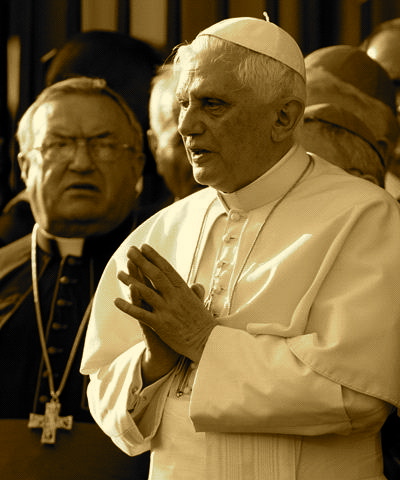
I apologize in advance for the probable ‘headiness’ of this post… it might be worth reading though, if you have a minute.
Just last Friday, the Holy Father’s hand-picked International Theological Commission concluded one of its annual sessions – the primary topic: ‘natural moral law.’ While this is a huge topic, I’ll try my luck at explaining it in some concise way. It has long been the tradition of the Catholic intellectual discipline that a ‘law’ of human moral behavior exists within the heart of the human person as an interior, essentially human guide to goodness; this idea was developed in the works of scholars such as St. Augustine and St. Thomas Aquinas, and continues to be an underpinning premise for the Church’s declarations on moral theology.
The basic idea of ‘natural moral law,’ as I briefly wrote above, is that morality can and should rightly be determined from a human vantage point. In other words, man possesses the capabilities within his very soul to determine the moral value of an act, given that he is rightly informed of the truths surrounding it. For this reason, natural moral law is not simply subjectivism – ‘whatever I think is what is right’ – but is rather a profoundly insightful view of the integrity of the human person; it accentuates man’s ability to reason correctly, even so far as to make complex moral decisions based on the light of informed reason alone. Certainly, an understanding that God created man out of love, and that He designed man in such a beautiful way greatly enhances one’s understanding of ‘natural moral law’ – it isn’t simply a fluke of nature, but rather an intentional dignity bestowed on the human person by a loving Father who desires us to be truly happy.
In keeping with this view, the Commission’s responsibility was to continue shedding light on such an important and relevant topic. Below is an excerpt from the Holy Father’s address to the Commission on Friday, expressing his thanks for their significant work. [N.B. Pardon my novice translation from the Italian text.]:
“The Catechism of the Catholic Church summarizes well the central meaning of the doctrine of natural law, noting that it ‘indicates the primary norm and essentials which regulate the moral life. It has as its focus the aspiration toward and submission to God, source and judge of all good, and furthermore the sense of “other” as equal to that of “self.” In its fundamental precepts, it is laid out in the Decalogue [Ten Commandments]. This law is called “natural” not in regard to the nature of irrational beings [i.e. animals, with which it has nothing to do], but because the reason that it promotes is proper to the nature of humanity.’ With this doctrine, two essential finalities are reached: on one hand, it is understood that the ethical meaning of Christian faith does not constitute a dictated imposition from outside man’s conscience, but rather a norm that has its foundation in the same human nature; on the other hand, beginning from the standpoint of natural law, which is accessible to every rational creature, it serves as the base for entering into dialogue with all people of good will and, more generally, with civil and secular society.”
Spiritual Direction: Why Do It?
Posted by Andrew Haines in Prayer
With a world as fast-paced as ours today, maybe the better question is, “Why not do spiritual direction?” All of us need a little time to process the mountains of information we’re exposed to on a daily basis – everyone from stay-at-home mothers to kindergarten students is bombarded with a whole flood of media each day. (N.B. I’m not recommending spiritual direction to kindergarteners, but mothers are at the top of the list!) How can we possibly find the time, or the energy, to find out where the Lord is speaking to us if we don’t step back for a minute and just calm down?
Saint Ignatius of Loyola, founder of the Society of Jesus (i.e. Jesuits), wrote a lot on the nature of prayer. In his Spiritual Exercises – or essentially, Prayer for Dummies – he provides many helpful hints to gauge our consciousness of God’s presence in our lives. Some of Andrew Reinhart’s posts have already hit on these areas, so I won’t belabor them, but just to name a few, Ignatius talks about consolation, desolation, dryness in prayer, etc. This all pretty much amounts to a step-by-step roadmap of what to do in any given situation. Really, it’s great. As far as St. Ignatius is concerned – and he is a saint, mind you – there is no phenomenon that exists in our prayer life that is not explained by the worldly life we are living.
So why all this? Well, the Spiritual Exercises of St. Ignatius of Loyola basically constitute the handbook of spiritual direction: the priest spiritual director uses these techniques, or similarly proven ones (generally written by a saint), to help the directee navigate through a life of deep prayer. The directee talks, the director listens, both pray, and in the end they decide together how God has manifested Himself in the past few weeks. I kid you not, it really is that easy! The hardest part of spiritual direction – at least with regards to the people who have asked me about it – seems to be the actual commitment to begin. Part of human nature is being hesitant to open ourselves to the God who created us; we are simply ashamed and embarrassed to be so frail. But, it is precisely in that brokenness that the mercy of God shows itself most powerfully. If you’re on the fence about beginning spiritual direction, take hope in God’s revelation to St. Paul: “My grace is sufficient for thee, for strength is made perfect in weakness.” (2 Corinthians 12:9) After that, go do it!
“Give Us This Day Our Daily Bread…”
Posted by Andrew Haines in Prayer, The Holy Father, Theology on 10.04.2007
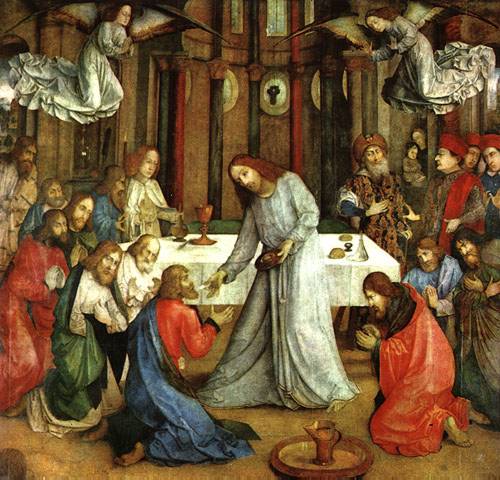
After a long hiatus, I’ll try to finish up the Holy Father’s reflections on the Lord’s Prayer in a timely manner. So far, we’ve looked at the introduction and first three petitions. This week, we’ll focus on the fourth, and perhaps most ‘human’ petition: “Give us this day our daily bread…”
After the first part of the prayer focuses solely on the goodness of God and the things of heaven (i.e. His will, power, name, etc.), Jesus suddenly throws in a petition for ‘bread.’ “We have the right and the duty to ask for what we need,” says Benedict. “We know that if even earthly fathers give their children good things when they ask for them, God will not refuse us the good things that he alone can give (cf. Lk 11:9-13).” (Jesus of Nazareth, p. 151) The bread Jesus speaks of certainly means real, actual bread, since He told his disciples that they ought not to worry about their daily sustenance but let the Father provide for them.
However, “bread” also makes us think of much more than ‘bread’ itself: the role of bread in Jesus’ ministry is undeniable; it appears everywhere “from the temptation in the desert and the multiplication of the loaves right up to the Last Supper.” (p. 155) Therefore, by asking the Father for bread we are really asking to share in the fullness of Christ’s mission. We are expressing our desire to see the earthly needs of all people met by the graciousness of God. Moreover, asking for this bread “presupposes the poverty of the disciples [ourselves]. It presupposes that there are people who have renounced the world, its riches, and its splendor for the sake of faith and who no longer ask for anything beyond what they need to live.” (p. 152) Christ calls us to ask for bread because he first calls us to be poor.
On a final little note, the Holy Father goes into an interesting discussion about the actual translation of the word, “daily.” In the original Greek text, the word epiousios is used; for most of us, that’s enough to confuse us, but the really confusing point is that this word is never found anywhere else in Scripture. Really, we don’t know what the translation should be because we simply don’t know what the word means. However, writes the pope, “the Fathers of the Church were practically unanimous in understanding the fourth petition of the Our Father as a eucharistic petition.” (p. 154) Whatever the original Greek word means, we do know that it signifies something super-normal – something that only God can provide us. This juxtaposition between “epiousios” and “bread” leads us to the underlying truth of this petition: namely, that God is the giver of both earthly and heavenly gifts, and that we must depend solely upon His goodness in all that we do.
Spiritual Direction: What Is It?
Posted by Andrew Haines in Church Doctrine, Prayer on 10.02.2007
In the past two years as a seminarian, I’ve talked with an amazingly high number of people who have asked (mostly indirectly) about spiritual direction. I have come to realize that people just have this insatiable desire to know what to do when it comes to their relationship with God. It’s pretty much that simple. And just as simple: people don’t know where to go to find such an aide. Enter… spiritual direction.
Although most people think of it – even just because of its name – as one of those ‘antiquated, obsolete’ practices that the modern Church has swept under the rug of Vatican II, nothing could be farther from the truth. In fact, a solid model for spiritual direction is something still being formulated even today. But, what is it? The terse answer would be, “Spiritual direction is when you go to a priest, tell him about your daily life, prayer, etc., so that he can help you to interpret where it is the Lord is leading you.” This is fine. Nothing wrong with that.
I, however, being a ‘guy,’ am of a slightly different school of thought when it comes to spiritual direction. I’d say that spiritual direction is the counsel we receive in order to prepare us for the spiritual combat we face day in and day out: the barrage of assaults from the Devil, the consolations we are given from Almighty God, and the work-a-day life that we all find ourselves, more often than not, trudging through. Spiritual direction provides the battle plan for the war between good and evil that we are caught up in, and in which we must be victorious if we are to inherit Eternal Life.
Needless to say, since we all struggle with living a holy life, we are all in need of spiritual direction in some form or another. As I mentioned, the usual and recommended form is that of going to a priest once every couple of weeks – in other words ‘regularly’ – and talking for at least an hour or so about experiences in prayer and day-to-day life. Ultimately, the directee knows himself or herself best, and the priest simply helps solidify the realities that they present to him by drawing on his depth of spiritual knowledge attained through years of personal prayer and theological formation. Spiritual direction is not confession, although sometimes a director will accept the role of regular confessor, also. But, it’s important to note, they are separate things.
The next post on this topic will talk more about what spiritual direction offers, in terms of struggles with prayer and growth in virtue, and why each of us should seriously consider spiritual direction in our own life.
"Adoration Belongs By Right to the Lamb..."
Posted by Andrew Haines in Prayer on 10.01.2007

One of the great gifts the Catholic Church offers us – or has been allowed to offer us by the decree of Her Divine Head, Jesus Christ – is the opportunity for ‘exposition’ and ‘adoration’ of the Blessed Sacrament. Surprisingly to some, however, many Catholics (perhaps the reader included?) have never heard of such things. I guess the simple way to go about this would be to explain what I mean when I say “exposition” and “adoration.”
To start, both are pretty basic concepts: exposition is when the priest makes the Blessed Sacrament visible in the monstrance (a transparent vessel used to hold the consecrated Host), and adoration is the act of worship performed by the faithful once Christ is visible to them. Exposition cannot occur without adoration – that is it’s whole point! But, adoration can occur, and should occur even when the Host is not exposed in the monstrance. That’s pretty much the whole deal on that… now for the meat and potatoes of this post.
So what are we supposed to do once the Lord is present to us in such a profound yet simple way as in Eucharistic exposition? What does it mean to ‘adore’ Him? The answer might be much simpler than you’d think. Perhaps the best thing we could ever hope to do is simply sit there, gazing at Him and allowing Him to gaze back at us. In fact, this is exactly the answer given to St. John Vianney, the great Curé d’Ars, when he questioned one of his parishioners as to how he spent his time with the Lord in the Blessed Sacrament.
But alas, we live in a fallen world, and simply gazing at Jesus under the species of ordinary bread hardly captivates our relentlessly functioning intellect. There are a lot of things that you can do to focus on the Lord, but one suggestion that I would make is this: spend at least 10 or 15 minutes in quiet adoration of Jesus, meditating as best you can on his love for you personally as he is there present to speak to you. Even though it can seem like a lifetime, just this short amount of quiet ‘mental prayer’ can be enough to propel us higher and higher in the spiritual life – but it has to start somewhere. Use this short time to approach Christ with your heart, not just your mind, and tell him the things that you would tell only to your most beloved friend. Show him the raw side of your heart, in need of love. We ravish the Lord’s heart with one glance from our eyes – by just being there and looking at Him! Allow Him to do the same to yours.


